
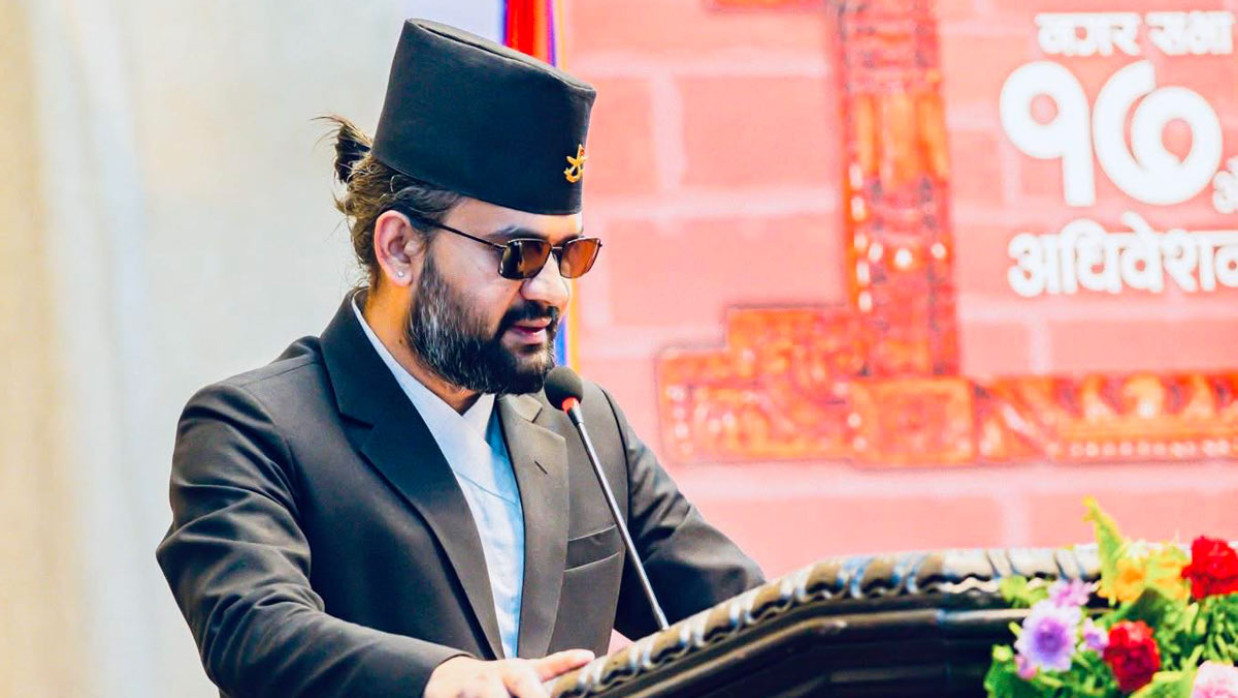
During a meeting with India’s Ambassador Naveen Shrivastava, Prime Minister Balendra (Balen) Shah expressed his interest to visit India, at an appropriate time after receiving an invitation from Indian Prime Minister Narendra Modi. The date of the visit to India is yet to be decided, however some Indian and Nepali media outlets have published news that Shah will visit India from 23 to 25 November (7-9 Mangsir). During the visit, various agreements are expected to be signed along with the inauguration and foundation laying of major infrastructure and hydropower projects. Old and complex issues such as border disputes, additional air entry points, the Pancheshwar project, trade imbalances, and post-flood reconstruction cooperation will also be high on the agenda of the talks.
Some experts opine that PM Shah intends to proceed by taking more time for better preparations in order to gain a deeper understanding before visiting friendly nations. Previously, Nepal had a dismal experience about the quick travel of leaders to neighboring countries, to be more responsive to them rather than settling pressing issues. After swearing-in on March 27, 2026, PM Balen has also signaled that his visit to friendly nations will not be merely a formality and focusing on concrete outcomes rather than symbolic gestures.
After the rise of Balen Shah, Nepal has a firm desire to redefine its diplomacy and external relations by expanding horizons of foreign policy. Along with neighboring countries, it strives to transform the nation by inviting all friendly nations equally, who wish to support the development of Nepal. This policy of Nepal expanding diplomatic horizons, more or less resembles the Third Neighbor Policy, which is a facet of foreign relations of Mongolia referring to its building relationships with countries other than the Russian Federation and the People's Republic of China, two superpowers neighbors. Countries that have been characterized as "third neighbors" of Mongolia include the United States, South Korea, France and other developed nations. Nepal, in different ways, also practices a doctrine of non-alignment, strategic hedging, and economic diversification, attempting to look beyond its immediate borders to global partners like the United States, European nations, and international institutions to reduce high economic dependency on giant neighbors.
Additionally, PM Shah aims at a policy departure from traditional diplomacy to development diplomacy. He is limiting individual over-access but a meaningful meeting with diplomats. After taking office on March 27, 2026, Shah initially maintained a protocol of avoiding one-on-one meetings with foreign diplomats and envoys. In the past, the influential ambassadors and head of the foreign mission in Kathmandu had superfluous, frequent and high privilege of one-on-one access with the head of the government. Now, the Shah government is trying to regulate the meeting based on priority and necessity. Only after following his first 100 days in office, he met with India's Ambassador Naveen Srivastava in the morning and China's Ambassador Zhang Maoming in the afternoon on 10 August 2026. It displays equal importance to both the neighbors, with more preference to India as he met the Indian ambassador before the Chinese ambassador.
India and Nepal share deep-rooted, centuries-old civilizational, cultural, and interdependent economic ties, which feature extensive people-to-people movement. Over the past seven decades, the Indian development cooperation in Nepal has not only expanded but also diversified to cover a wide range of sectors that include health, education, power, connectivity, trade, agriculture, cultural heritage preservation and capacity building. Similarly, Nepal’s partnership with India is not only limited up to being one of the major importers of Indian goods but also seventh-largest remittance-sending country to India, and millions of Indians from border districts work in Nepal. More importantly, Nepal’s water resources and Gorkha recruitment in the Indian army are equally important for India.
Nepal can play the role of a dynamic economic, cultural and knowledge bridge between China and India. Despite being a challenging task, it has satisfactorily maintained balanced relations with both the powerful neighbors. Nepali reactions to India vary from warm cultural and personal ties to deep political frustration. A severe economic blockade in 2015 by India, left lasting public resentment, which many Nepalis attribute to the exposition of big brother mindset. Although, the open border between two countries has become a convenience for the movement of the people and, contrary to it, there is also a challenge for security, illegal trade, human trafficking, and misuse of open borders as well.
In recent days, senior leaders from Nepal visited India. Rastriya Swatantra Party (RSP) Chair and Former Deputy Prime Minister Rabi Lamichhane undertook a high-profile, multi-day visit to India from June 1, 2026. Lamichhane held an extensive series of high-level state meetings, including a one-on-one discussion with Indian Prime Minister Narendra Modi. Similarly, Minister for Foreign Affairs, Shisir Khanal, Finance Minister Swarnim Wagle and Home Minister Susan Gurung also paid an official visit to India.
From India to Nepal, on 16 to 19 August 2026, Indian Army Chief General Dhiraj Seth visited Nepal and received the honorary rank of General of the Nepali Army from President Ramchandra Paudel. Prime Minister and Defence Minister Balendra Shah held a courtesy meeting with Indian Army Chief General Dhiraj Seth. Between India and Nepal, Military diplomacy plays an equally important role along with political, cultural and economic diplomacy in maintaining cordial relationships between two countries. Prior to it, the visit of Indian Foreign Secretary Vikram Misri in Nepal on May 11 was postponed due to protocol issues. Munu Mahawar, an Additional Secretary at India’s Ministry of External Affairs, visited Nepal.
In the changed context, PM Balen Shah’s visit to India has special importance for Nepal and how India comports with him, it would also determine the future course in Nepal India relationships. In recent days, India–Nepal relations have, somehow, fluctuated and both countries need to work together for enhancement of profound and trustworthy relationships. The very special relationship between two countries must turn towards a new decisive shift and there should be no space for old baggage. During the visit, along with potential agendas on trade deficit, transit facility, energy trade, open border regulation and projects implementation, it is also expected that inclusion of other pressing agendas, such as additional air routes, EPGs report and Kalapani border disputes etc, would be in favor of both the countries.


0 Comments
LEAVE A COMMENT
Your email address will not be published