

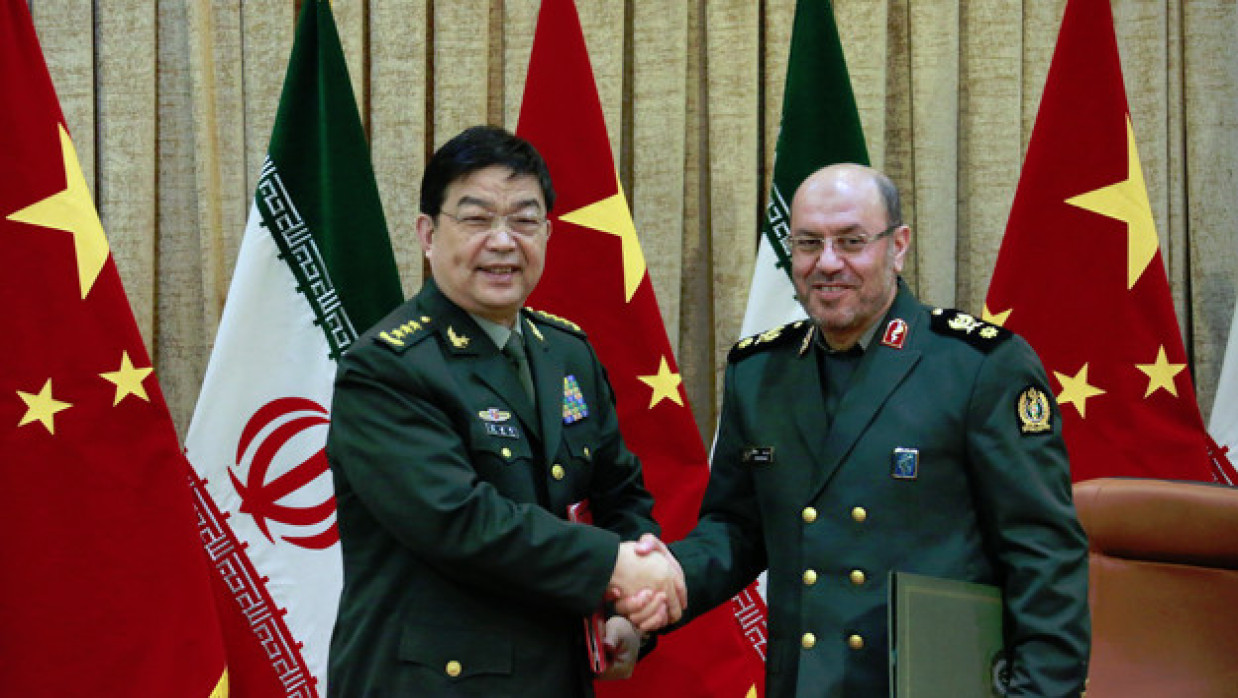
Deliveries of Chinese military equipment to Iran over the last thirty years have helped develop Iranian military capabilities in multiple areas, including surface-to-air missile systems, ballistic missile guidance systems, radar technology, and GNSS networks. Although China has claimed neutrality in Middle Eastern affairs, Chinese technology transfers to Iran have arguably helped Tehran better resist foreign coercion and improve its precision-strike capabilities. Chinese radar engineers were among those killed in the February 2026 attacks during Operation Epic Fury.
Historical Foundations of Sino-Iranian Military Cooperation
China–Iran defense relations began during the 1980s. Beijing became one of Tehran's closest arms suppliers following Western sanctions in the aftermath of the Iranian Revolution. China has provided Iran with artillery, tanks, and anti-ship missiles during the Iran-Iraq War. Arms transfers have largely evolved into technology transfers over the decades.
In the aftermath of the Cold War, China began assisting Iran with its domestic arms industry. Instead of supplying weaponry outright, China has transferred electronics, missile subsystems, and radar technology to Iran. Transferring military-related technology rather than weaponry has the benefit of limiting China's political risk of sanctions. China has also worked with Iran in the fields of civilian telecommunications, surveillance, and dual-use industrial systems since the early 21st century. Many of these systems have found their way into Iran's military sector.
Radar Systems and Anti-Stealth Detection Capabilities
Another major area in which China has aided Iran is radar systems. Chinese military experts were sent to Iran to assist with radar systems intended to track stealth jets like the F-35 and F-22 during the Joint Comprehensive Plan of Action (JCPOA) negotiations, per documents obtained by The Intercept. As Foundation for the Defense of Democracies (FDD) senior research analyst Richard Grabner pointed out, the radar systems sent to Iran from China Electronics Technology Group Corporation's (CETC) 14th Research Institute in Nanjing could play an integral role in strengthening the country's air-defense awareness system.
It also demonstrates that China wasn't simply selling Iran the hardware. Engineers were on the ground, maintaining these systems and training Iranians to use them. Moreover, it wasn't simply one Chinese radar system on Iranian soil: the deaths of the Chinese nationals during the initial wave of strikes indicate that the radar systems they were there to maintain were considered key to Iran's air defenses.
Chinese nationals from CETC's 38th and 22nd Research Institutes were also present in Iran during the attack.
Long-Range Air Defense and Missile Shielding
China is suspected to have delivered Iran the HQ-9B long-range SAM system as well after June 2025. Conceptually similar to Russia's S-300, the HQ-9B allows Iran to shoot down more planes, cruise missiles, and some ballistic targets.
These deals likely came from oil-for-missiles trades that circumvented sanctions detection. The missile sales exemplify the transactional basis of Chinese-Iranian relations: China gets oil, and Iran improves deterrence.
HQ-9B pairs with Chinese radars to more closely connect Iran's air-defense network detection-to-shoot-down capabilities.
Satellite Navigation and the Rise of BeiDou in Iranian Targeting
One gift from China that may be operationally significant is access to its BeiDou navigation satellite constellation. Until recently, Iran depended almost exclusively on American GPS satellites, which Beijing has threatened to disable during wartime. Now Iran appears to be developing new capabilities for Chinese-made, encrypted BeiDou-3 satellites.
Chinese state media was reported to be celebrating BeiDou’s contribution to Iran’s increased strike accuracy against regional adversaries, claiming a “significant upgrade” in precision-guided munitions. European intelligence analysts also concluded that Iran demonstrated “better targeting than previously observed.”
GPS is gradually becoming supplemented, if not replaced, by BeiDou capacity.
Dual-Use Electronics and Missile Development Support
This flow reportedly persisted even during combat operations, with Chinese vendors supplying missile and drone manufacturing firms with dual-use semiconductor chips classified as "civilian goods". These chips can be used in guidance systems, communication packages, and EW systems.
This type of transaction demonstrates one of the key features of China's military relationship building: allowing partners to develop internal capacity without losing plausible deniability. Instead of blatantly sending arms shipments, China uses other gray-zone methods of technology transfer with few repercussions.
By doing this, China can continue to exert leverage while skirting diplomatic clashes with Western leaders over sanctions.
Strategic Limits of the China-Iran Partnership
The China–Iran partnership is clearly not analogous to the China–Russia one, however close their technological collaboration might be. China sees Iran as an energy partner and balancer against other powers in the Middle East, but not as a strategic ally. The IRGC's relative autonomy vis-à-vis Iran's regular military has been another factor that has given pause to Chinese leaders who would like to see stronger alignment. By contrast, in Russia, where there is a single paramount leader to whom the entire security bureaucracy reports, Iranian state security is split among multiple power centers. So far, this has made deeper security coordination less predictable than China might like.
Instead, China has stuck to low-key military cooperation. This is also why China hasn't said anything about the rumored deaths of Chinese radar technicians during the war.
Conclusion: A Quiet but Decisive Technological Partnership
Iran has received anti-stealth radar systems, medium- and intermediate-range air defense systems, integrated satellite navigation systems in its missiles, and a supply of dual-use electronics from China. The country's military remains heavily reliant on equipment provided by Russia. China has also been accused of providing Iran with weapons technology through various indirect methods. China is also wary of upsetting the United States, pushing ahead with deals that make Iran a more credible regional power without going so far as to provoke American wrath by providing Iran with any significant game-changing military technology.
China is playing a fine line with Iran by continuing to sell its defense industry technology to bolster Iran while stopping short of provoking the United States. Iranian officials have said that Chinese defense industry experts are training members of Iran's military. In November 2021, three Chinese technicians reportedly died in Iran while testing a rocket drone.


0 Comments
LEAVE A COMMENT
Your email address will not be published