

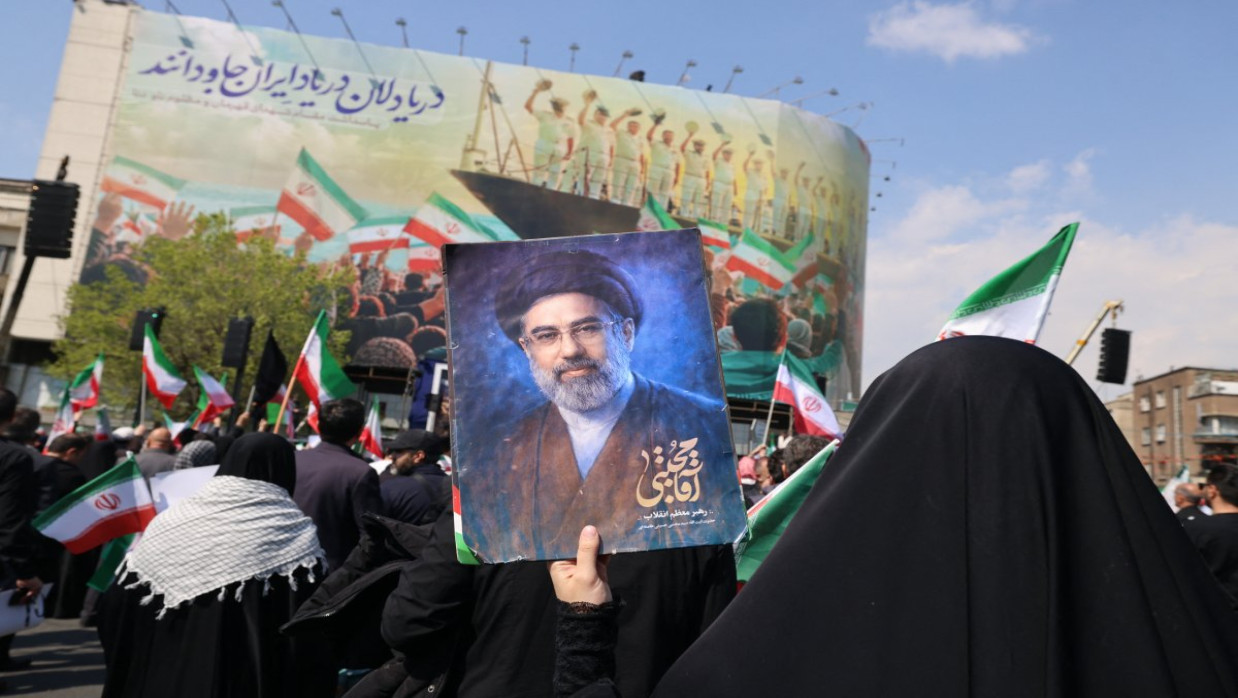
On June 23, 2025—marked as the 2nd of Tir, 1404, on the Persian calendar—a ceasefire between Iran and Israel was announced. This "night of the decree" shifted the trajectory of global affairs; although the world may appear unchanged on the surface, we have yet to fully grasp its impact.
Neither Israel nor the United States could defeat Iran: Operation "True Promise III" (Wa’deh Sadegh III) was executed in 20 waves over a 12-day war imposed on Iran.
At least 150 vital and strategic targets within the fictitious state of Israel were razed to the ground: the Mossad headquarters, the Ministry of War, the Nuclear Research Center, and the Aman Military Intelligence Center (the Mossad's assassination planning center), the Weizmann Institute, the Nevatim Air Base, the Ashdod power plant, the Haifa refinery, the Rafael military industries, the Stock Exchange building of the child-murdering regime, and dozens of other sensitive military and economic targets in Tel Aviv, Haifa, Bat Yam, Rishon LeZion, Be’er Sheva, and other cities of the Zionist regime.
As witnesses to this victory, it is our responsibility to tell the story accurately. This milestone is more than just a slogan; I don't want to call it a ‘12-day war,’ it is the fulfillment of Iran’s True Promise.
Iran waited a reasonable amount of time before ethically responding to Israel in April 2024 (True Promise I) and again waited in October 2024 (True Promise II). Iran was criticized for it—for not being reactive, for refusing to engage in massacres or acting as Israel, for having its own calendar, its own timing, and its own codes. But this time, Israel had crossed the line: Said Ohadi, head of the Foundation for Martyrs and Veterans Affairs, stated that between 13 and 24 June 2025, Israel killed 1,100 people and wounded over 5,600 in Iran.
Israel targeted the peace and lives of children in their homes—a direct assault on a nation that prioritizes dignity and the protection of children and the family. What then, is the use of the Armed Forces, if not to defend their people and territory?
The Iranian response deposed the war manuals—from Sun Tzu to Gene Sharp—that we've been accustomed to since childhood. It proved that even in this regard, Western strategies are outdated, decadent and obsolete. They only know how to kill and then hide it, deceive, bluff.
I have heard so many times that there are no rules in war, but that is also a lie, because Iran won ethically. They played the others’games and won using their rules within the framework of international law, —Article 51 of the United Nations Charter establishes that any member state may exercise its right to self-defense, alone or alongside allies.
Iran responds according to these terms, but aligned with the founding principles of the Islamic Republic: it does not seek war, yet it demonstrates both the resolve and capacity to respond to aggression whenever necessary.
Today, Wikipedia may do as it will. It can rewrite history or even lie about who started the war. However, the thousands of men, women, and children I lived alongside during those ‘nights of war’, remain. Their calm, their hospitality, and their cries of ‘Allahu Akbar’ (God is Great) stand against those in the West and the Zionists who may again err or underestimate them.
Shortly after being evacuated from the university and from Tehran on the tenth day of the war, people in Caracas asked me two things: Why did a young woman like me choose to live in such a different place, where the hijab is worn, and they asked if I had come to understand the Islamic Republic’s system of government.
To the first question, I explained that the cultural difference was the very reason I went. I was told many times that Iran ‘wasn't for me.’
Regarding the second question, I responded that I had researched Iran’s governance thoroughly, long before applying for my scholarship. Consider this: why would a 35-year-old mother of a 14-year-old daughter apply for higher education in a country with fewer rights or less progress than her own? I wouldn't. I was seeking enlightenment from my country's strategic ally, and the reality I found far surpassed my research and expectations. Iran defies Western paradigm and propaganda. I dare say that it is precisely because they know what Iran is truly like that they attack the country so harshly and bombard us in the West with information that is completely at odds with what Iranian society is actually like.
I can speak now with hindsight, but before I could verify things empirically, I had to do my research.
Following the 2020 assassination of General Qasem Soleimani, I began researching the truth behind Iran’s governmental system and society.
It was a difficult task. Most information reaching us is distorted, and Iran’s own official channels often project a level of conservatism and impenetrability that doesn’t exactly invite foreign scrutiny. Nevertheless, my interest and curiosity prevailed and I was able to make some progress.
In 2023, while producing and hosting my analysis and investigative program Entre Líneason La IguanaTV, I dedicated an episode to Iran’s cultural influence as a key player in the multipolar world.
From there, I commented on Iran’s style of government, a theocratic state that practices Twelver Ja'fari Shia Islam. While the executive branch, composed of a president and various ministers, manages the country and the legislative branch passes laws, the Supreme Leader sits at the top of this republican reality. Elected by a Council of Experts under the principle of wilayat al-faqih, the Supreme Leader and upper echelons of the shia clergy are the beholders of political power.
The Supreme Leader establishes broad policy guidelines based on religious values, holds significant authority to oversee key appointments, and serves as the Commander-in-Chief of the Armed Forces. He alone has the authority to declare war.
While more complex than the U.S. two-party system or the Spanish monarchy, this system is, at the same time, more transparent and coherent.
If we speak of paradigms, in the U.S. a corporate-driven ‘deep state' has survived, steering a two-party system that changes colors every four years but neither corrects itself nor acts in the interest of the people—and yet this is marketed as the only model of freedom.
In Spain, they are ruled by a monarchy and a representative government, which simply administers mechanisms ensuring the primacy of the economy and that the population consumes and pays taxes through exploitative dynamics that increasingly erode the family unit. And this is exported as a model of society.
In the case of models demonized by the Western media, specially Iran, which is our focus in this story about stories, why reject or try to abolish the existence of a theocratic republic if it works in terms of what is expected from a government (protection, care for needs and a vision for the future based on comprehensive human development)? Because it defies the established Western paradigm which is decadent and unwilling to change or evolve.
An eternal dispute over the cultural model
The fundamental characteristic of the Iranian Revolution is its ideological and Islamic nature, but also its cultural heritage. In February 1979, following the collapse of a monarchy that served foreign domination, Iran began to be governed under the leadership of Imam Khomeini.
The nation abandoned anti-nationalist despotism. Following a referendum, it established an Islamic political and social system centered on the nationalization and self-management of its resources and capabilities - which are considerable. At that time, 98.2 percent of voters favored that system.
During the demonstrations and massive anti-Shah protests, Iranians from all sectors and ideologies in the society did not hesitate to challenge both Pahlavi and the U.S. government. A common sentiment in the streets was: "We don’t want Jimmy Carter’s version of human rights; we want rights defined by us."
Although Jimmy Carter was viewed as a human rights champion in the West, he neither convinced nor deceived the Iranians who saw him blindly supporting an arrogant Shah who squandered public resources.
The anti-American sentiment among all age groups in Iran was rooted on the fact that the oppressive monarchical regime and its injustices survived only through U.S. support, —support that validated its human rights violations and began when the CIA orchestrated a coup against President Mohammad Mosaddegh to install the Shah in the first place.
In 1979, once the Revolution had arrived and a new Constitution was established, the Iranian people opted for a clear, concise law—not overly extensive and absolutely aligned with verses from the Quran.
Forty-six years later, walking through Iran only allowed me to see how a Constitution—a compendium of principles that speak of an 'exemplary government' and an 'ideal society,' according to its own standards—even with its flaws and amidst internal and imposed difficulties, is not far from reality.
The third principle of the Iranian Constitution states that the Government is responsible for using all means at its disposal to foster the appropriate environment for the development of moral values based on faith and virtue, combating all expressions of perversion and corruption; raising the general level of knowledge in all fields, providing free education and physical training for all. It also emphasizes the expansion of higher education.
According to this principle, it also undertakes to strengthen the spirit of truth-seeking, research, and creativity in all scientific, technical, cultural, and Islamic fields through the establishment of centers dedicated to the pursuit of truth and the provision of incentives to researchers; to exercise a total rejection of colonialism and prevent foreign interference; to abolish all forms of despotism, dictatorship, and monopolism; to ensure political and social freedoms within the limits set by law; to promote the people’s participation in determining their political, economic, social, and cultural future; to eliminate unjust discrimination and create equal opportunities for all in material and spiritual aspects; to strengthen the national defense structure to the utmost through general military training in order to safeguard the independence and territorial unity of the homeland and the Islamic system; to guarantee the right to health and shelter; to establish a sound and equitable economy and to eliminate all forms of deprivation in the areas of food, housing, work, and health, and to universalize social security; to ensure self-sufficiency in science, technology, industry, agriculture, and military affairs, as well as in other fields; to guarantee all individual rights, for both women and men, and to establish fair legal safeguards for all, and equality of rights before the law; and finally, to organize the state’s foreign policy based on Islamic values, on fraternal commitment to all Muslims, and on full support for the world’s dispossessed.
I take a breath, jot down my notes, and leave the theory for the end, for I witnessed these principles in action every day for four months, naturally, organically. Months filled with multiple forms of peace, war and a love that is nothing more than that type of respect longed for by a woman in any society.
Más allá de cualquier especulación, las certezas llegan por tres vías: la más confiable e infalible es la espiritual; la más accesible en estos tiempos, la información y el conocimiento; y la más desaprovechada: experimentar. Si alguien quiere comprobar lo que vivo, viaje hasta allá en tiempos de paz o en guerra, da igual, la sociedad iraní se comportará de la misma manera, eso sí, hágalo con poco equipaje en las maletas y en la mente porque vendrá cargado y luego no sabrá qué hacer con tantos regalos.
Y si no quiere o puede viajar, pero quiere conocer y entender cómo realmente funciona, toma decisiones y opera Irán, entonces, indague cómo piensa el otro que lucha contra el mayor enemigo de la humanidad. Investigue. Lea algunas traducciones de Hafez, a Rumi o a Sa’di entre los grandes poetas persas que son considerados próceres en Irán, y busque el Corán.
Let this serve as a way to tell a brief story that has been everlasting. Every day something surprising happens in Iran for those of us who refuse to let go of our capacity for wonder.
As a student and foreign resident, I got to know five cities: Tehran, Qom, Mashhad, Shiraz, and Bushehr near Bandar Abbas, and each one showed a different side of Iran.
I lived alongside people of different nationalities, social strata, and even beliefs and ideologies in total harmony. No title or job position separated me from the ordinary Iranian, and I put myself in the shoes of the woman who doesn’t know how to wear a hijab, who doesn’t want to wear it, the one who wears a beret in bohemian Shiraz, and also the one who wears a chador in the holy city of Mashhad; I didn’t just look where I wanted to look, but I did observe carefully, opening my mind and heart, and everything I couldn’t believe or didn’t understand I consulted in a small green book I bought at the Caracas Book Fair a year earlier, when I realized that to understand the conflicts in West Asia and all the lies we’re told about that region, I had to open my eyes to Islam and its various currents.
Beyond any speculation, certainties come through three channels: the most reliable and infallible is the spiritual; the most accessible in these times, information and knowledge; and the most underutilized: experience. If anyone wants to verify what I’m experiencing, travel there in times of peace or war—it doesn’t matter; Iranian society will behave the same way. Just make sure to travel light, both in your luggage and in your mind, because you’ll return loaded and won’t know what to do with so many gifts.
And if you don’t want to or can’t travel, but want to know and understand how Iran really functions, makes decisions, and operates, then find out how the other side thinks as it fights against humanity’s greatest enemy. Do your research. Read some translations of Hafez, Rumi, or Sa’di—among the great Persian poets who are considered national heroes in Iran—and look into the Quran.


0 Comments
LEAVE A COMMENT
Your email address will not be published