

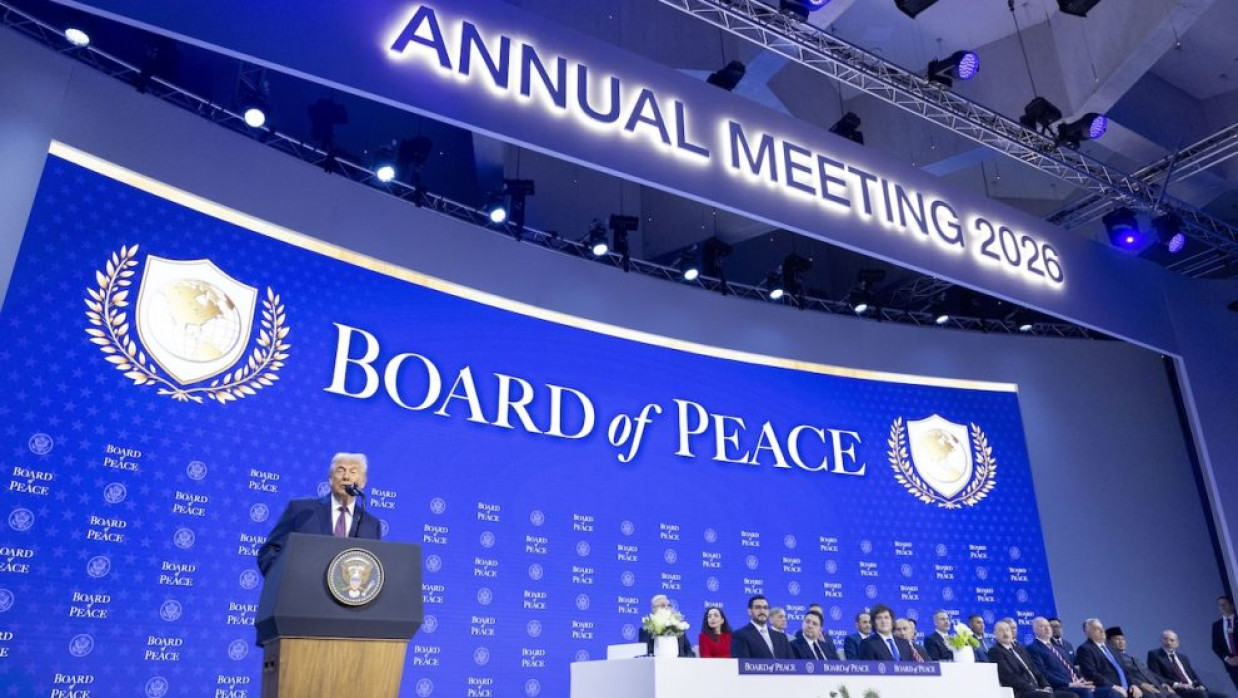
It’s crunch time when Donald Trump’s Board of Peace meets in Washington this week to finalise the implementation of the second phase of the president’s Gaza ceasefire plan.
Mr. Trump needs the 20-member Board to demonstrate significant progress on multiple thorny issues that will define the success of his plan and whether war-ravaged Gaza will stabilise or be the target of a renewed full-scale Israeli assault.
The interconnected issues include the disarmament of Hamas, the demilitarisation of Gaza, Israeli withdrawal from the Strip, the introduction of an international stabilisation force and a Palestinian police force, the reconstruction of Gaza, and the linkage between breaking stalemates in Gaza and resolving the Israeli-Palestinian conflict with the creation of an independent Palestinian state.
Arab and Muslim-majority members of the Board, including Saudi Arabia, the United Arab Emirates, Qatar, Egypt, Turkey, Indonesia, and Pakistan, are reluctant to commit troops to an international stabilisation force and funds for the reconstruction of Gaza without Hamas agreeing to disarm and a timetable for the complete Israeli withdrawal from the Strip.
 |
Speaking at the Munich Security Conference this weekend, Saudi Foreign Minister Faisal bin Farhan said, “We need to see a real end to the conflict. That means we need to have clarity on when Israel is going to withdraw, when Hamas is going to disarm, when everyone is going to comply with all 20 points of the 20-point plan.”
Indonesia has gone furthest by preparing up to 8,000 troops for service in Gaza. Even so, Army Chief of Staff Maruli Simanjuntak cautioned, “We are just preparing ourselves in case an agreement is reached.”
In a statement, the Indonesian Foreign Ministry insisted that the potential role of the country’s troops would “focus on protecting civilians, humanitarian and health assistance, reconstruction as well as training and strengthening the capacity of the Palestinian Police,” not disarming Hamas.
The ministry said the West Bank-based, internationally recognised Palestine Authority would have to approve Indonesian participation in the stabilisation force.
Established in January by Mr. Trump and countries eager to cater to the president’s narcissism, the Board projects itself as a potential rival to United Nations peacekeeping efforts with Gaza as its first project.
So far, Mr. Trump’s plan has produced mixed results in its first phase, which saw the release of the remaining living and deceased Hamas-held captives abducted by the group during its October 7, 2023, attack on Israel.
However, the plan has failed to silence Israeli guns as Israel launches daily air and drone strikes that violate the ceasefire.
 |
While the truce has significantly reduced the number of daily Palestinian casualties, some 600 have been killed since the ceasefire took effect on October 10 of last year.
Similarly, Israel has selectively allowed an increased flow of humanitarian aid into Gaza that averted the risk of a famine but has done little to alleviate the health crisis.
Moreover, Israel severely throttles the number of Palestinians allowed to either leave the Strip for medical treatment or return to Gaza through the recently reopened Rafah Crossing between the territory and Egypt.
Kickstarting the plan’s second phase requires Mr. Trump to twist not only Hamas’s arm but also Israeli Prime Minister Binyamin Netanyahu’s. So far, Mr. Trump has harped on Hamas, threatening it with dire consequences if it fails to disarm, while turning a blind eye to Israel’s ceasefire violations.
The Board of Peace High Representative for Gaza, Nikolay Mladenov, implicitly suggested that Mr. Trump no longer can afford to do so because it undermines the credibility and legitimacy of the Palestinian committee that is tasked with running Gaza’s day-to-day affairs under the Board’s supervision.
 |
“If you put the committee tomorrow in Gaza and the violations of the ceasefire continue the way they are now, we’re only embarrassing the committee and ultimately making it ineffective,” Mr. Mladenov said in Munich.
While insisting on its right to resist Israeli occupation, Hamas has suggested it could decommission what’s left of its heavy weaponry but keep its sidearms. US officials have floated the idea of a weapons buyback that would compensate individual fighters for surrendering their arms and grant them immunity.
Israel has rejected anything but the total disarmament of Hamas and asserted that only it can do so, a goal Israel has failed to achieve in almost 2.5 years of war.
Israeli Cabinet Secretary Yossi Fuchs said this week that Israel intended to give Hamas 60 days to disarm and would renew its assault if it does not.
Israel may have timed the announcement in recent days of widely denounced measures that enhance Israel’s control of the West Bank, curtail the power of the Palestine Authority in those parts it nominally controls, and expand Israel’s ability to seize Palestinian lands to coincide with the Board of Peace’s meeting in Washington.
 |
Many in the international community beyond Arab and Muslim states see the measures as violations of international law and a prelude to Israeli annexation of the West Bank.
Like Israel’s ceasefire violations, the measures are likely to reinforce Hamas’s refusal to unconditionally lay down its arms and Arab and Muslim resolve to condition their commitment of troops to an agreed formula for the disarmament of Hamas, a timetable for the Israeli withdrawal, and steps to pre-empt an Israeli annexation of the West Bank.
In doing so, Mr. Netanyahu hopes Mr. Trump will give him a free hand in Gaza.
For Mr. Trump, it’s a high-stakes game. A renewed Israeli assault on Gaza would generate public pressure on Arab and Muslim-majority states to withdraw from the Board of Peace, which already many view as a vehicle that serves US and Israeli rather than Palestinian interests.
So far, Mr. Trump has gotten away with having Israel’s back when it comes to the Palestinians. However, with deeds rather than words likely to determine the fate of his Gaza ceasefire plan, Mr. Trump may have to accept that it’s crunch time on an issue that will co-define how he is remembered.


0 Comments
LEAVE A COMMENT
Your email address will not be published