

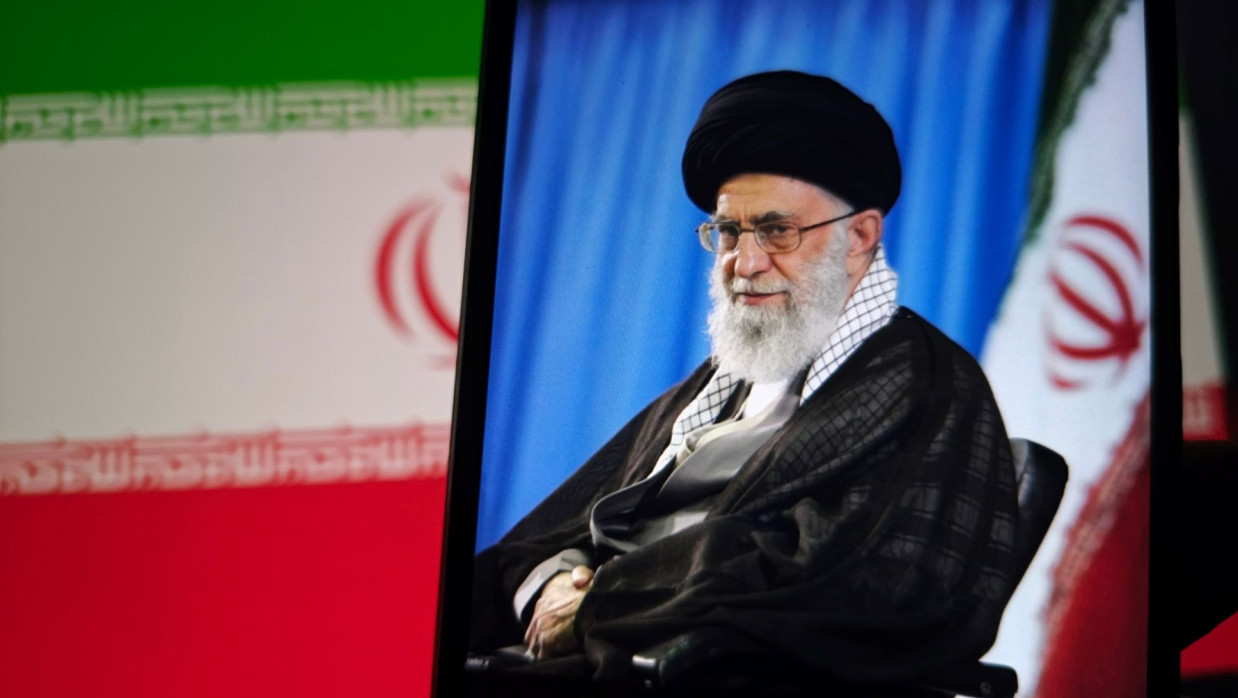

Iran’s Supreme Leader Ayatollah Ali Khamenei is caught between a rock and a hard place.
Asserting that foreign powers instigated the protests will not reduce widespread popular concern about the country’s dire economic circumstances, with rampant 40 per cent inflation and the collapse of its currency.
The regime’s brutal crackdown has allowed it to regain control, with protests, for now, petering out.
State media quoted the Intelligence Ministry as saying that authorities had arrested 3,000 “armed rioters” linked to “terrorist groups.”
Iran analyst Ali Vaez quipped that it was “stunning that the sclerotic IRI (Islamic Republic of Iran) doesn’t understand that blaming high casualties/fatalities on foreign infiltrators means that the regime can secure neither Iran’s airspace nor its streets.”

For now, the question is for how long the government can retain control with potential future flashpoints around February 11, the 47th anniversary of the Iranian revolution, February 17, the 40th day of mourning for those killed in the protests, and March 20, the Iranian New Year.
By February, two US aircraft carrier groups would have arrived in Middle Eastern waters, enabling President Donald Trump to wage a sustained air campaign against Iran if he decides to do so.
Mr. Trump has threatened to intervene in Iran if the government continues to kill protesters or execute alleged rioters.
Another round of protests, and potentially of violence, whether in the immediate future or further down the road, is all but certain if Iranian leaders fail to address the country’s structural economic problems, resulting from mismanagement, runaway corruption, and sanctions.
The irony is that Mr. Khamenei needs the very foreign powers he blames for the unrest, particularly the United States, to help him break the vicious cycle.
Without sanctions relief, Mr. Khamenei, or whoever succeeds him, will not be able to tackle Iran’s economic problems.
The Supreme Leader also needs the United States to keep Israel on a leash.
Making the necessary changes that would persuade Mr. Trump to offer Mr. Khamenei a way out of the crisis may be a tall order, even if American and Israeli leaders, and the violence that killed more than 100 Islamic Revolutionary Guard Corps (IRGC) personnel, bolstered Iranian assertions of foreign instigation of the protests.
To achieve agreement with the US, Mr. Trump’s special envoy, Steve Witkoff, said this week that Iran would have to address the nuclear and ballistic missile issues as well as its existing stockpile of enriched uranium, and stop supporting groups like the Yemeni Houthis and Lebanese Shiite militia and political movement Hezbollah.

Iranian state media broadcast video of alleged foreign operatives joining the protests
Iran’s assertions of foreign intervention echoed testimonies from protesters quoted by the Financial Times that reported that agitators had mingled with the demonstrators.
“There were groups of men in black clothes, agile and quick. They would set dustbins on fire and then quickly move to the target,” one protester said.
Another demonstrator reported seeing a dozen black-clad men “looking like commandos,” calling on residents to join the protests.
In a similar vein, Israeli foreign intelligence service Mossad’s Farsi-language spokesperson urged Iranians in a December 29 social media posting to take to the streets, assuring them that, “We are with you, remotely and verbally. We are also with you on the ground.”
Israeli Heritage Minister Amichai Eliyahu last week reinforced Mossad’s message by telling Israeli media, “When we attacked in Iran during ‘Rising Lion,’ we were on its soil and knew how to lay the groundwork for a strike. I can assure you that we have some of our people operating there right now.”
Mr. Eliyahu was referring by its code name to Israel’s June 2025 attack on Iran.
 |
At the time, Israeli media reported that Mossad had deployed some 100 agents in Iran in advance of its 12-day war with the Islamic Republic.
This week, pro-Netanyahu Channel 14’s diplomatic correspondent, Tamir Morag, reported that “foreign actors are arming the protesters in Iran with live firearms, which is the reason for the hundreds of regime personnel killed. Everyone is free to guess who is behind it.”
Israel has long favoured the return to Iran of Reza Pahlavi, the son of the ousted Shah, who left Iran in 1979.
Israel first waged a large-scale digital influence campaign in Persian promoting Mr. Pahlavi and Iran’s return to monarchy in 2023. Mr. Pahlavi visited Israel at the time.
The campaign used hundreds of fake social media accounts and online personas posing as Iranian citizens to project Mr. Pahlavi as a popular candidate to lead a post-Islamic Republic Iran.
More recently, many of the accounts were activated to encourage Iranians to join the protests.
 |
With little effect, the Iranian government has sought to capitalise on fears that Iran could descend into civil war similar to Syria by warning against separatism and highlighting in state-aligned media, protests in Kurdish-majority regions in the west and among the Baloch in the southeast that Israel and the United States allegedly support.
Adding his voice to the Israeli choir, former CIA director and Secretary of State Mike Pompeo tweeted, “The Iranian regime is in trouble….Riots in dozens of cities… Mashad, Tehran, Zahedan. Next stop: Baluchistan… Happy New Year to every Iranian in the streets. Also, to every Mossad agent walking beside them.”
Mr. Pompeo’s reference to the restive Baluch-populated province of Sistan and Baluchistan may be particularly relevant.
Mr. Pompeo, prominent Republicans, like Senator Lindsey Graham, former Trump National Security Advisor John Bolton, and Israeli leaders have long advocated regime change in Iran, in part by supporting militant ethnic minority groups.
 |
“Iran is a powder keg… Iran has as many, if not more, ethnic, religious, class, and regional cleavages as its Middle East neighbours. It is also loaded with small arms and young men trained during their mandatory military service to use them. It could easily explode or collapse,” said journalist Borzou Daragahi.
“There’s a distinct possibility of civil war after regime change as well as interference by outside interests... Secession isn’t out of the question… For the sake of regional and world peace, the best option may be to help secession happen and thereby take a downsized Iran, freed from a murderous regime, off the geopolitical chessboard entirely,” added Wall Street Journal columnist Melik Kaylan.
Bordering on Kurdish-majority areas, Ilam Province has emerged as a protest flashpoint with deadly clashes between demonstrators, including members of Komala, one of several armed Kurdish groups, and security forces in the towns of Malekshahi and Abdanan.
Last month, Jaish al-Adl (the Army of Justice), a Pakistan-based group that traces its roots to Saudi-backed anti-Shiite groups in Iran with a history of attacking Iranian security forces, and other Baloch groups, created the Mobarizoun Popular Front to wage an “up-to-date” insurgency against the Iranian regime.
The group said it had killed an Iranian security official in Sistan and Baluchistan on January 7. Earlier, it claimed to have killed four security officials on December 10.
 |
Jaish al-Adl has insisted in the past that it was not seeking Baloch secession from Iran. Instead, it wanted to “force the regime of the guardianship of jurisconsult (Iran) to respect the demands of the Muslim Baloch and Sunni Muslim society alongside the other compatriots of our country.”
Ansar al-Furqan, a Baloch group that did not join Mobarizoun, last month said it had killed 16 Iranian security officials in Kerman Province. Iranian media put the number at three.
This month, three masked Lorians, one of whom brandished a weapon, threatened to resist a regime crackdown.
“If you continue to suppress the people with guns and shotguns, the people of Luristan will no longer take to the streets empty-handed,” the men said in a video statement.
A minority close to the Kurds, Lors account for six per cent of the Iranian population.
 |
Media reports and analysts with close relations to various Middle Eastern non-state actors said Iran, acting on information provided by Turkish intelligence, had recently intercepted fighters of the Iraq-based Kurdistan Free Life Party (PJAK) attempting to infiltrate Iran.
A proponent of Kurdish autonomy in Iran, the PJAK, an affiliate of Turkey’s outlawed Kurdistan Workers Party or PKK has primarily launched hit-and-run attacks in the past against Iranian security forces with alleged covert support of US and Israeli intelligence.
Iraqi Kurdish leaders fear that Iranian Kurdish cross-border attacks could drag their autonomous region into a widening regional conflict.
Visiting this week a special forces base in Urmia in West Azerbaijan, an Iranian city populated by Kurds, Azeris, and other minorities, near the borders with Iraq, Turkey, and the autonomous Azerbaijani region of Nakhichevan, IRGC Ground Forces commander General Mohammad Karami warned Iran was ”ready to respond to any attack.”
Dr. James M. Dorsey is an Adjunct Senior Fellow at Nanyang Technological University’s S. Rajaratnam School of International Studies, Associate Editor of WhoWhatWhy, and the author of the syndicated column and podcast, The Turbulent World with James M. Dorsey.

0 Comments
LEAVE A COMMENT
Your email address will not be published