

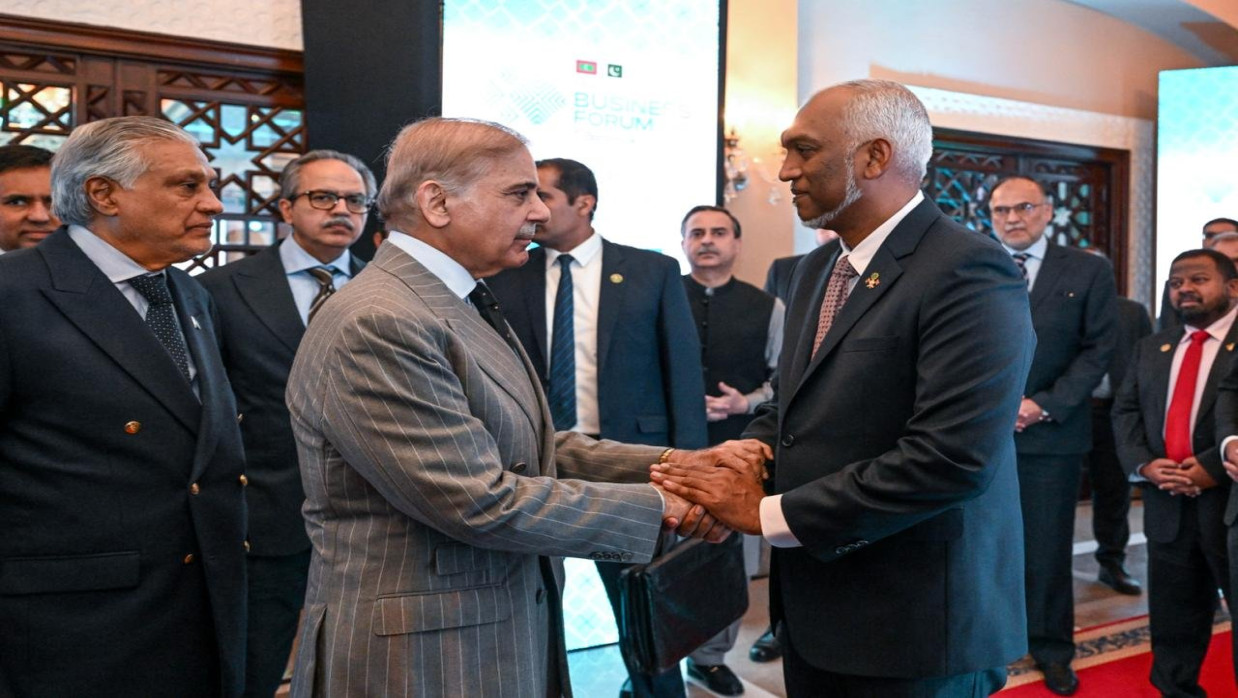
As the Maldives expands its diplomatic and defense relations with Pakistan, New Delhi faces a difficult question: how far should India’s security concerns influence the foreign policy choices of its smaller South Asian neighbors?
This adds to the mix of South Asia's current political climate. Maldives President Mohamed Muizzu has traveled to Pakistan. He was in the country from 20 to 22 October 2026. This is his first visit in 11 years as President of the Maldives. Trying to strengthen the relationship between the two countries. This again puts India in a difficult position. Pakistan and the Maldives have signed 20 MoU's with each other, some concerning defense, sea, and cyber security. This brings us to the question at hand in South Asia. Can non-powerhouses make their own decisions without relying on larger countries?
Pakistan and the Maldives marked 60 years of relations. PM Shehbaz Sharif and President Muizzu want to increase trade between the two countries. Currently, it is $13.9 million a year; they hope to raise it to $200 million in 2 years. While this may be high, the two countries are looking to further their relationship. With deals in Agriculture, Medical, Education and Security.
For India, however, the economic agreements are not the principal concern. New Delhi is particularly sensitive to Pakistan's potential military presence in the Indian Ocean, where the Maldives sits at a strategically important point along major international shipping routes. Indian defense planners are unlikely to welcome the possibility of Pakistani naval vessels making more frequent visits to Maldivian ports or participating in joint maritime exercises.
India can be understood to have these concerns as well. The Maldives is near India's Lakshadweep islands and is so far from India that it must cross that water for trade and national security. If Pakistan continues to grow its relationship with the Maldives military, it can become difficult for India. Especially if you add China to the mix.
But they shouldn't have to ask India permission to work with other countries. India has valid concerns about Pakistan expanding its military influence in the region. We should also understand that the Maldives has the right to build relationships with whomever it wants. If we can make this distinction, it will help us build more trust with our neighbors.
This whole topic also ties into why Muizzu became president in 2023. When running for office, he focused on getting the Indian military out of the Maldives. He then reached a deal with India to have civilians fly the aircraft India provided. These are mainly used for search and rescue and medevacs.
Over time, Muizzu understood why it benefited him to stay on good terms with India. The Maldives needs India in many aspects, whether it's aid, tourism, trading, or help in times of need. By traveling to India in October 2024, he showed he can repair the relationship with India.
Muizzu has also been trying to establish relationships with other countries. China, Turkey, Saudi Arabia, Malaysia, and Pakistan are all becoming key players in his efforts to broaden the Maldives' foreign relationships. He has also increased military spending, which could show he wants to grow the Maldives' power.
Members from the Opposition party, the Maldivian Democratic Party, have voiced their concern over these deals with Pakistan. They believe that if they get too close to Pakistan, it will affect their relationship with India. Ex-President Mohamed Nasheed and ex-defense minister Mariya Ahmed Didi both believe that the Maldives should not get involved in India's problems with Pakistan. Although these points may be true, we don't know what these deals entail.
Political reasons may also be at play. As mentioned above, Muizzu spoke badly about India, so his opposition can use that against him. This could be one reason why his party believes that the deals with Pakistan will harm their relationship with India.
Perhaps the most consequential aspect of Muizzu's visit to Pakistan was his renewed appeal to revive the South Asian Association for Regional Cooperation (SAARC). Established in Dhaka in December 1985, SAARC was intended to promote regional cooperation among South Asian countries. Unfortunately, persistent hostility between India and Pakistan has prevented the organization from fulfilling much of its original promise.
SAARC held its most recent summit in Kathmandu in 2014. After that, a summit was supposed to be held in Islamabad in 2016, but it never materialized due to rising tensions. Since then, SAARC has seen no action at the Summit level. This means South Asia is missing out on trade, infrastructure development, and poverty alleviation, among other things.
Muizzu should be taken seriously when he says we need to look back at SAARC. The smaller nations of Bangladesh, Nepal, Bhutan, Sri Lanka, and the Maldives would all benefit economically if the region could cooperate again. Their growth should not depend on the India-Pakistan dispute.
Bangladesh should play a major role in ensuring SAARC becomes functional again. By connecting South Asian countries, they can work together to help build their countries. Whether that means sharing energy or helping one another trade. Not only would this benefit the smaller countries, it would also benefit India as well.
We shouldn't see Muizzu's time in Pakistan as just him going against India. He is a country that wants to expand its foreign relations while staying neutral. India will always have its concerns about its neighboring countries. But we should also allow these countries to grow.
India needs to learn how to be a strong leader in South Asia. By allowing other countries to flourish. We don't need Pakistan to be isolated and the smaller countries to bow down to India's every move. These countries can have relationships with India and other surrounding countries.
So maybe we can take Muizzu's trip to Pakistan as a positive step. If both India and Pakistan could come to terms with one another, the Maldives could open up South Asia to more countries and trade.


0 Comments
LEAVE A COMMENT
Your email address will not be published