

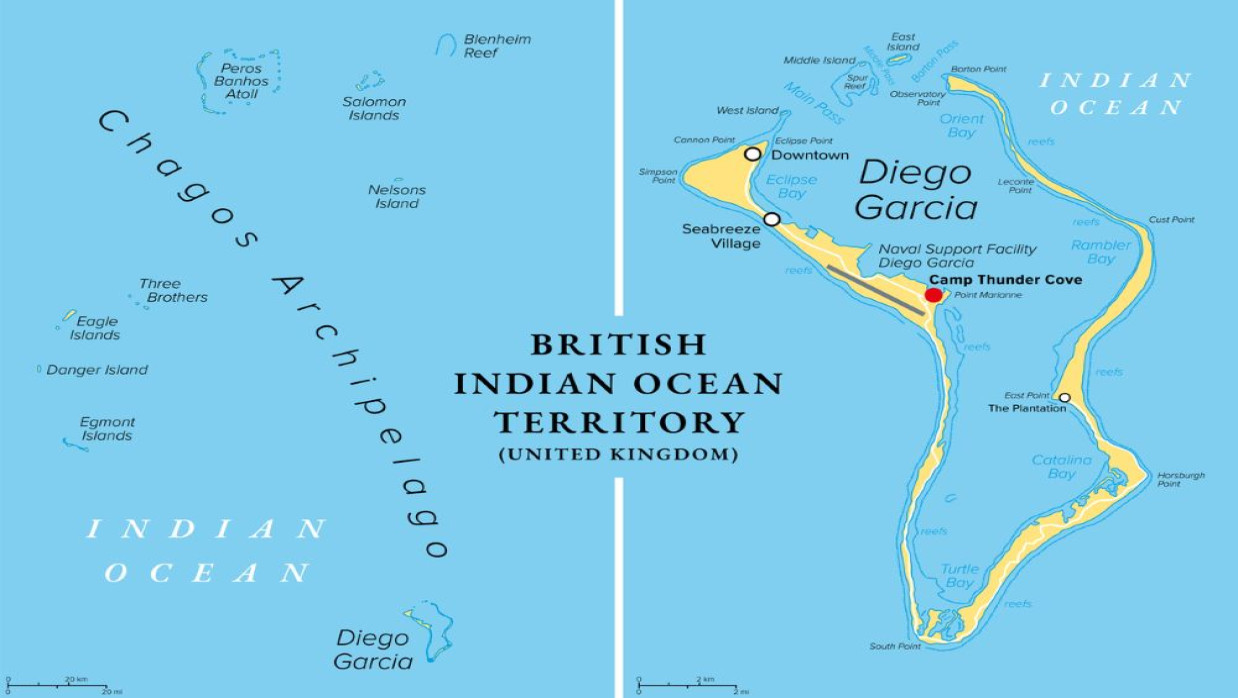
With the US, UK, India, and China all looking towards the Indian Ocean, the sovereignty issue over Chagos comes into play. Can we continue to see the Indian Ocean as just another ocean, or will it remain a place for superpowers to flex their military might and dominate smaller states? As countries grow more interested in the Indian Ocean, it has become one of the hottest areas for superpower competition. It has shifted from a body of water connecting many countries to a hotbed of military competition. The US, UK, India, and China have all been vying for military access, the ability to spy, and the chance to build bases. With Chagos coming into play, we see how smaller countries can get caught up in the superpowers' game.
There has been controversy around who owns Chagos. Some argue it should be handed over to Mauritius, which has a legitimate case since the UK took it before Mauritius gained independence. The UK has stated that it will hand over the Islands but would like to keep the base on Diego Garcia. The Maldives also claim the islands due to history, and India and China are trying to take advantage of the situation and expand their territory in the Indian Ocean.
Will the Indian Ocean remain a sea of many countries, or will it continue to be used as a playing field for superpowers?
How Did This Happen?
In 1965, Britain broke the Chagos Islands off from Mauritius. This happened three years before Mauritius gained independence from Britain. They then created the British Indian Ocean Territory and offered Diego Garcia to the Americans.
The people who lived on Diego Garcia are called Chagossians. They were stripped of their homes in the late 1960s and early 1970s and forced to move to Mauritius and Seychelles. Where many of these families struggled with poverty and discrimination.
Diego Garcia became one of America's key military bases. It had a long runway for military planes to land and take off, and deep-water ports for ships to dock. It was a strategic point for the Americans to attack targets in the Middle East, Africa, and Asia.
Mauritius has fought for many years to gain the Chagos Islands back from Britain. The International Court of Justice ruled in 2019 that Mauritius was not properly decolonized and that Britain must relinquish control of the Chagos as soon as possible. The UNGA backed this decision.
These developments strengthened Mauritius's claim and placed Britain under growing diplomatic pressure.
On May 22, 2025, Britain and Mauritius signed an agreement under which London would recognize Mauritian sovereignty over the entire archipelago, including Diego Garcia, while securing rights to operate the military facility for an initial 99 years.
This deal is noteworthy in history. Britain would recognize Mauritius as the territorial owner of the territory and then lease Diego Garcia back from it. This means they would accept Mauritius as the sovereign nation whose right to keep Diego Garcia is based on the deal.
This deal can be argued to contain a contradiction. As stated before, Britain would end the colonization of this territory but keep the benefits of that colonization (US military presence).
If sovereignty is given over to Mauritius, why should Britain be able to maintain their previous relationship with the island? Shouldn't this deal end Britain's ties to the island?
The Maldives Objects
By claiming that the Maldives once controlled Chagos, the country has further complicated the dispute.
President Mohamed Muizzu claims that he can provide evidence that the Maldives had ties to Chagos before Britain. He even pulled up documentation he believes was created during the time of King Hassan IX, who ruled in the 1500s. Along with other forms of navigation/cultural/geographical ties.
Geographically, the Maldivian argument has some intuitive appeal. Chagos lies south of the Maldives along the Chagos-Laccadive Ridge, a major submarine geological formation extending through the northern and central Indian Ocean. Mauritius is considerably farther away.
Geographical distance alone doesn't give a state sovereignty over an area. Likewise, geographic connection alone doesn't mean a country owns islands in that region.
As previously stated, Mauritius has a stronger claim because the area was part of Mauritius during its colonial era and was removed by the British in 1965. This also aligns with what the ICJ has ruled: colonized countries cannot split their territories when freeing them.
While we can look further into why the Maldives may have these claims, we should use history to our advantage and see whether any claims exist. Whether through documents found, archaeology, or previous rule. The Maldives shouldn't be looked down upon simply because it will upset an agreement already made between two nations.
In April of 2023, the International Tribunal for the Law of the Sea ruled that there was no dispute between Mauritius and the Maldives. But this does not address any land claims the Maldives may have.
So there is no conflict, but we can look further into past claims.
With this being said. We also need to consider what would happen if the Maldives started making more claims under this agreement. It would put their relationship with Mauritius at risk and could also draw India into the situation. This could create more tension in the area than needed.
India's Growing Influence
India has been one of Mauritius's strongest allies. From their past relationships to religion and money flowing into the country. India has become very influential in Mauritius.
One example is India helping build an airstrip on Mauritius's Agalega Islands. This allows better air traffic monitoring and greater distance from the mainland.
Mauritius maintains that Agaléga is not an Indian military base. Nevertheless, the infrastructure has evident dual-use potential, and its strategic value cannot be separated from India's ambition to become the principal security provider in the Indian Ocean.
Indian assistance also extends to coast guard capabilities, hydrographic surveys, military training, government administration, and satellite-related cooperation.
New Delhi presents these activities as legitimate partnerships designed to strengthen Mauritius's sovereignty and maritime security. That argument has considerable substance. Small island states often lack the resources to monitor enormous exclusive economic zones, combat illegal fishing, respond to maritime emergencies, and protect offshore resources.
However, dependence on a single security partner can gradually reduce a country's freedom of strategic choice.
When one foreign government becomes deeply involved in surveillance, defense equipment, infrastructure, and administrative training, the distinction between partnership and dependency becomes increasingly important.
It may be too early to call Mauritius a satellite of India. Mauritius can align itself with many countries. Europe, China, Africa, and others. With its democracy and previous foreign relations, it can always play them off against one another.
India will also have to deal with the Maldives. Another nearby country that has seen political ups and downs. If they continue to help Mauritius with its borders, it will have to stay on good terms with the Maldives.
China and the Competition for Maritime Access
China's expanding economic and naval presence has fundamentally changed the strategic calculations of other Indian Ocean powers.
Beijing depends heavily on maritime trade routes carrying energy supplies from the Persian Gulf and commercial goods between Asia, Africa, and Europe. Protecting these routes has become an increasingly important national security objective.
China established its first acknowledged overseas military support base in Djibouti in 2017. Chinese companies have also invested in major port infrastructure across the Indian Ocean, including projects in Pakistan and Sri Lanka.
These developments have raised concerns in Washington and New Delhi about China's potential ability to sustain naval operations far from its shores.
Yet commercial port investment should not automatically be interpreted as military expansion. Ports serve legitimate economic purposes, and host governments often seek Chinese financing because alternatives are expensive or unavailable.
There's a difference between allowing commercial usage, port calls from navies or providing logistics. Having a military base there is different.
However, competition will occur. China wants a secure sea lane to rely on. India wants to maintain power in the region, and America wants to keep its military dominance there.
Mauritius and the Maldives increasingly find themselves positioned between these competing interests.
America's Global Military Network and the Question of Legitimacy
The United States maintains an extensive worldwide network of military installations, access agreements, and defense facilities. Estimates sometimes exceed 800 overseas sites, but the figure depends on whether it includes small installations, temporary facilities, and other military locations.
Proponents claim that U.S. bases worldwide prevent hostile action, secure trade routes, assure allies, aid relief efforts, and help in emergencies.
While there are some good arguments here. The Indian Ocean holds many trade routes, and if these are put at risk, the world economy can suffer.
There are also instances where the U.S. has used its military presence to intimidate governments, impose sanctions, intervene in countries' affairs, and help further a cause that may not have global buy-in.
So, should the U.S. have military installations in the Indian Ocean? I believe they should, but are they necessary to have installations built off of colonialism and stealing from indigenous peoples?
Diego Garcia presents precisely this moral difficulty.
A military installation created after the forced removal of an indigenous island community cannot be evaluated solely through strategic calculations.
Britain and the United States may regard Diego Garcia as indispensable. But military usefulness does not erase the circumstances under which the facility was established.
A stronger long-term approach would reduce the region's dependence on permanent foreign military bases and develop security cooperation based on transparent agreements, regional consent, and international law.
Mauritius will retain sovereignty under this deal with the UK. However, more issues may arise.
As of early November 2026, the agreement has not taken effect since being signed in May 2025. Implementation has been delayed due to the British Parliament. There has also been conflict over America's role in this process. Mauritius has said this is unacceptable and may take further action in court.
Britain has acknowledged Mauritius in a deal. This means they have given Mauritius sovereignty. But this does not mean that sovereignty has been given yet.
This deal would allow Britain to have control of Diego Garcia for the next 99 years. As well as allow America to continue using it.
This would benefit Mauritius because it would gain recognition from other countries. They would gain a large sum of money and settle a dispute that has been going on for years.
It would benefit Britain because it would still have an important outpost. It could also quell controversy over their possession.
It would benefit America because it could still use this outpost.
Each government therefore has practical reasons to support some version of the settlement.
But the arrangement also risks perpetuating a familiar colonial pattern: sovereignty may formally belong to a smaller state while decisive control over strategically valuable territory remains with a powerful foreign government.
That outcome should not be accepted uncritically as the final achievement of decolonization.
The Forgotten Chagossians
The greatest injustice in the Chagos controversy is not simply the dispute between Mauritius and the Maldives. It is the historical treatment of the Chagossian people.
They lost their homes because powerful governments considered their islands more valuable as military facilities than as inhabited communities.
Their displacement remains one of the most troubling episodes in Britain's late-colonial history.
A fair settlement would have to let them participate, compensate them for what they lost, and provide ways to keep their culture alive. It would also need to provide a place they can move to that works.
Mauritius has a strong argument for sovereignty over these islands. But sovereignty will not fix the problem that currently exists. If these islands were to be given to the Maldives, that would not solve their problems either.
The Chagossians must not become secondary participants in negotiations over their own homeland.
A genuinely postcolonial settlement would place their rights alongside states' security interests, rather than treating those rights as an inconvenient complication.
Toward an Indian Ocean Free from Colonial Rivalries
This struggle over the Chagos Islands can be viewed as part of a larger shift in world affairs. Many small countries will continue trying to gain sovereignty, while big countries will continue trying to maintain their empires. The US and UK have no right to believe their military interests trump those of an island nation or country. Just as India and China shouldn't feel that they have the right to rule over a body of water because their influence is spreading there.
Developing these security relationships can also replace the idea of keeping foreign forces stationed there indefinitely.
It has to prove that its sovereignty is worth something. With the recent riots in Mauritius over the high cost of living, lack of water, and government issues, it should focus on its people's needs, not disputes with other nations.
Therefore, we should argue that the UK/USA have interests in the area but should no longer benefit from the colonial power they once were.
Lease agreements may allow Britain to benefit from their current stance and allow foreign military presence on the island for another 100 years. It could be seen as a compromise but isn't enough to remedy this situation.
We need to look at what evidence the Maldives have to offer. We need to look at what Mauritius has done to gain this ruling and stand by their decision. We need to help the Chagossians gain justice and a say in this issue. We, as Indians, Chinese, British, and Americans, all should know we don't own the Indian Ocean.
The Indian Ocean should not become another arena for competing empires, whether old or new.
Its future should be determined through international law, regional cooperation, respect for sovereignty, and the interests of the people who actually inhabit its islands.
The true measure of decolonization will not be which national flag flies over Chagos, but whether the people and nations of the Indian Ocean finally acquire the freedom to shape their own destiny.


0 Comments
LEAVE A COMMENT
Your email address will not be published