

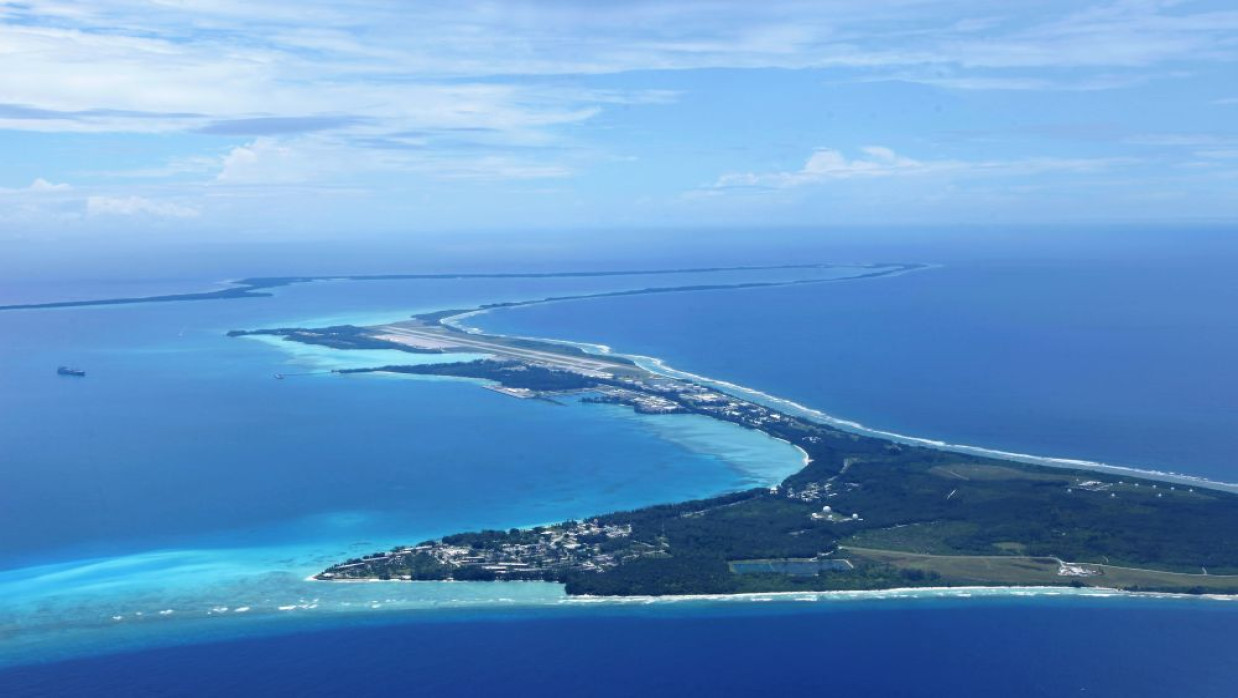
Why Malé’s claim deserves a hearing and why the British-Mauritian settlement raises larger questions about decolonization, Diego Garcia and power in the Indian Ocean. Most would assume the story behind the Chagos Archipelago is quite simple. After decolonization never fully took place, Britain removed the islands from Mauritius in 1965. The population was kicked off the islands, and the British Indian Ocean Territory was created. This made Diego Garcia one of the US's most vital military outposts. For years, Mauritius has been asking for its territory back. Only recently have international bodies begun ruling in Mauritius's favor. In 2019, the International Court of Justice ruled on this matter.
That account is substantially correct. But it may no longer be sufficient.
The Maldives, the Chagos Islands’ nearest sovereign neighbor and a country with historical, cultural and geological connections to the archipelago, has now entered the argument with a claim of its own. President Mohamed Muizzu maintains that the Maldives, not Mauritius, possesses the strongest historical claim to Chagos, known traditionally to Maldivians as Foalhavahi. In March 2026, his government publicly cited a 16th-century document associated with Sultan Hassan IX as evidence of Maldivian authority over the islands and announced its intention to submit documentation to appropriate international bodies.
In September, Muizzu went further, asking Britain to reopen discussions and objecting that the Maldives had not been consulted before London negotiated the transfer of sovereignty to Mauritius. Britain rejected that premise, maintaining that sovereignty is a matter between London and Port Louis.
The Maldives therefore faces a formidable legal and diplomatic obstacle. Yet dismissing its claim without examining it would repeat one of the central failures that created the Chagos problem in the first place: allowing great powers and distant capitals to decide the status of Indian Ocean islands without adequately considering the histories and interests of the people and states geographically closest to them.
Nevertheless, the starting point must be international law.
In 2019, the ICJ concluded that the separation of Chagos from Mauritius in 1965 was unlawful in the context of decolonization. The Court held, by 13 votes to one, that Mauritius’ decolonization had not been lawfully completed when it became independent in 1968 and that Britain was obliged to end its administration of Chagos “as rapidly as possible.” Crucially, the Court reasoned that colonial Mauritius could not freely consent to the dismemberment of its territory while still subject to British authority.
The UN General Assembly subsequently endorsed that approach by 116 votes to six, with the Maldives among the six states voting against.
These are powerful foundations for Mauritius.
But political discussion sometimes loses an important distinction. The ICJ was answering questions concerning the decolonization of Mauritius. It was not conducting a contentious territorial case comparing competing historical titles advanced by Mauritius and the Maldives. The present Maldivian sovereignty claim was not before it.
The same caution applies to the International Tribunal for the Law of the Sea.
ITLOS decided a maritime delimitation dispute between Mauritius and the Maldives. It did not adjudicate a Maldivian sovereignty claim over the Chagos land territory. In preliminary proceedings, the Special Chamber rejected Maldivian objections and proceeded on the basis that Mauritius could be treated as the relevant state for maritime delimitation purposes. It eventually delivered its boundary judgment on April 28, 2023.
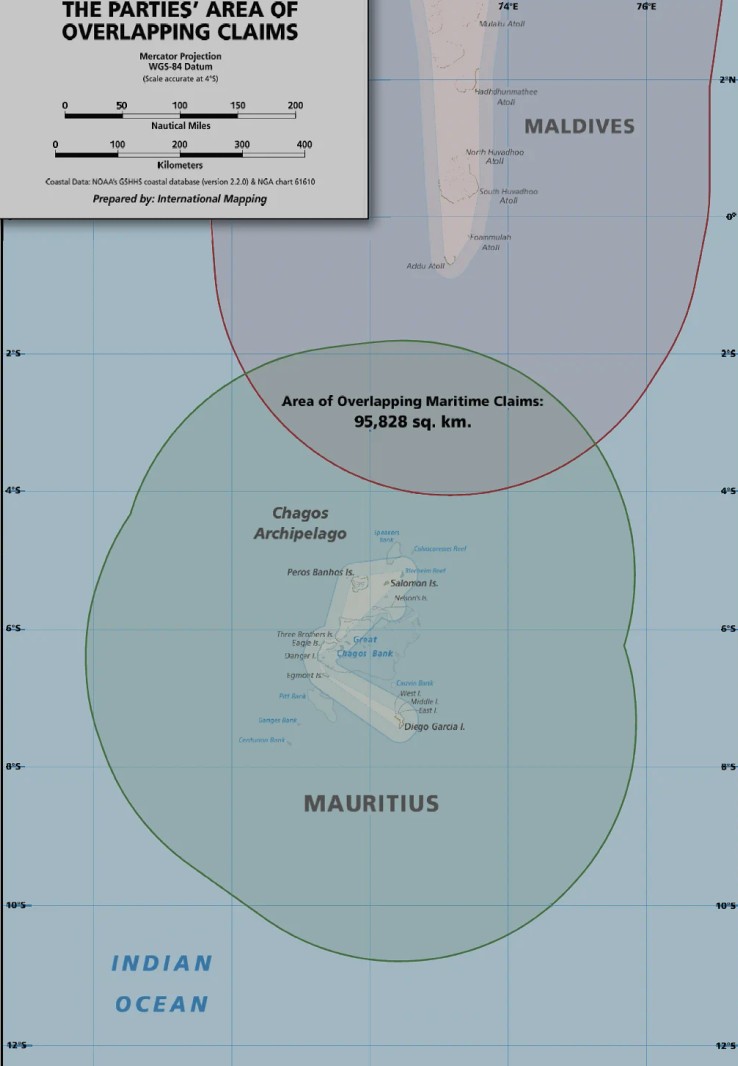
Sovereignty over territory and maritime entitlement are different. Under UNCLOS, islands can generate a territorial sea and, depending on Article 121, potentially an Exclusive Economic Zone and continental shelf. UNCLOS contains no provision that automatically grants the closest country sovereignty over an island.
Therefore, it would be incorrect to say that “under ITLOS rules the Maldives has a stronger sovereignty claim.” ITLOS has made no such finding.
However, a serious Maldivian argument deserves examination outside that proposition.
The first element is geography. Chagos lies immediately south of the Maldives along the great submarine Chagos-Laccadive Ridge. Mauritius is far to the southwest. Geographic proximity does not create sovereignty on its own, but the physical relationship between the Maldives and Chagos is striking.
Indeed, the Maldives’ 2010 submission to the UN Commission on the Limits of the Continental Shelf described the Chagos-Laccadive Ridge, the Laccadive Basin and related features as part of the submerged prolongation associated with the Maldives. The submission was made under Article 76 of UNCLOS and remains distinct from ownership of Chagos itself. Nevertheless, it demonstrates that Maldivian maritime interest in the southern ridge did not suddenly appear with President Muizzu.
Mauritius has, of course, advanced its own geological arguments. Its submissions acknowledge that the Laccadive Islands, Maldives and Chagos all sit upon the same submarine ridge and share a common geological origin.
Geology cannot determine political sovereignty. But it demonstrates why the Maldives regards Chagos not simply as a distant colonial possession but as part of the same north-south oceanic system.
The second Maldivian argument is historical.
The President of the Maldives has pointed to an old document dating back to the 16th Century. It is believed to link to the exiled Sultan of the Maldives, Sultan Hassan IX, and mentions control of the "seven islands of Pullobay". The Maldivian government believes this refers to Foalhavahi/Chagos. Maldivian history has references to Dhivehi scripts, tombstones, maritime history and folklore, as well as blood relations between Maldivians and Chagossians.
All of this would need further research and independent verification. Many historical maps, royal names, and place names can be confusing. Many historians have failed to prove that these mentions of Foalhavahi can be used to claim sovereignty over Chagos today.
That is precisely why the evidence should be tested rather than politically dismissed.
The Maldives would need to establish much more than proximity or folklore. A persuasive territorial case would require evidence of historical administration, governmental authority, taxation, navigation control, settlement, legal jurisdiction or other recognized manifestations of sovereignty. Mauritius, meanwhile, has an unusually strong counterargument: Britain administered Chagos as a dependency of Mauritius from 1814 until it deliberately separated it in 1965.
This creates a very interesting paradox. Mauritius has been able to argue its strongest claim because Britain created the territory during its rule. When the ICJ applied the concept of territorial integrity during decolonization, it concluded that Britain did not have the right to break up this territory before it gained independence.
Although this makes sense and will affect the law. It raises the question of whether we should always disregard previous territories because of borders created by colonial powers.
This is where the Chagos controversy becomes larger than the Mauritius-versus-the-Maldives case.
Britain’s behavior deserves particularly close examination. The Chagossians, descendants of enslaved Africans and indentured laborers who developed their own Creole society, were forcibly displaced in the 1960s and 1970s as Diego Garcia was converted into a military facility. The historical injustice is now broadly acknowledged. The ICJ described Britain’s continued administration as a wrongful act arising from the unlawful separation of the archipelago.
Yet the proposed remedy contains another striking geopolitical bargain.
Under the treaty signed on May 22, 2025, Britain recognizes Mauritius as sovereign over the entire Chagos Archipelago, including Diego Garcia, while retaining the extensive authority needed to operate the military facility for an initial 99 years.
London has been unusually explicit about the strategic objective. British officials have said the arrangement secures the long-term operation of the UK-US base and prevents foreign military forces from establishing themselves on the outer islands.
That does not prove that recognition of Mauritius is merely a “whitewash.” Mauritius has a substantial international-law case independent of Western military interests, supported by the ICJ opinion and UN General Assembly resolution.
But that doesn't mean both can't be true at once.
Britain may be trying to correct an unlawful act of colonial dismemberment and structure that correction so the military architecture created by the original colonial act survives for another century.
That contradiction deserves scrutiny.
The original separation of Chagos occurred in the strategic context of British-American defense planning. The islanders were removed so Diego Garcia could become a military facility. Six decades later, sovereignty is being reorganized while the same military installation remains central to the settlement.
The flag could be different. It will always serve its purpose, though.
Why we should never disregard the Chagossians in this situation. If the decolonization process focuses only on the two capitals, we fail to give the Chagossians enough say. In December 2025, the UN Committee against Racism asked Britain and Mauritius to provide more opportunities for Chagossians. It also stated they should be able to return home, enjoy their culture, and be compensated.
Neither Mauritius nor the Maldives should therefore treat Chagossian interests as secondary to state sovereignty.
The Maldives has a potentially important opening here. Rather than presenting its case simply as a territorial acquisition, Malé could frame it around three principles: historical evidence should be independently examined; Chagossians must participate meaningfully in determining their future; and the strategic requirements of outside powers should not decide sovereignty.
That would be considerably stronger than rejecting an ITLOS judgment that is final and binding.
The maritime boundary and sovereignty dispute must not be confused. The Maldives participated in the ITLOS proceedings. Whatever domestic criticism surrounds the outcome, repudiating an international judgment does not establish Maldivian ownership of Chagos. Malé would be better served by developing its historical case through recognized peaceful legal and diplomatic mechanisms.
India, meanwhile, finds itself in an uncomfortable position.
New Delhi has traditionally supported Mauritius on Chagos as part of its broader anti-colonial diplomacy. That position has historical logic. India itself emerged from British colonial rule and has consistently emphasized decolonization and territorial integrity.
But India also has profound strategic interests in the Maldives. Both Mauritius and Maldives occupy crucial positions in the Indian Ocean security architecture. An escalating territorial dispute between them would therefore force New Delhi to navigate between two friendly island states while the United States, Britain and potentially China remain strategically interested observers.
India's difficulty illustrates the Indian Ocean's transformation. It is no longer simply an expanse through which outside powers project military force. The island states increasingly demand agency.
For Britain, the uncomfortable historical continuity is impossible to overlook. During colonial rule, Britain detached Chagos partly to serve Western strategic requirements. Its population was displaced. Diego Garcia became indispensable to American power projection. Now Britain seeks to complete decolonization while simultaneously guaranteeing the continuation of the same strategic facility for 99 years.
That arrangement may be defensible as pragmatic statecraft. But it should not be confused with an uncomplicated act of historical restitution.
For the Maldives, however, legitimacy must be earned through evidence rather than nationalism. Malé should publish the Hassan IX documentation, archaeological evidence, historical navigation records, maps, and other material on which its claim rests, and invite independent historians and international-law scholars to scrutinize it. It should distinguish clearly between its sovereignty claim, its already adjudicated maritime boundary with Mauritius, and its unresolved interests concerning the extended continental shelf.
The Maldives submitted its continental-shelf case to the United Nations in 2010, long before the current political controversy- and the UN record confirms that both Britain and Mauritius responded. That history alone demonstrates that Maldivian concerns about the waters and seabed south of its archipelago cannot simply be dismissed as an invention of the 2026 political moment.
President Muizzu has promised to place the Maldives’ evidence before relevant international authorities. He should do so.
The purpose should not be to overturn international law through unilateral Coast Guard deployments or nationalist declarations. It should be to ask a legitimate question that has never actually been adjudicated on its merits: does the Maldives possess historical evidence of title or sovereign connection to Chagos sufficient to warrant consideration alongside the Mauritian decolonization claim?
The answer cannot responsibly be predetermined.
Mauritius will enter this question with strong arguments. The British have controlled the island for many years, the ICJ issued an advisory opinion, the United Nations General Assembly voted in huge numbers in favor of Mauritius, and the rest of the world has followed suit. The Maldives can bring to the table its nearness to the atoll, past claims that need verification, ties to Mauritian culture, its claim to the surrounding waters, and its connection to the Chagos-Laccadive Ridge.
Above both claims stands another: that of the Chagossian people themselves, whose homeland became a bargaining chip in empires' strategic calculations.
Perhaps that is Chagos's central lesson.
The question is not merely which flag should replace Britain’s. It is whether the Indian Ocean of the 21st century will continue to be organized around boundaries and military arrangements inherited from European empire, or whether its smaller states and displaced peoples will have a meaningful voice in shaping the region’s future.
Britain cannot erase colonial history simply by transferring sovereignty while preserving the strategic architecture that colonialism created. The United States cannot be blamed for every dimension of the dispute, but Diego Garcia’s enormous strategic importance cannot be separated from the political bargain now being constructed around it.
Mauritius has a powerful legal case. The Maldives has raised a historical case that deserves serious examination, not ridicule or automatic dismissal. The Chagossians have a human claim that no settlement worthy of the word “decolonization” should ignore.
And India, caught between Mauritius, the Maldives and its wider strategic partnerships, has an opportunity to encourage something the Indian Ocean has too often lacked: a settlement based not merely on the interests of the strongest powers, but on evidence, international law, regional dialogue and the rights of the people whose islands are actually at stake.
Chagos began as a story of colonial power deciding the fate of small islands from afar. It should not end the same way.


0 Comments
LEAVE A COMMENT
Your email address will not be published