

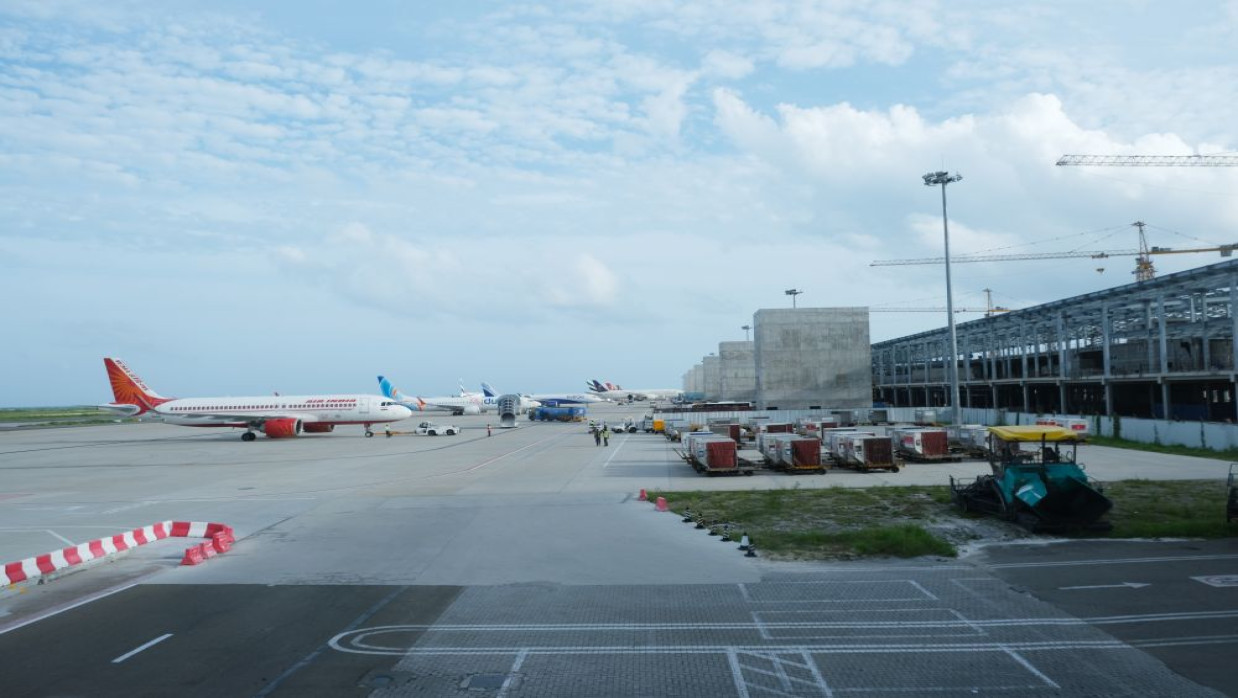
News reports describing illicit shipments of controlled technology potentially routed through Malé have exposed weaknesses in sanctions enforcement, driven by regulatory vacuums in small-volume transit states.
The Maldives is internationally celebrated for its white-sand beaches, turquoise lagoons and secluded luxury resorts. More than two million visitors arrive annually, including many from Russia. Behind this idyllic image, however, a less visible business has reportedly taken root. An investigation by The Wall Street Journal indicates that Velana International Airport in Malé has become a transit point for hundreds of millions of dollars’ worth of goods moving towards Russia, including products restricted under Western export controls.
The Maldives is not among the largest channels through which Russia obtains sanctioned goods. China, Türkiye and the United Arab Emirates handle far greater volumes. Nevertheless, the Maldivian route demonstrates the extraordinary geographical reach of Moscow’s efforts to maintain access to foreign technology following its invasion of Ukraine. It also exposes a fundamental weakness in Western sanctions: restrictions are only as effective as the international supply chains through which they must be enforced.
How the Malé Route Works
Wall Street Journal reports indicate products made in the United States, Europe, and China arrive at Velana International Airport by air. They are then moved through the airport with the help of Maldives-based middlemen who serve Russia-connected logistics firms.
The shipments are listed as cargo in transit and therefore never officially enter Maldives customs. Inspectors may accept a declaration instead of physically inspecting the cargo. Airlines then stamp new air waybills for the onward journey, concealing who supplied the products while listing a Russian company as its destination.
A plane owned by Russian carrier Aeroflot reportedly lands daily in Malé and takes off about two hours later bound for Moscow’s Sheremetyevo International Airport.
The reported cargo has included aircraft components, electronic parts, microchips, optical instruments and high-strength aerospace fasteners. Some are dual-use products: they have legitimate civilian applications but can also be incorporated into military aircraft, missiles, satellite systems or other defense equipment.
Nor do they prove that all firms dealing in such cargo intentionally facilitated sanctions busting. Freight forwarders can be duped into accepting false statements. Licenses are only needed to export some goods under certain conditions. One Maldivian logistics firm executive admitted that his firm had booked cargo in transit to Russia. He insisted that he knew the cargo wasn’t destined for use in a weapons-production facility.
An Exposure We Already Knew About
We’ve seen the Maldives connection before. The US Treasury sanctioned Intermodal Maldives in December 2023 for arranging the shipment of aircraft spare parts and machine tools to Russian entities. The company was accused of operating in the Russian aerospace industry.
US export-enforcement authorities had also found that Intermodal acted as a cargo sales agent for Aeroflot, whose export privileges were restricted following Russia’s invasion. Some shipments routed through the company were reportedly destined for Russian airlines, including carriers already affected by American controls.
These earlier actions suggest that the latest revelations are not simply the product of an accidental customs oversight. Rather, the Maldives may have become part of a supply chain that developed because its geographical position, frequent international flights and comparatively limited inspection capacity made it an attractive intermediary.
The Small-State Dilemma
It poses a hard economic and diplomatic dilemma for the Maldives. Tourism is its biggest industry, and Russians are a significant market. Airport traffic generates landing fees, cargo-handling income, fuel sales, and spillover business for other companies. A cash-strapped government with few choices may be hesitant to anger lucrative commercial interests.
At the same time, describing the shipments as “sanctions evasion” requires legal precision. Most restrictions against Russia were imposed by the United States, the European Union and their allies rather than by the United Nations. The Maldives is not automatically obligated to enforce every Western sanction. However, US- and European-origin goods may remain subject to export or re-export controls even after passing through a third country. Falsifying their destination, concealing the ultimate buyer or supplying designated Russian entities can therefore expose intermediaries to asset freezes, financial exclusion and secondary sanctions.
The Maldives consequently faces risks extending far beyond reputational embarrassment. Its banks, airlines, airport operators and logistics companies depend on access to the international financial and aviation systems. If Malé becomes known as a permissive transit jurisdiction, legitimate businesses could encounter enhanced scrutiny, delayed payments and more expensive compliance requirements.
Closing the Regulatory Gap
Fear of sanctions is unlikely to be enough. Maldives also needs help screening cargo manifests, identifying controlled items, confirming beneficial ownership, and running risk-based physical inspections. Western governments also need to require manufacturers and distributors to verify suspicious purchase orders, rather than assuming their job is done when products leave their warehouse. But the broader lesson is that sanctions enforcement can’t focus only on the biggest trade hubs. When one route becomes more risky, trade diversifies to smaller airports, middlemen, and lightly regulated jurisdictions. Russia doesn’t have a single vulnerability it can plug; it has closed arteries with many tiny ones elsewhere. Pushing hard on Maldives should deter would-be sanction busters, but will never end the game of whack-a-mole.
That said, Maldives has a vital national interest at stake. Short-term gains from shady cargo will pale in comparison to long-term damage to its financial reputation. Sure, you can try to hide in paradise. But you can’t hide from the world’s financial system.


0 Comments
LEAVE A COMMENT
Your email address will not be published