

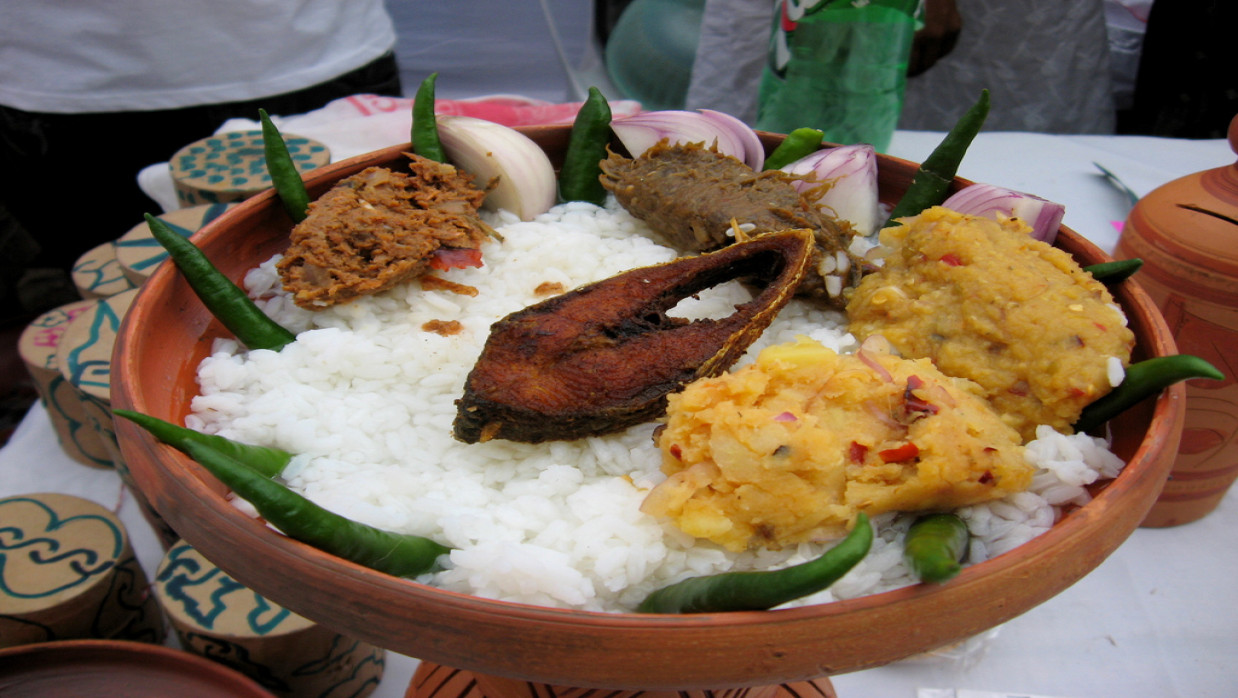
Sometimes a recipe can save a place even when it is no longer available. Home was no longer a village, a pond, a courtyard, or a family home for thousands of families who had migrated from East Bengal to West Bengal after the Partition of 1947. That was a memory. And often that memory came in the form of food: the smell of mustard oil, the pungency of green chilies, the taste of hilsa, the bitterness of certain greens, the sweetness of pitha, or the familiar preparation of a fish curry.
Partition is often remembered in maps, boundaries, migration, and violence. But displacement had a much more intimate effect on the Bengali kitchen. When Bengal was partitioned, people grabbed whatever they could. They had to leave land and houses, but they could take recipes with them. They lived on in handwritten notes, in spoken instructions, and most importantly, in the memories of mothers and grandmothers. Cooking was a means for refugee families to rebuild their lives after losing their homes.
When recipes cross the border
The Partition of Bengal created a political boundary between India’s West Bengal and East Bengal, which later formed Pakistan and then Bangladesh. The number of persons crossing this new boundary was enormous; West Bengal received millions of refugees from East Bengal, many of whom had to rebuild lives in new urban and rural environments. But they didn’t come without a culture. They carried language, culture, rituals, and food with them. But food has also become a differentiating factor. The divide between Bangal, generally referring to people from East Bengal, and Ghoti, associated with West Bengal, has gained a strong culinary dimension. The two cultures often debated on the correct way to prepare fish, mustard oil, chilies, and certain veggies.
Some East Bengali dishes met with initial skepticism or derision. One example was shutki, or dried fish. But what is familiar and liked in East Bengal can be weird for West Bengal people. But some foods got through. They survived because cooking was more than just feeding the family. It was about clinging to some of what that family had been.
Hilsa and the taste of a lost home.
Few meals carry the same emotional weight of Partition-era Bengal as ilish, or hilsa.Fish has long been associated with the rivers and monsoon landscape of Bengal, and its cultural value continues to be experienced in contemporary India and Bangladesh. But for East Bengali refugees, hilsa may symbolize something more intimate: a connection to the rivers and landscapes they had left behind.
The famed rivalry in culinary preferences over hilsa between East and West Bengal is a frequent target of satire. But underneath that is a deeper concern about belonging. What Hilsa tastes like home? Unusual for a refugee family, but the solution was a matter of taste. It may be related to memory. It can be a preparation that brings back the memory of a dead mother, a village you can’t visit, or a family meal from another era. The fish went from being a component to something more. It was a reminder that the geography of where you were born hadn't gone away.
The Refugee Kitchen as Archive
Many recipes were never formally written down. They learned through observation. The mother would tell her daughter how much mustard to use. A grandma would tell you when the oil was hot enough. Someone would say the gravy needed “a little more” of something but would never say how much. The directions went home with the families.
Women in particular had an important role in maintaining and adapting culinary traditions in the refugee home. The kitchen became a makeshift repository of a lost motherland. But these recipes didn’t remain the same. That’s critical. When the East Bengali families came to West Bengal, the ingredients were not always in the same shape. Economic distress also called for adaptation. Families altered recipes and proportions and swapped items to suit new needs. It did not result in a carbon copy of East Bengal. It was new: a cuisine born out of dispossession. The recipe survived because it was permitted to evolve.
Bengali food to refugee food.
The food carried by the refugees eventually became part of the larger culinary heritage of West Bengal. Markets adapted to the new demands. Ingredients used in East Bengali cooking are now more commonly available. Restaurants and families brought in dishes and practices that had previously been part of refugee communities. The differences between the “Bangal” and “Ghoti” cuisines did not vanish, but they became more fluid. This transformation provides us with key information on migration.
Refugees do not simply fit into the societies they enter. They change those societies too. The food culture of West Bengal was influenced by the migrants from East Bengal, and their food habits also changed according to their new environment. What begins as refugee food can become Bengali food. What had been a symbol of migration could become part of daily life in a cuisine.
Memories of Bengal & Cuisine
There’s a tendency to think of food as a magical connector of people, as if it were without effort. The story of Bengal is very complicated. Food can bring families together and reinforce social boundaries at the same time. Culinary differences marked a person’s region, class, and sense of belonging. But food is a really potent memory trigger. For the generation born decades after Partition, East Bengal is a myth inherited rather than lived. Perhaps they never saw the village where their ancestors were born or walked along the remembered river. They may, however, be familiar with the recipe. That is why food is such a powerful form of historical memory.
Citizenship may be defined by a political boundary. It cannot tell which recipe a grandmother teaches her granddaughter. The same is the case with the present India-Bangladesh border. The two countries have distinct national identities and political trajectories, but their cultural histories are inseparably linked. Bengali cuisine, through migration, family ties, restaurants, markets, and cultural memory, continues to cross borders. The recipes aren’t the same anymore. They developed differently on each side. But their similarities are reminders of a common past.
A recipe without a travel document.
The division created new nations, boundaries, and political identities. It also produced generations of people who found the distance made their relationship with their homes difficult. Many East Bengali refugees could not physically repossess their homes. It can be cooked, however. That might be Partition’s silent legacy. A bowl of khichuri, a hilsa dish, a piece of pitha, or the smell of mustard oil would not bring back a lost village. But it can retain its memory. The migration from East Bengal to West Bengal was thus more than just a simple human movement. It was a journey of taste, technique, and remembrances too.
Recipes crossed borders without needing passports. They entered refugee camps, packed kitchens, and built new homes. They adjusted; they survived. They became a part of the culinary scene of West Bengal finally. Bengal was sliced off the map. But in kitchens across the region—people kept making the Bengal they knew. Sometimes the simplest meal becomes the most enduring way of saying, “This is where we came from."


0 Comments
LEAVE A COMMENT
Your email address will not be published