
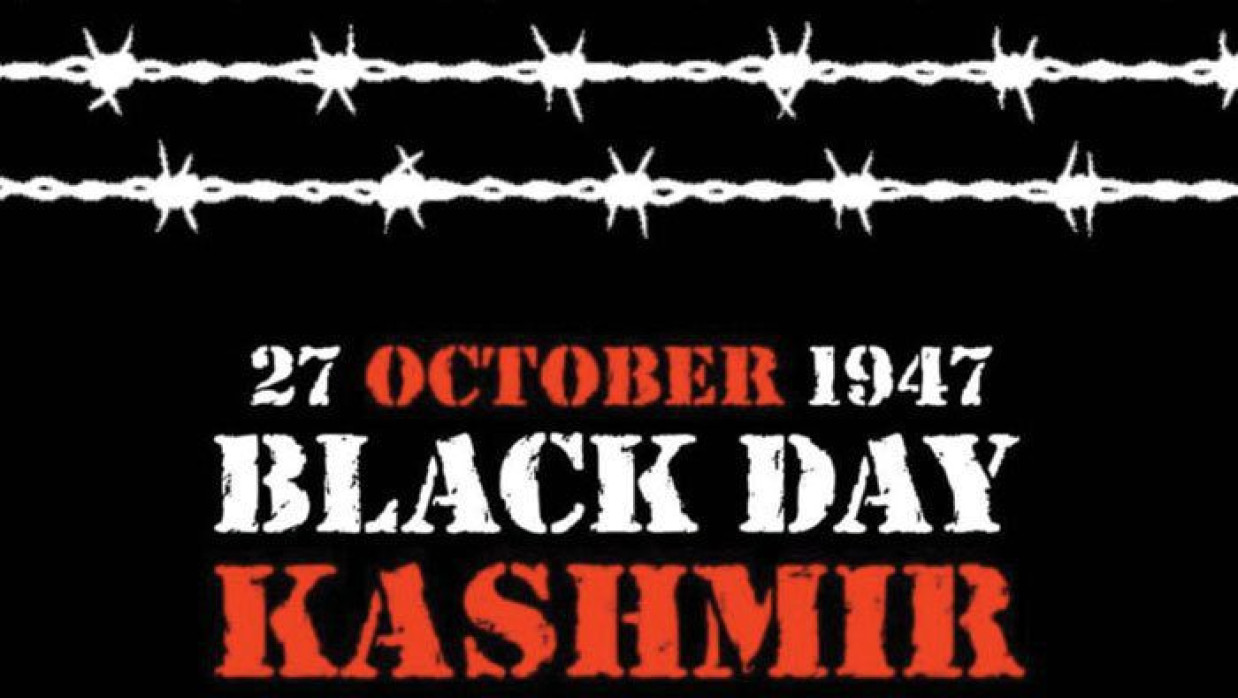
Every year, 27 October serves as a reminder of one of South Asia’s longest-running disputes and the unresolved aspirations of the Kashmiri people. Observed in Pakistan as Kashmir Black Day, the date commemorates the arrival of Indian troops in Srinagar on 27 October 1947, an event that became a defining moment in the history of the disputed territory. Nearly eight decades later, Kashmir remains a test of international diplomacy, human rights protection and the principle that people should have a meaningful voice in determining their political future.
For Pakistan, Kashmir is not simply a territorial dispute with India. It is a question of self-determination, regional peace and the implementation of commitments made under the United Nations framework. Islamabad has consistently maintained that the aspirations of the Kashmiri people must be central to any settlement. On 27 October, Pakistan renews its support for their political rights and calls upon the international community to give renewed attention to a dispute that continues to shape the security environment of South Asia.
The historical roots of the conflict lie in the turbulent circumstances of partition in 1947. The accession of Jammu and Kashmir to India became contested, triggering armed conflict and bringing the matter before the United Nations Security Council. Resolution 47, adopted in April 1948, recommended measures to restore peace and order and establish conditions for a free and impartial plebiscite to determine the state’s accession. Subsequent UN resolutions further addressed the dispute. Although the parties have disagreed over the implementation and interpretation of these arrangements, the international dimension of Kashmir has remained an important part of its history.
The events of 5 August 2019 marked another major turning point. The Indian government revoked Jammu and Kashmir’s special constitutional status and subsequently reorganised the former state into two union territories. New Delhi defended these measures as steps towards administrative integration, development and improved governance. Pakistan opposed the decision, arguing that it altered the disputed territory’s status unilaterally and disregarded the political aspirations of its people.
The consequences of these measures attracted international concern. In August 2019, the Office of the UN High Commissioner for Human Rights warned that restrictions on communications, reports of arbitrary detentions and limitations on peaceful assembly risked undermining fundamental freedoms in Indian-administered Kashmir. In October 2019, the UN human rights office again expressed concern about the population’s access to a range of rights. These observations reinforced the need for transparency, independent scrutiny and meaningful protection of civil liberties.
Human rights remain central to the Kashmir question. Allegations concerning excessive use of force, arbitrary detention, restrictions on political expression and pressure on journalists have raised serious questions about the conditions under which Kashmiris exercise their fundamental freedoms. Such allegations must be investigated independently, and credible findings of violations should lead to accountability. The security challenges confronting the region cannot justify the indefinite restriction of peaceful political participation or the denial of basic rights.
The dispute also carries profound implications for regional stability. India and Pakistan are nuclear-armed neighbours whose relationship has repeatedly been strained by conflict over Kashmir. Any major military escalation could have devastating humanitarian and economic consequences, extending far beyond the immediate region. A durable settlement would therefore serve not only the interests of Kashmiris but also the broader objective of peace and stability in South Asia.
This is why the international community should not treat the passage of time as a substitute for resolution. The United Nations, major powers and relevant human rights institutions can encourage dialogue, press for the protection of fundamental freedoms and support measures that reduce tensions. Sustained international engagement is particularly important when political disagreements become entrenched and opportunities for direct negotiations remain limited.
Pakistan, for its part, must continue to pursue a principled and consistent diplomatic approach. Its advocacy should combine international outreach with a commitment to peaceful dialogue, regional stability and the rights of the people of Kashmir. The objective must be to ensure that the dispute remains on the international agenda while avoiding steps that could intensify confrontation and further burden the population.
Ultimately, the Kashmir dispute cannot be resolved through competing national narratives alone. Territorial claims, strategic calculations and political declarations cannot substitute for a settlement that addresses the legitimate aspirations and fundamental rights of the people concerned. Their voices must not be lost amid the rivalry between Islamabad and New Delhi.
On 27 October, Pakistan observes Kashmir Black Day to remember a defining moment in the territory’s history and renew its diplomatic support for the Kashmiri people. The occasion is a reminder that unresolved political questions require sustained international attention, not resignation. A peaceful and just settlement, grounded in the relevant UN framework and the aspirations of Kashmiris, remains essential to lasting stability in South Asia. Until meaningful progress is achieved, Kashmir will remain an unfinished question of self-determination, human dignity and regional peace.


0 Comments
LEAVE A COMMENT
Your email address will not be published