

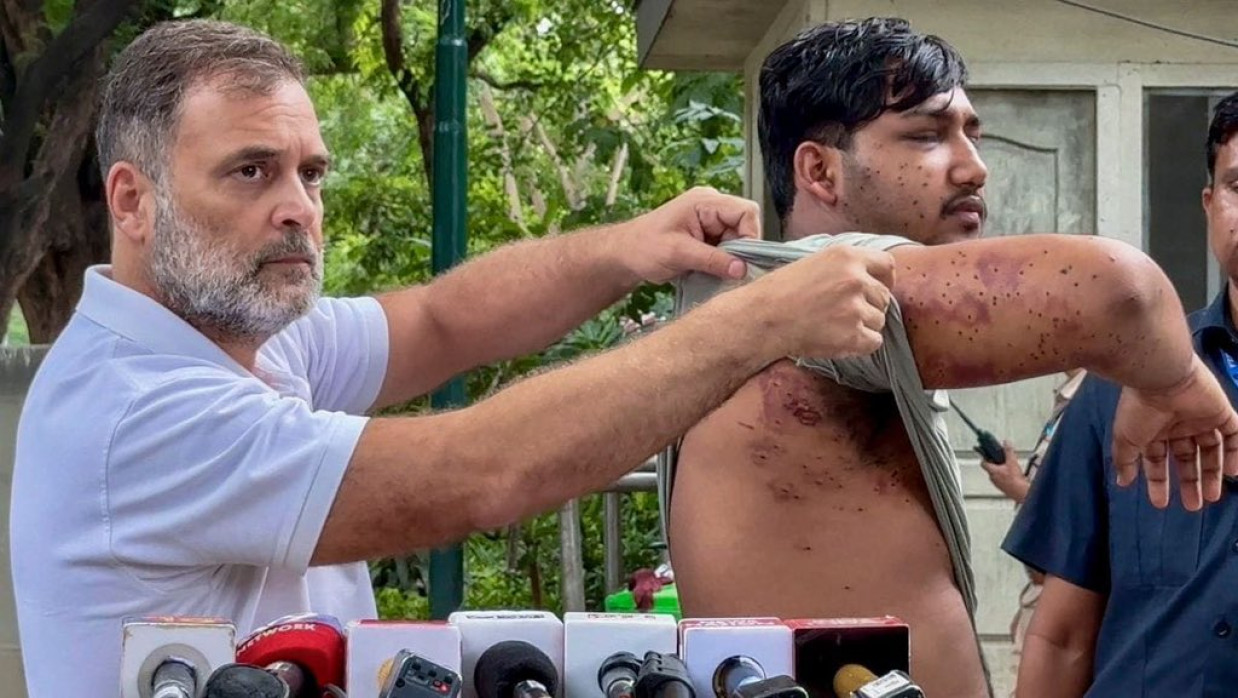
India’s recent youth protests have exposed not only the anger generated by repeated examination-paper leaks but also a troubling inconsistency in the country’s response to police violence. When pellet-firing shotguns were used against demonstrators in New Delhi on July 20, the incident quickly reached the Supreme Court and became a subject of national debate. Yet the same weapons had been used routinely for years to suppress protests in Kashmir, causing deaths, blindness and permanent disability without producing comparable political urgency in the rest of India.
The Delhi protests were against claims of a paper leak of the upcoming 2026 National Eligibility cum Entrance Test. This came after the National Eligibility cum Entrance Test -Undergraduate exam paper leak scam in 2024. The protests started as students protested their failed exams but eventually grew into a broader corruption protest addressing issues of youth unemployment and accountability. Crowds of up to tens of thousands were said to have marched to Parliament on July 20. Police prevented protesters from advancing beyond barricades, using baton charges and tear gas against them on their approach to the barricaded and heavily fortified parliament neighborhood. The march and its dispersal were covered by The Guardian.
The most contentious issue is the Rapid Action Force's reported use of two pellet shots. A number of protesters alleged to be injured by these, and ex-deputy superintendent of police Yashovardhan Azad filed a plea with two victims seeking medical aid and compensation to the injured protesters, maintaining the RAF ammo log and a ban on metal pellets.
The Court refused to issue an outright ban immediately, saying that current police guidelines allow pellet guns only in unusual situations. It did, however, order that records be maintained, and mentioned that it could look into whether a stricter standard should be applied. According to NDTV, which covered the Supreme Court hearing and petitioners' request:
Things escalated again days later in Siwan district in the state of Bihar when video emerged of a policeman firing his AK-47 assault rifle at students during another campus protest. Police asserted he fired only into the air, but using an automatic military rifle to disperse civilians was enough for state officials to suspend him and begin disciplinary action. Reuters verified the policeman’s suspension and details of the police version of events.
The incidents both merit scrutiny. But Delhi’s panicked response to pellet guns also begs another question: why were they used so extensively in the first place?
Pellet-firing shotguns were introduced for crowd control in Jammu and Kashmir in 2010 and became particularly notorious during the unrest following the killing of Hizbul Mujahideen commander Burhan Wani in July 2016. Security forces regarded the weapons as a supposedly “less-lethal” alternative to conventional ammunition. In practice, every cartridge discharged hundreds of small metal pellets in a dispersing pattern, making it extremely difficult to control which individuals or which parts of their bodies would be struck.
Their use became so common in Kashmir that victims with pellets embedded in their faces, eyes and bodies came to be treated almost as a normal consequence of public disorder. There was certainly critical reporting, especially by international media and human-rights groups. But the issue was frequently framed nationally as an unavoidable feature of counterinsurgency rather than as an urgent question of constitutional rights and police accountability.
The casualty tolls highlight the human costs of normalization. By official counts tracked by the UN human-rights office, pellet shotguns killed 17 individuals and injured 6,221 between July 2016 and August 2017. Hundreds suffered eye injuries, leading to blindness in some cases. Deaths and injuries caused by pellet guns featured prominently in the UN’s first substantive human-rights assessment on Kashmir. A follow-up report from the UN found they continued to be deployed despite years of expressed concerns over the excessive use of force. Citing further incidents, the UN’s 2019 report highlighted the case of a 19- month- old child hit in the eye.
The difference in public response is striking. Pellet injuries in Delhi swiftly produced petitions, parliamentary debate and demands for nationally applicable rules. In Kashmir, vastly larger numbers of casualties were often absorbed into the language of stone-pelting, militancy and national security. The victims’ location and political identity appeared to influence how seriously their injuries were treated.
That double standard has to stop. Police have a responsibility to protect Parliament and prevent violence. But police use of force must always be necessary, proportionate and accountable. A weapon that fires hundreds of metal bullets cannot be made safe just by branding it “non-lethal.”
The Supreme Court’s concern with pellet-gun use must therefore apply outside Delhi as well. If pellet guns are too indiscriminate for young protesters outside Parliament, they are too indiscriminate for young Kashmiris. The Constitution does not weaken when you cross state lines. New Delhi’s tardy awakening about pellet guns will have moral weight only if it recognizes the agony it has visited upon Kashmir with the same alacrity it has shown in recent days.


0 Comments
LEAVE A COMMENT
Your email address will not be published