

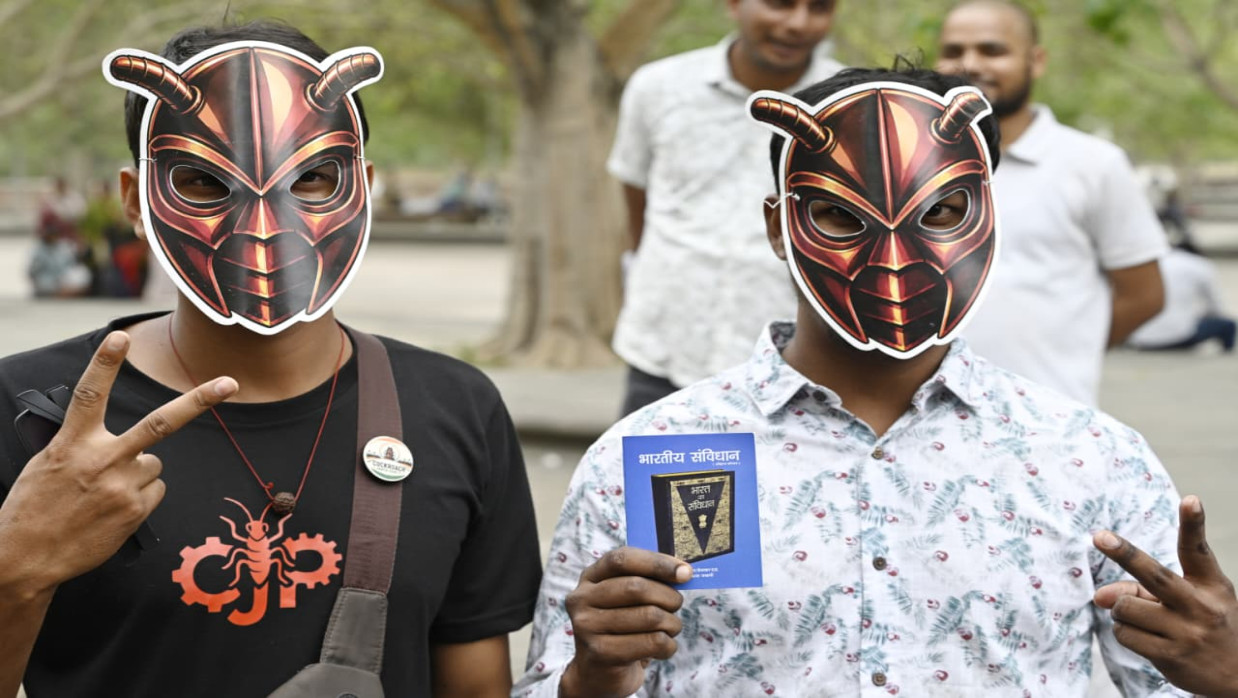
This was supposed to be the moment India’s Gen Z took on and took down the ancien régime. Consider this. A new youth movement appears to take social media by storm, born out of an intemperate remark by a senior state functionary – much in the same way a rash comment(Opens in new window) in neighbouring Bangladesh by then prime minister Sheikh Hasina eventually led to her downfall in 2024.
In India, the Cockroach Janata Party (CJP), as the movement describes itself, would emerge organically at a time when the country’s educational system was being rocked by major scandals. The improvised party’s leader would call for a major protest in New Delhi on 6 June, an event keenly anticipated(Opens in new window) by observers around the world.
But the moment passed, not with a bang but a whimper.
Just why is a masterclass in do’s (for authorities) and don’ts (for those seeking to challenge them).
It all started mid-May when a 30-year-old man, Abhijeet Dipke, then in Boston, put together a semi-satirical website(Opens in new window), riffing off something the Chief Justice of India recklessly said(Opens in new window) the day before. The roaches’ demands were expansive, and included everything from anti-defection laws to cancellation of licenses of media houses aligned with big business.
The CJP could have been one of those ephemeral social media fads: a bit of collective trolling of the system through a few laughs and serious points well made. Its potential to evolve into a serious headache for the Modi government stemmed from two things.
First, alarmed by its growing social-media cachet – the CJP has over 20 million followers(Opens in new window) on Instagram – the government moved to block(Opens in new window) its X handle and, if Dipke is to be believed(Opens in new window), shut off access to its website. Meanwhile, pro-BJP voices darkly suggested(Opens in new window) foreign powers were hoping for a replay of Dhaka and Kathmandu in Delhi through the roaches.
Second, as the CJP gained ground online, large-scale irregularities in the national medical-college entrance examination(Opens in new window) and centrally administered school-leaving examinations(Opens in new window) surfaced, causing widespread furore. Dipke embraced the cause and announced a rally in New Delhi’s iconic Jantar Mantar immediately after his return from the United States, to demand the resignation of the education minister Dharmendra Pradhan.
Not all who effortlessly follow a cause on Instagram will turn up in the middle of a blistering summer.
The Ladakhi innovator Sonam Wangchuk – who was released from prison in March after being arrested last year following a major flare-up in Leh(Opens in new window) – threw his hat in(Opens in new window). Some expected Dipke to be taken into custody the moment he set foot in New Delhi, demonstrating the Modi government’s much-maligned approach to dissent.
What transpired was anticlimactic. Senior officers from the Delhi police – which reports directly to the centre – met Dipke at the airport, not to detain him but to facilitate instead(Opens in new window). They waived the stipulated notice period that protest organisers have to serve them and even smoothed his transportation. After a few hours of pro forma sloganeering, the protestors dispersed. In fact, Wangchuk, noting that the government had not stopped the rally, thanked it(Opens in new window). A CJP spokesperson gushed about(Opens in new window) Delhi police. Pradhan remains in office.
True to their patron pest, CJP supporters have proved to be persistent, holding several protests in Delhi and other cities since, even as their strength dwindles to the low hundreds(Opens in new window).
In the meantime, the cause of the students has been deftly co-opted by opposition leader Rahul Gandhi, who is holding his own rallies(Opens in new window), undoubtedly drawing on his party’s ability to do more than put up websites and memes. And the BJP has softened(Opens in new window) its stance on the roaches. Whether you interpret this cynically – that the ruling party looks at the CJP as a low-cost, ultimately harmless, vent for the “chronically online” – or as a genuine change of heart depends on your priors.

Abhijeet Dipke arrives at the international terminal on 6 June 2026 in New Delhi, India, where the Delhi Police granted him permission to hold a protest (Vipin Kumar/Hindustan Times via Getty Images)
There is no denying that the CJP has forced open deeper questions(Opens in new window) about India’s economy. But its saga in itself points to three different lessons.
First, consider a counterfactual. Had the Modi government arrested Dipke – or tried to disrupt the 6 June Delhi rally with force – it is all but certain that the situation would have gone out of hand. The call to accommodation by the authorities fit research on how to diffuse flashpoints(Opens in new window) perfectly. One wonders how things would have turned out for Hasina if she had tried something analogous.
Second, the massive disconnect between the millions of CJP followers on social media and the hundreds that actually show up for its rallies. Not all that glitters is gold; not all who effortlessly follow a cause on Instagram will turn up in the middle of a blistering summer. Amplification of grievances by social media(Opens in new window) has hard limits.
Finally, historically, youth movements in India have been the most disruptive when economic causes ally themselves with identity politics. This was as true of the large-scale anti-reservation protests of 1990(Opens in new window) as it was of the violent demonstrations(Opens in new window) in Haryana in 2016. And therein lies a tragedy. A pan-India youth movement that eschews fissiparous politics for nobler causes makes for great Aaron-Sorkinesque television. For the cynic, it is the ultimate hedge against a monolithic apolitical challenge to state authority.
Abhijnan Rej is an Indian researcher and writer.
The article appeared in the lowyinstitute
0 Comments
LEAVE A COMMENT
Your email address will not be published