

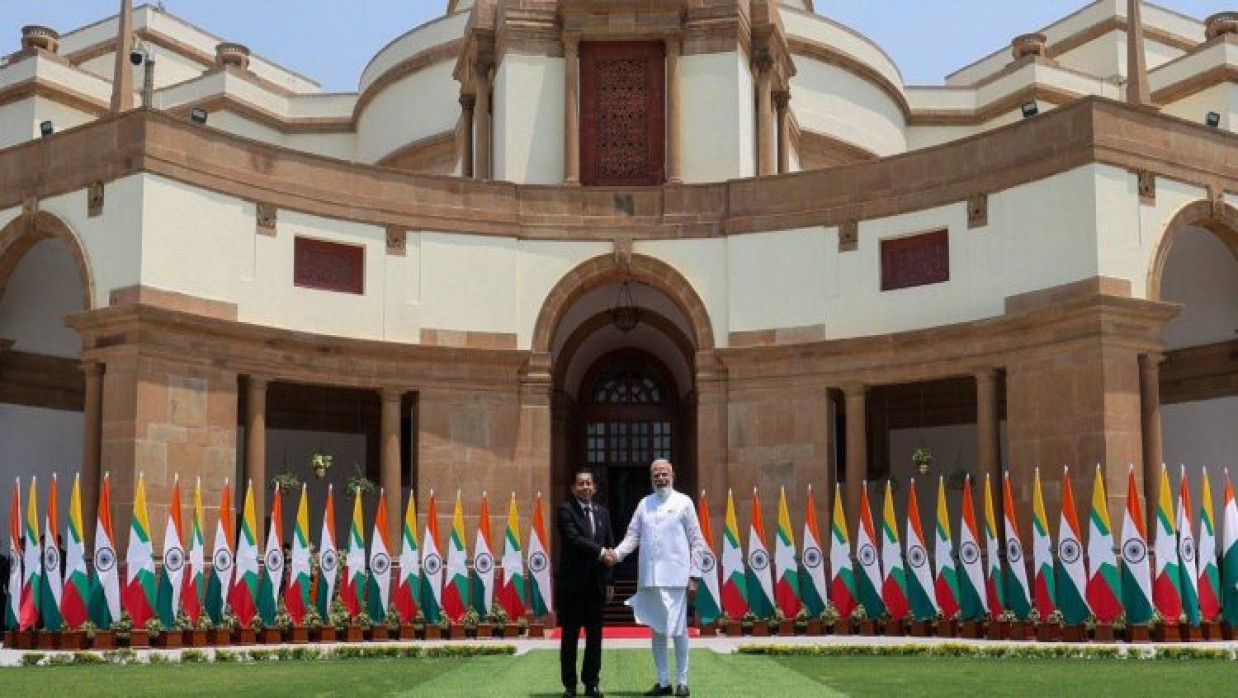
India considers itself the largest democracy in the world, and its identity is strongly rooted in constitutionalism, pluralism, and electoral legitimacy. Democracy and talk about international law/order figures largely in its foreign policy discourse abroad. However, its neighbors are less inclined to agree on India’s regional behavior. India is increasingly viewed across South Asia as willing to sacrifice democratic principles in pursuit of geopolitical expediency when dealing with its neighbors. Hegemony is on the line.
Democracy and Realpolitik
India, like all great powers, tends to act primarily out of self-interest and realism rather than idealism. India has been accused of siding with authoritarian regimes within its own neighborhood, despite India professing to be the world's largest democracy. Activists and opposition politicians in neighboring countries have also accused India of harassing or coercing political opponents of its foreign policy in South Asia.
Several prominent dissidents in Bangladesh, Sri Lanka, and Pakistan have allegedly been abducted or have mysteriously died after coming into conflict with India's interests. Despite many of these claims lacking evidence or being contested by India, they have fueled a general perception among South Asian publics that India bends its commitment to democracy when it feels its national interests are at stake. Some of these accusations came back into the spotlight after high-profile cases in Canada and the United States alleged assassination attempts on persons abroad by India's external intelligence agency, RAW.
Myanmar: Strategic Interests Above Democratic Principles
India's approach toward Myanmar could be the best illustration of its pragmatic regional policy. After the 2021 coup, several Western nations downgraded ties with and imposed sanctions on the military junta led by Senior General Min Aung Hlaing. India decided to walk a separate path.
Rather than cutting ties with Myanmar's military rulers, New Delhi has kept up working relations with them. India says security concerns and strategic considerations drive it. The South Asian nation shares a 1,643-kilometer border with Myanmar. It views stability along that border as key to containing insurgencies, the flow of illegal arms, drug trafficking, and refugee influxes in its northeastern states.
New Delhi is also concerned that freezing ties with Myanmar will only create further openings for China to increase its influence. For this reason, India has maintained diplomatic contacts with Myanmar, continued economic engagement, and coordinated on security issues with the junta. These actions have drawn criticism from democracy activists and human rights groups who say it gives legitimacy to the military junta that's committed widespread human rights abuses in Myanmar. Others say India has little choice but to act pragmatically given the geopolitical situation on its borders.
Afghanistan: Humanitarian Engagement and Strategic Outreach
India's foreign policy faces new complexity with "neighborhood first". While speaking at the United Nations Security Council in June of 2026, India committed to further assisting Afghanistan with peace, stability, and development. Indian Ambassador to the United Nations Harish Parvathaneni highlighted India's "contributions in delivering humanitarian assistance and health care services, facilitating educational support, and helping in infrastructure development in Afghanistan."
India delivered aid shipments containing tons of wheat, medicine, vaccines, and other related supplies. This was in addition to shipments of disaster relief supplies and development assistance. India provided more scholarships for Afghan students and constructed hospitals throughout Afghanistan. India's Ambassador to the UN stated that India has helped build more than 500 development projects across all 34 provinces of Afghanistan. Praise has been given to India for these actions, which are said to demonstrate productive engagement with Afghanistan and regional neighbors. Skeptics of Indian foreign policy say humanitarian aid has been linked to goals like wanting to stay involved in Afghanistan and prevent gains by rival neighboring countries. India's approach to policy in Afghanistan has many similarities to its policy on Myanmar, as it walks the line between humanitarianism and realpolitik.
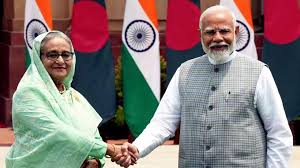
Bangladesh: Supporting Hasina against all odds
India's relationship with former Bangladesh prime minister Sheikh Hasina has at times been Bangladesh's most polarizing discussion about India. India is accused of putting her as prime minister in 2008 and supporting her in three consecutive elections, including the controversial 2024 election. Reasons given for this are drawn from dialogues presented in former Indian president Pranab Mukherjee's memoir with then Bangladesh Army Chief Moeen U Ahmed during Bangladesh's power transition before the 2008 election, in which Mukherjee claims India wanted Hasina as prime minister and helped install her to keep its interests steady in Bangladeshi politics.
Opponents of Hasina's regime further alleged that India was always willing to accept elections with little mass political support and limited democratic credibility. Also, corruption charges, authoritarianism, and alleged economic mismanagement were often ignored by successive Indian governments that provided diplomatic support to Dhaka. Critics also allege that many bilateral deals signed under Hasina's regime unduly favored India, raising questions over the national interests of Bangladesh's sovereignty.
It has been linked to old conspiracy theories like the Agartala Conspiracy Case in the 1960s, when Mujibur Rahman was charged by Pakistan for conspiring with India. Although many Bangladeshis idolize Mujib as the Father of the Nation, many skeptics point out that the conspiracy is an example of seeing nationalists vs foreigners from different points of view.
Another key area of debate is India's alleged role in the 2009 Bangladesh Rifles (BDR) mutiny and massacre. During the 2009 Bangladesh Rifles massacre, a total of 74 people were killed, including 57 Bangladesh Army officers. Accusations about Indian involvement have resurfaced due to new probes into the mutiny and massacre, and ongoing public discourse. Some conspiracy theories also point towards the involvement of foreign hands. It has been alleged that agents from India attempted to create/hijack the mutiny crisis. Even some proponents say that sabotaging the Bangladesh Armed Forces was beneficial for India's long-term goals. That said, these are only allegations. India has denied all such claims.
The SAARC Paradox
Another criticism of India is its regional cooperation. South Asia is one of the least integrated regions in the world. Despite shared history, culture, and geography, cooperation between South Asian countries has not reached the level it needs to. The South Asian Association for Regional Cooperation was established to encourage economic and political cooperation among South Asian countries, but its utility has been diminishing with each passing year.
Many regional experts believe that India, being the largest economy in South Asia and the most powerful state in the region, has a special responsibility to energize regional institutions. They argue that the politicization of issues has stalled significant progress, and SAARC is largely moribund at a time when regional cooperation is needed more than ever.
This vacuum has led countries to look to bilateral partnerships outside South Asia, reducing the chances of regional economic development and problem-solving.
The Challenge of Regional Leadership
In addition to economic and military might, true leadership also demands trustworthiness, inclusiveness, and accommodation of smaller neighbors' interests. Supporters of India say it has promoted regional development by increasing trade and investment, providing disaster relief, and humanitarian aid. Critics of Indian behavior believe such positives are outweighed by the view that India interferes in the political affairs of its neighbors and expects a privileged relationship.
India's struggle to reconcile the attractiveness of its soft power, rooted in its democracy, with hard-power aggressiveness will influence regional affairs for some time. South Asia's coming decades will be determined by how it collectively addresses climate change, economics, migration, and security, but also by whether its largest country can earn the trust of its neighbors while standing up for itself.
Conclusion
India will always play a critical role in South Asia. Its large size, economy, and geopolitical interests tie its future to the rest of the region. However, being a leader also has its obligations. India must do more if it wants to be seen not only as the world's largest democracy but also as South Asia's most responsible leader. It needs to address contentious issues with its neighbors, do more to solidify regional cooperation through institutions, and demonstrate that its democracy extends to how it conducts business with them if South Asia ever hopes to thrive.

0 Comments
LEAVE A COMMENT
Your email address will not be published