

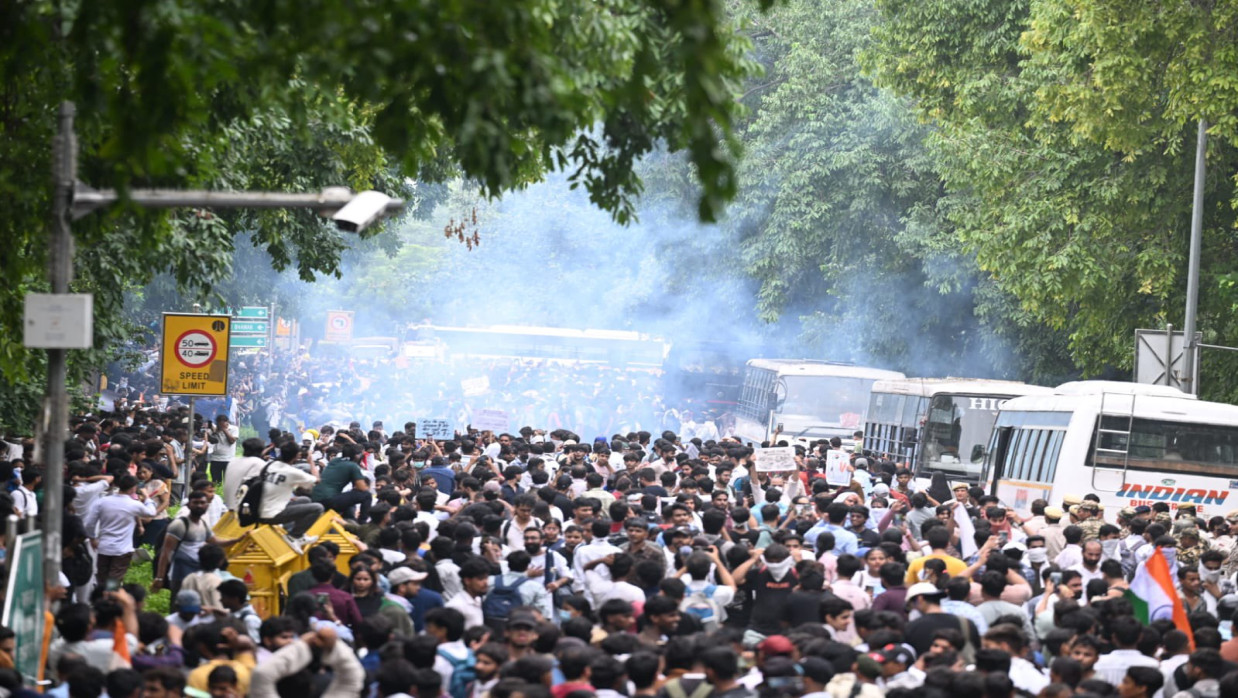
Jantar Mantar in New Delhi is no longer just an 18th-century astronomical observatory built by Maharaja Sawai Jai Singh II in 1724 to track the stars with massive stone instruments. For more than three decades it has served as India’s most recognisable public square of dissent, a place where citizens bring their grievances within earshot of Parliament.
In the summer of 2026 it once again became the epicentre of a youth-led uprising. The 2026 Delhi Jantar Mantar protests; also called the Indian Gen Z protests or Cockroach protests; began on 6 June 2026. What started as a satirical online response to official disdain has grown into a sustained demand for the resignation of Union Education Minister Dharmendra Pradhan and systemic reform of India’s high-stakes examination system.
From Observatory to Dissent Square
Until the late 1980s the preferred protest ground in Delhi was the Boat Club lawns near Rajpath (now Kartavya Path), offering a direct line of sight to Parliament and the seats of power. That changed in October 1988 when more than five lakh farmers led by Bharatiya Kisan Union leader Mahendra Singh Tikait occupied the area for nearly a week, bringing cattle, cooking fires and sustained disruption.
Authorities cited security concerns. By 1993 large demonstrations were redirected to the more contained stretch of road beside the Jantar Mantar observatory. Its location, close enough to be visible yet easier to barricade, made it the de facto designated protest site.
The site’s modern political identity was sealed in April 2011 when social activist Anna Hazare began a hunger strike demanding a strong Lokpal Bill. The India Against Corruption movement that followed turned Jantar Mantar into a national symbol and helped birth the Aam Aadmi Party. Subsequent waves of protest, after the 2012 Nirbhaya case, anti-CAA demonstrations, farmers’ agitations, the 2023 wrestlers’ sit-in against sexual harassment allegations, and countless smaller campaigns, cemented its status.
Attempts to shut it down have failed. In 2017 the National Green Tribunal ordered a ban citing noise and hygiene complaints. The Supreme Court in July 2018 ruled there could be no complete ban on peaceful protest at Jantar Mantar or Boat Club, directing authorities instead to frame regulatory guidelines that balance the fundamental right to assemble with residents’ rights. Supreme Court ruling (Indian Express). The principle remains: democratic dissent must have a physical space in the capital.
Birth of the Cockroach Movement
The 2026 protests emerged from a different spark. In May 2026, Chief Justice of India Surya Kant made remarks during a Supreme Court hearing that were widely interpreted as comparing certain youth or lawyers with fake degrees to “cockroaches.” The phrase landed like a slap on a generation already struggling with unemployment, exam stress and a sense of being dismissed.
Abhijeet Dipke, a 30-year-old political communications strategist, former Aam Aadmi Party social-media volunteer and Boston University student, responded with sharp satire. On 16 May 2026 he launched the Cockroach Janta Party (CJP) online. Its tagline and manifesto reclaimed the insult: “What if all the cockroaches come together?” Eligibility was framed as unemployed, chronically online, and ready to rant. The Instagram account exploded, gaining more than 20 million followers within days and briefly overtaking major political parties. The hashtag #MainBhiCockroach became a badge of defiance.
Dipke and the movement then turned online rage into physical presence. On 6 June 2026 CJP held its first major demonstration at Jantar Mantar, demanding Pradhan’s resignation over the NEET-UG paper leak and broader examination irregularities. It was the first significant occupation of the site since the wrestlers’ protest of 2023.
The Fuel: Paper Leaks, Broken Trust and Lost Lives
The immediate trigger was the NEET-UG 2026 examination. Held on 3 May for more than 2.2 million medical aspirants, the results were cancelled on 12 May after a leaked “guess paper” showed near-total overlap with the actual Chemistry section. Investigations pointed to an interstate network involving coaching operators and individuals linked to the National Testing Agency. A re-test was ordered for 21 June.
In the intervening weeks at least 11 to 22 NEET aspirants died by suicide, according to various media counts. Families spoke of shattered confidence after years of preparation, financial strain and the crushing uncertainty of a system that could be compromised. Parallel irregularities in CBSE on-screen marking added to the sense that competitive examinations, the primary ladder of social mobility for millions, had become unreliable.
For students and parents the demand for ministerial accountability was not abstract. It was personal. The protest charter called for transparent investigations, structural reforms to secure exams, compensation for affected families, and the resignation of the minister ultimately responsible for the education bureaucracy.
How the Hype Was Built
CJP’s rise was a textbook case of digital-native mobilisation meeting an old physical stage. Memes, reels and satirical posters turned police action and government statements into viral content. Humour became a weapon: posters comparing the government to a heartless ex, reels turning lathi-charges into “Subway Surfers” gameplay. Supporters across India ordered food via Zomato and Swiggy and sent it directly to the protest site, pizzas from Nagaland, bulk meals from distant cities, until organisers had to ask people to stop.
The arrival of Ladakhi education activist Sonam Wangchuk on 28 June amplified the moral weight. He began an indefinite hunger strike linking the examination crisis to his long-standing concerns about education and democratic accountability. After 26 days, and following talks with Union ministers, he ended the fast on 24 July, stating that the issue of examination integrity would now be discussed in Parliament.
Police actions, particularly the tear gas and lathi-charge during the attempted 20 July “Chalo Sansad” march toward Parliament, further fuelled the movement. Protesters rebuilt tents overnight under torchlight after the site was dismantled. Crowds returned larger. Solidarity from student organisations (AISA, SFI, AISF), farmers’ groups, wrestlers and ordinary citizens broadened the base beyond pure Gen Z.
Ideology and Motivation
The ideology is straightforward and non-partisan in its core claim: public institutions that gatekeep opportunity must be accountable. The satirical “cockroach” framing rejects elite contempt for the unemployed and the examination-obsessed. It insists that young people who have invested years and family savings into a single high-stakes test deserve a fair, leak-proof system and someone in power willing to take responsibility when it fails.
Motivation runs deeper than one minister’s resignation. It is the accumulated frustration of repeated paper leaks over years, the mental-health toll of chronic uncertainty, the feeling that the education system has been captured by opaque networks, and the broader anxiety that India’s demographic dividend is being squandered by unresponsive governance. Many participants describe the protest as a last democratic recourse after petitions, online outrage and official reassurances produced little structural change.
Why Jantar Mantar Still Matters?
Jantar Mantar’s power lies in its continuity. It is the physical manifestation of the constitutional right to peaceful assembly, upheld by the Supreme Court against attempts at total prohibition. The 2026 protests sit in a long line that includes Tikait’s farmers, Anna’s anti-corruption fast, Nirbhaya’s outpouring of grief and the wrestlers’ demand for justice. Each time the site has absorbed the energy of citizens who refuse to be invisible.
The current agitation has already forced dialogue, personnel changes in the education bureaucracy, and public discussion of examination integrity. Whether it secures the full resignation demand remains to be seen. What is already clear is that a generation has used the oldest tools of Indian democracy, the sit-in, the hunger strike, the reclaiming of an insult, amplified by the newest tools of social media, to insist that the system answer for its failures.
In favour of the protest stands a simple democratic proposition: when the pathways that determine life chances for millions are compromised, the right to demand accountability at the heart of the capital is not disruption. It is the system working as intended. Jantar Mantar, once built to read the heavens, continues to serve as the place where Indians insist their government look down and listen.


0 Comments
LEAVE A COMMENT
Your email address will not be published