

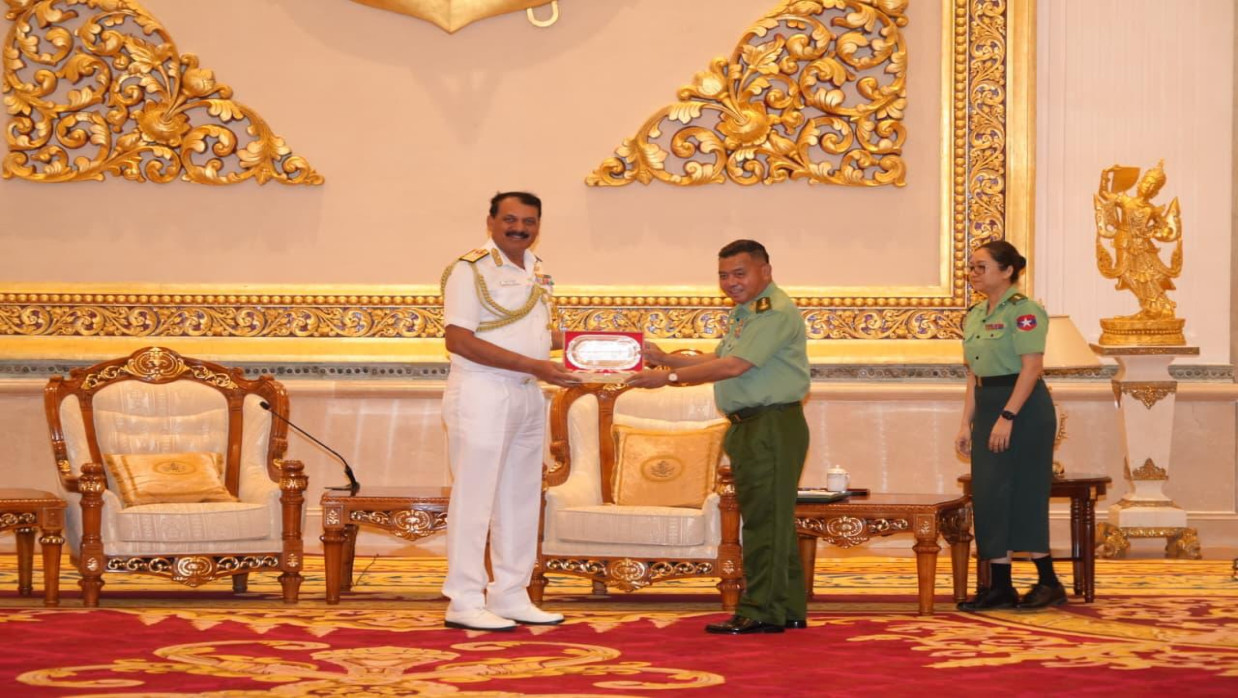
Defense ties between India and Myanmar have traditionally been dictated by geography, necessity, and regional jockeying for influence. The inauguration of Myanmar's ninth UN Peacekeeping Officer Course by India in Naypyitaw has added fuel to that raging fire. Indian efforts to engage with Myanmar's military junta amid airstrikes, village arson, and attacks against civilians will almost certainly draw scrutiny, especially when many governments in the West have placed Myanmar military leaders under diplomatic boycotts since last year's coup. India's pursuit of security, regional clout, and countering China has placed moral considerations secondary to strategic interests.
Questions have also been raised over the composition and purpose of the peacekeeping course itself. Indian Army teams are training 30 Myanmar officers from the army, navy, and air force on "Protection of Civilians during UN Peacekeeping Missions, Military-Civilian Cooperation, Ethics, and Effective Peacekeeping." But many view such efforts as hypocritical. Although Myanmar military officers are learning how to safeguard civilians overseas effectively, the Myanmar military has continued to bomb civilian targets in Chin State, burn villages in Sagaing and Mandalay regions, and launch attacks against civilians and resistance fighters throughout the country. India's decision to provide training to Myanmar officers will no doubt give the illusion that the regime has received international legitimacy.
But Myanmar policy can't be boiled down to human rights concerns. Proximity is another driver of New Delhi's policy. Myanmar is India's lone ASEAN neighbor with whom it shares a land border. The two countries are separated by a long and porous border that runs for more than 1,600 kilometers through India's strategically vulnerable northeast. Movement across this frontier is nearly unchecked and has long enabled insurgencies, illicit arms flows, drug trafficking, and refugee flows. For years, New Delhi has counted on Myanmar's generals to keep insurgent groups in Northeast India in check. Defense diplomacy between the two countries' militaries has frequently been seen in Delhi as necessary for security in India's northeast.
Indeed, Myanmar's Commander-in-Chief, General Ye Win Oo, was in New Delhi this week, meeting with Indian Navy Chief Admiral Dinesh Kumar Tripathi. The two are said to have discussed conducting joint military drills and coordinating on armed groups along the border. India worries that instability in Myanmar will exacerbate violence in its northeast. Conflict in Myanmar has already driven refugee flows into India, particularly in the state of Mizoram, which borders Myanmar's Chin State and has ethnic and cultural links to the population there. Delhi fears that without a functional Myanmar state, it could be confronted with a failed state on its eastern border.
Finally, India's motivations are linked to its competition with China. Myanmar's geographic location grants it strategic influence over South Asia and Southeast Asia and connectivity to the Indian Ocean. China has poured billions of dollars into development projects in Myanmar through the China-Myanmar Economic Corridor. Chinese projects in Myanmar range from ports, pipelines, and roads. Beijing considers the alliance with Myanmar, as part of its Belt and Road Initiative, a means of reducing Chinese dependence on the Strait of Malacca for its energy needs. Beijing's growing access to Indian Ocean ports has worried India. New Delhi's signature "Act East" policy focuses on increasing connectivity with its southeastern neighbors to counter Chinese influence. Large-scale Indian-backed projects, such as the Kaladan Multi-Modal Transit Transport Project and the India-Myanmar-Thailand Highway, aim to bolster economic ties with Myanmar and open new routes into ASEAN markets. Both have been delayed numerous times due to the worsening security crisis in Myanmar and the widening war between the junta and resistance forces.
As such, India seems reluctant to turn its back on Myanmar's military regime completely. New Delhi is concerned that if the junta is pushed too much, it could gravitate even further towards Beijing. India also lacks the economic and diplomatic clout that Western nations have to influence domestic politics in Myanmar. New Delhi's best bet, then, becomes engaging with the junta to maintain influence over whoever is in power in Naypyitaw, while continuing its relationships with some of the ethnic armies in the borderlands.
Indian foreign policy has always leaned more towards realism than idealism when dealing with other governments' internal politics. New Delhi has traditionally maintained relations with governments of all political hues when it suited their interests. India has also typically adopted a realist approach towards its neighbors, often privileging security interests over normative concerns. India now needs to ensure it can walk this tightrope.
India can no longer hide behind the Myanmar contradiction, as the largest democracy in the world and a responsible power that respects international norms of behavior. Continued defense ties with the Myanmar military regime could further discredit India's carefully cultivated international image. In fact, New Delhi has drawn criticisms from civil society groups, human rights organizations, and some members of the international community for disregarding the plight of Myanmar's people.
Balancing these concerns, Indian policymakers will argue that completely cutting off engagement will accomplish nothing and may further destabilize regional security. India needs to keep lines of communication open with Myanmar's military leadership to ensure border security, protect investments, and check China's influence. Besides, New Delhi must think that by engaging Myanmar, it at least has some chance of influencing the political outcome there. Total isolation only benefits China.
The hard truth is that Myanmar is fragmented. Ethnic armed organizations and resistance groups control or fight for significant swathes of territory in Myanmar's borderlands. The junta's writ extends only partially beyond Myanmar's center. This reality makes India's Myanmar policy particularly difficult to navigate. Delhi can't simply engage with the generals in Naypyitaw. As India deepens military ties with Myanmar, New Delhi will have to engage with non-state actors who exercise influence over territory contiguous to the India border.
India's military engagement with Myanmar is thus about more than arms deals and joint exercises. It is also a front in a wider geopolitical competition being fought out along the lines of regional security, great-power politics, economic connectivity, and uncertainty about Myanmar's trajectory. Sending Indian peacekeepers to Naypyitaw may help preserve India's foothold in the city. But it also starkly underscores the ethical and strategic quandaries India faces. For better or worse, Delhi will have to balance values and interests as violence escalates in Myanmar and great-power rivalry heats up in the region.

0 Comments
LEAVE A COMMENT
Your email address will not be published