

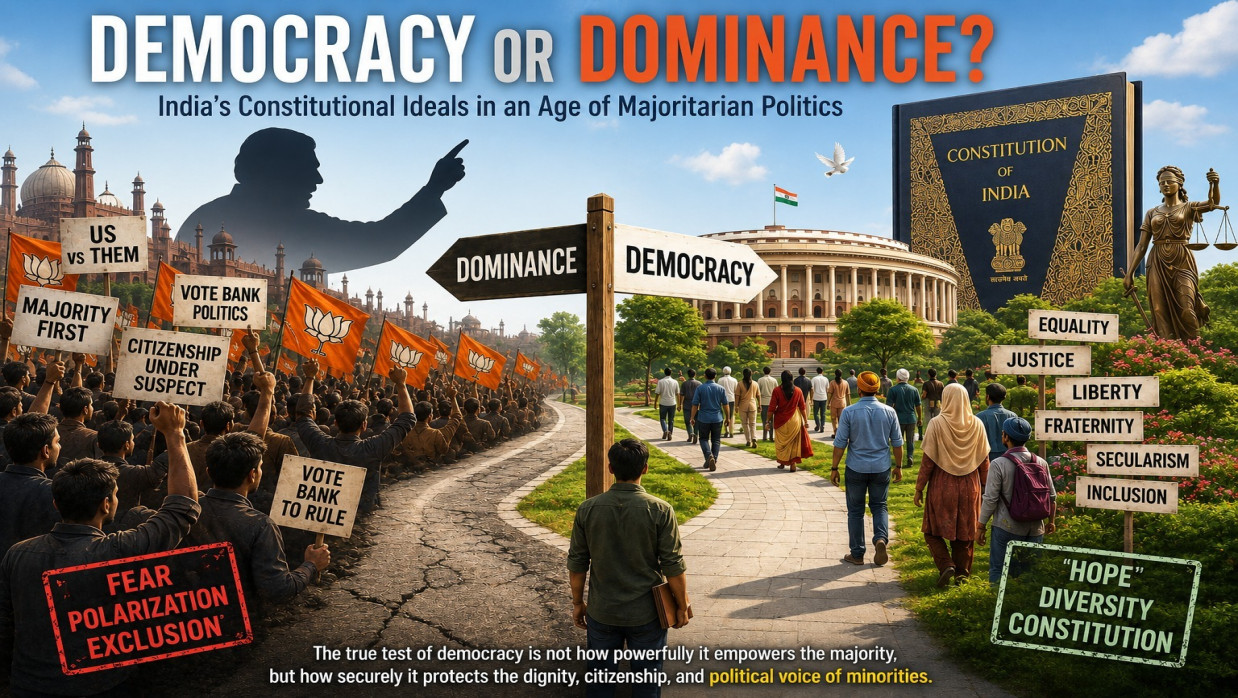
Democratic processes have been measured by election procedures, vote counting, and the peaceful transfer of power through voting. However, history has repeatedly taught us that democracy should not be based solely on the process but also on the protection of minorities, the upholding of constitutional values, and equal citizenship, regardless of one’s religious, ethnic, or linguistic affiliations. It is possible for nations to hold elections continually even as they move away from their true democratic pluralism, as long as victory in those elections takes precedence.
Today, many political analysts believe that India, the world’s largest democracy, is at a critical moment.
Recent political developments in states like West Bengal, Bihar, and Assam have deepened concerns about the future of secular democracy, minority representation, and constitutional citizenship in India. For many critics, the issue is no longer just about routine political competition. Instead, they see it as part of a larger transformation in Indian politics — a shift from constitutional democracy toward a more majoritarian political culture, where electoral calculations increasingly outweigh the inclusive ideals on which modern India was built.
The key issue at the heart of this debate is whether it will be possible to safeguard the rights of minorities through a secular constitution if discourse and conduct become increasingly non-secular.
India’s Constitution, shaped under the intellectual guidance of B. R. Ambedkar and inspired by the pluralistic visions of leaders like Jawaharlal Nehru and Mahatma Gandhi, envisioned a republic in which citizenship would rise above religious identity. The constitutional framework guaranteed equal rights, secular governance, and democratic participation for all communities, including India’s large Muslim population, many of whom have lived in the subcontinent for centuries before the emergence of modern nation-states.
However, many critics fear that present-day electoral politics in India is moving in a different direction.
In several regions, especially border states and politically sensitive areas — allegations involving voter exclusion, demographic targeting, citizenship scrutiny, and identity-based polarization have become increasingly common in political discourse. Muslims who have lived in India for generations are often portrayed not simply as political rivals, but as demographic threats, suspicious citizens, or outsiders whose loyalty is repeatedly questioned during election periods. This is one of the most critical transformations for many scholars of Indian politics in post-independent India.
Majoritarian nationalism has, without a doubt, influenced the country's political scene in its own way. The supporters of the existing political regime claim that these changes represent a valid move to protect India's identity, sovereignty, border security, anti-immigration policies, and cultural rejuvenation. Strong nationalism is required for India’s survival amid the growing uncertainties of the geopolitical environment.
Critics, however, argue that nationalism becomes dangerous when the line between citizenship and religious identity begins to blur.
Debates surrounding citizenship verification, electoral rolls, demographic politics, and identity documentation in Assam have become symbols of this broader national anxiety. Policies connected to citizenship identification and migration control may appear administrative on the surface, but their political and psychological effects reach much deeper. When large groups of people begin to fear exclusion from the democratic process or uncertainty about their place within the nation, democracy itself enters a morally fragile space.
The same is even more pronounced in areas where social balance is fragile and past records of ethnic or secessionist violence are present.
The northeast Indian states, known collectively as the “Seven Sisters,” have a history of disputes over identity, immigration, ethnicity, and regional sovereignty. It has been suggested by many observers that persistent political discourse emphasizing exclusion, demographic anxiety, and religious division may inadvertently resurrect past grievances or instigate novel ones. Experience demonstrates that political exclusion almost never results in stability but only engenders an increasing estrangement between the community and the state.
Democracy can erode not just because of the loss of rights but also through a gradual erosion of confidence in the belief that institutions are shared equally by all.
It may well be the greatest challenge India confronts at present.
It is one thing for minorities to be granted the right to vote; it is another matter altogether whether minorities continue to feel politically dignified, constitutionally secure, and psychologically safe under democratic dispensation. It happens when successive elections are fought by using religion, demographics, or nationality as weapons.
Such politics may deliver short-term electoral success, but they can carry serious long-term consequences for national unity.
History shows that many of the world’s strongest democracies struggled not because they lacked constitutions, courts, or elections, but because their political cultures became too deeply polarized. Constitutional democracy depends not only on laws and institutions, but also on democratic ethics — restraint, inclusion, tolerance, and institutional neutrality. A constitution alone cannot protect secularism if political actors and public discourse stop believing in peaceful coexistence.
This is the reason why B. R. Ambedkar once cautioned:
“Constitutional morality is not a natural sentiment. It has to be cultivated.”
These words ring true even more now. India's international reputation has always been built on its incredible diversity. It has never been renowned merely for being a predominantly Hindu country, but for being a civilized state that could encompass several religions, tongues, cultures, and ethnicities under one constitutional system.
Today, that pluralistic legacy is facing growing pressure. The danger of deeply polarized politics is that exclusionary thinking slowly becomes normalized. Once citizens are viewed mainly through religious or demographic categories, democratic discourse itself changes. Elections stop focusing on governance, economic growth, education, healthcare, or institutional reform. Instead, politics becomes centered on identity, belonging, and demographic fears. However, while such tendencies can invigorate party politics, they erode the moral base of democracy.
India needs more than prosperity or election victories to sustain its long-term stability; it also requires that all groups of people continue to feel they belong to the country. Democracy will not last long if major segments of society feel politically or constitutionally marginalized.
This is especially important for a nation as large, diverse, and strategically important as India.
The implications go far beyond domestic politics. India’s democratic path carries major regional and global significance. As one of South Asia’s leading powers and an increasingly influential global actor, India’s approach toward pluralism, minority rights, and constitutional democracy shapes international perceptions about the future of democracy in the developing world.
That is why the world is watching closely. India now stands before a defining choice between two competing visions of democracy. One sees democracy mainly as the numerical dominance of the majority through elections. The other view sees democracy as a constitutional civilization in which majority rule is balanced by minority protection, equal citizenship, institutional neutrality, and secular governance.
The difference between these two visions may shape the future character of the Indian republic itself.
History repeatedly reminds us that nations become strongest not when minorities fear the majority, but when every citizen — regardless of religion or identity — feels equally protected by the state and equally represented within the national imagination.
The true measure of democracy is not how strongly it empowers the majority, but how securely it protects the dignity, citizenship, and political voice of minorities.
India’s Constitution offered that vision. The question now is whether India’s political culture will continue to preserve it.
Democracy survives not when the majority rule without limits, but when the rights, dignity, and security of every minority are protected without fear. A nation that safeguards its minorities safeguards its own future.


0 Comments
LEAVE A COMMENT
Your email address will not be published