

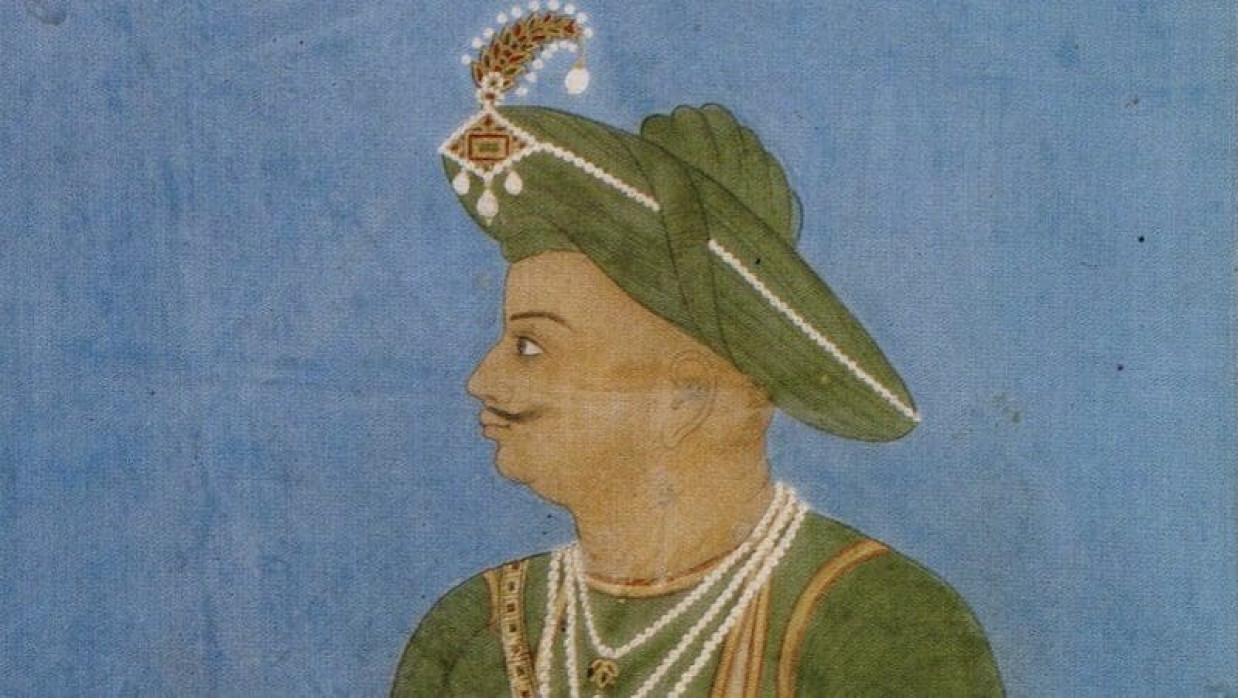
Most people understand the American Revolutionary War (1775–1783) as a conflict that took place wholly within the Atlantic world, pitting the British Crown against its thirteen North American colonies. But in fact, the War for American Independence was part of a larger imperial conflict that spanned the globe, from the Caribbean to West Africa and from the Mediterranean Sea to the Indian Ocean. Few participants in this global struggle against empire have been more overlooked or intriguing than Tipu Sultan, the "Tiger of Mysore," who waged war against British expansion into South Asia.
Hyder Ali and his son Tipu Sultan, rulers of the Kingdom of Mysore, were among the most successful opponents of British rule that the East India Company ever faced. While Mysore did not ally itself to the American colonies through a treaty as France did, the continuation of hostilities with Hyder Ali and Tipu Sultan strained British military resources in India at crucial moments. It helped tilt the imperial balance of power in favor of the American revolutionaries. The combination of Mysore's wars with those of France pulled British resources in two directions and indirectly but importantly helped ensure American independence.
It turns out that a little-known Indian empire aided America's fight for independence. But that is because the American Revolution was actually part of a global revolution against British imperialism.
British Imperial Expansion and the East India Company's Global Reach
The connection begins with the British East India Company's incredible influence. The Company was given a royal charter in December 1600. The organization started as a trading company, but gained control of its own army and navy, built its own tax networks, and exerted its own diplomatic influence. By the mid-1700s, it was essentially governing India.
The British East India Company was just as strong in the East as it was in the colonies. The Company had a monopoly on tea imported to North America, which was a massive point of contention for the colonists. Passed in 1773, the Tea Act essentially subsidized the Company, giving it an edge over colonial merchants who purchased tea from it to sell in colonial markets. The revolt against tea taxes led to the Boston Tea Party.
So here we have it: the same Company that American colonists were fighting against economically was expanding its military might all the way to India. They were a common enemy.
Mysore Under Hyder Ali: A Rising Anti-Colonial Power
Before Tipu Sultan became the "Tiger of Mysore," Hyder Ali modernized Mysore enough to take on European armies.
Hyder Ali revamped the Mysorean army along modern European lines of organization, developed modern artillery, and even allied with the Marathas and the Nizam of Hyderabad when it suited him. Above all else, Hyder Ali correctly identified the British East India Company as the biggest threat to India's future independence.
Hyder Ali managed to devastate British forces during both the First Anglo-Mysore War (1767–1769) and the Second Anglo-Mysore War (1780–1784). Hyder disrupted British supply lines and stopped the Company from taking over southern India just as Britain was busy waging war in North America.
Essentially, Hyder prevented Britain from concentrating all its military might on a single front thousands of miles from its other territories.
The American Revolution as a Global War
It didn't take long for the War of Independence to turn into something more. The conflict became international when Europe joined the fray.
France recognized the US in 1778, and Spain and the Dutch Republic followed soon after. Britain then found itself threatened in the Caribbean, Gibraltar, West Africa, and India. Spreading itself so thin weakened the British capacity to quell the revolution in the colonies.
The campaigns in India played an important role in this context. British administrators in London cautioned that defeat in India, or even just a lengthy war, would be just as harmful as a colonial loss.
Aware of this fact, American diplomats like John Adams kept a close eye on India. Every battle the British lost only gave the colonies more momentum.
Tipu Sultan: The "Tiger of Mysore"
Tipu Sultan inherited his father's warrior legacy and his anger toward the British colonialists. When Hyder Ali died in December 1782, Tipu rose to power over Mysore at a pivotal time internationally.
Tipu gained notoriety both for his military conquests and public image against the British. Tigers featured on Tipu's swords, flags, clothing, and palace walls symbolized power, independence, and revolution.
Tipu loved tigers so much that he had a machine created with a tiger killing a British soldier, which can now be seen at the Victoria and Albert Museum in London. It is a carved wooden mechanical sculpture (an automaton) showing a tiger attacking a British soldier. Inside the object is a small organ mechanism. When operated, it produced growling tiger sounds and the soldier's groans. Tipu used this tiger machine as propaganda against the British.
Tipu wanted to expand his power beyond just fighting local battles. He wanted Mysore to become an independent nation that could ally with France, the Ottoman Empire, and the United States.
The Battle of Pollilur: A Turning Point in Imperial Warfare
The Battle of Pollilur, fought on September 10, 1780, was one of the most decisive battles against British forces.
The army of the British East India Company, led by Colonel William Baillie, was routed by Hyder Ali and Tipu Sultan's Mysorean forces. Nearly 3,000 Company soldiers were killed or captured, a catastrophic loss for the British in eighteenth-century India.
Much of the carnage was enabled by Mysore's deployment of iron-cased rockets, a technology that the British would later reverse-engineer into the fearsome Congreve rockets used in wars on European soil, including the War of 1812.
The defeat sent shockwaves through the British government, showing colonial dominance in India was not inevitable by any means.
French Strategy and the Mysore Connection
France helped bridge the gap between America and Mysore. French soldiers and artillery experts helped professionalize the Mysore army. French navies harassed the British in the Atlantic and Indian oceans. French ports in Île de France (present-day Mauritius) allowed them to aid attacks on the British in Southern Asia. Tipu Sultan corresponded with French officials and attempted to ally himself with France during the French Revolution in the 1790s. Tipu sent his delegate, Salim Ali, to study French warfare and made attempts to request military support from the French Directory. While this occurred after American independence, it was part of the same objective: building alliances abroad against the British. With France's help in America and India, Britain now had to split its focus and resources. Dividing a nation's attention across multiple theaters of war was something the colonials could not do on their own.
American Awareness of Mysore's Resistance
The Americans could not send aid to Mysore due to resource constraints, but they remained informed about events there.
News of Mysorean triumphs spread through dispatches and the colonial press. Americans realized that setbacks in India hurt Britain worldwide.
John Adams notified Congress of Mysore's triumphs over the Company in 1782. Dispatches like these confirmed impressions of multicontinental British weakness.
American privateers also harassed shipping associated with the Company trade networks.
The Limits of Cooperation Between America and Mysore
For various reasons, including distance and poor communications, there was little practical cooperation between Americans and Mysore. The Americans needed French assistance and had no ships to send to the Indian Ocean. For his part, Tipu needed to focus on the immediate British threats from other Indian powers.
However, even if there was no alliance between the two foes of Britain, they were part of the same worldwide conflict against British hegemony.
The Treaty of Paris and the Withdrawal of French Support
Things took a turn for the worse with the signing of the Treaty of Paris in 1783. France signed a peace treaty with Britain and turned its attention back to Europe. Mysore lost an important ally just when she needed it the most. Tipu could not hold out much longer without continued French support against the British and their Indian allies, including the Marathas and the Nizam of Hyderabad. The worldwide anti-British alliance that briefly linked America, France, and Mysore began to collapse.
Tipu Sultan's Continued Resistance After American Independence
Tipu Sultan did not give up and continued fighting British expansion even after the American Revolution.
He fought against the British during the Third Anglo-Mysore War (1790–1792) and the Fourth Anglo-Mysore War (1799) to defend Mysore's sovereignty. He tried to develop alliances with the Ottoman Empire and Afghanistan, and maintained contact with the French revolutionary regime as well.
Tipu Sultan's struggle was one of the first major examples of modern anti-colonial resistance in South Asia.
Tipu's monetary and administrative reforms reflected his drive towards making Mysore a modern, industrialized nation-state that could stand up to the European powers.
The Fall of Srirangapatna and the Death of the Tiger
Tipu Sultan's last stand was at the Siege of Srirangapatna in May 1799. British troops breached the walls of the Mysorean capital, Srirangapatna, after months of warfare. Tipu Sultan was killed in action at the gates of the city, unwilling to give himself up. India's status as an independent regional power quickly dissolved. The British were able to increase their presence throughout southern India rapidly. British imperialism would remain the controlling power of the Indian subcontinent for almost 150 years, until 1947.
A Shared Legacy of Anti-Imperial Resistance
The connection between the American Revolution and resistance in Mysore demonstrates the global nature of eighteenth-century conflicts. Wars were rarely isolated uprisings, but rather part of a larger global struggle for commerce, control, and empire.
The Americans' revolt lasted a relatively brief period compared to the resistance in Mysore. However, they both defied British control and showed that the empire could be contested, even from thousands of miles away.
Tipu drew Britain's resources thin by taking soldiers, money, and attention away from the fight in North America. It appeared he indirectly helped America gain its independence.
Reframing the American Revolution as a Global Struggle
Revisionist historians are beginning to see the American Revolution as part of a global imperial crisis rather than just an Atlantic world event. Britain was embattled everywhere, from the naval wars in the Caribbean to disruptions in trade networks in West Africa to campaigns over territory in India. The resistance put up by Mysore was among the most formidable in these conflicts. When we view the American Revolution in its global context, we gain a better understanding of the events that took place and recognize the interconnectedness of anti-colonial struggles that preceded 19th-century nationalism.
Conclusion: The Forgotten Tiger in America's Story
We shouldn't forget that the American Revolution was part of a global conflict against British imperialism. The fight against Britain included people and places far beyond the scope of the Atlantic world.
The Kingdom of Mysore and the American colonists were not official allies, but they were enemies of a common foe: The British East India Company and the British Crown. Tipu Sultan's victories, such as the Battle of Pollilur, directly stunted British expansion at a critical time. French support further tied the conflicts together in a joint effort against British imperialism.
Tipu Sultan may have died in 1799, but his fight lives on as one of the first resistance movements to coincide with the American fight for independence. When you look at the American Revolution through a global lens, the struggle against the British becomes more than a story about America. It's a story that includes the Tiger of Mysore.


0 Comments
LEAVE A COMMENT
Your email address will not be published