

Introduction: An Election Beyond Numbers
In Bengal, we have reached the political battleground where India’s democracy fights for its life and soul.
This fight is not just about two political parties. It goes beyond deciding who will run Bengal. This election is about India and what Indians stand for. Will Indian federalism survive another assault? Will India’s secular democracy prevail, or will Hindu nationalism be able to get away with institutional theft? Can pluralism, as we have come to associate with Bengal, thrive when being physically and verbally assaulted?
Friends from Bangladesh and across South Asia. With the West Bengal BJP vs TMC fight polarizing the entire country politically, disputes over voter deletion, central forces patrolling the streets in intimidating numbers, and institutions being weaponized for political gains, this election is about Bengal’s democracy…, by extension, India’s democracy.
Do Bengalis and Indians stand for oppression? Stay tuned for June 30.
Bengal’s Historical Legacy of Pluralism
It’s true that West Bengal has historically been different from much of South Asia. Most parts of South Asia were sites of religious nationalism, but Bengal has been politically conscious through reformist and literary movements, and through centuries of syncretic cultures that transcend religious identities.
The Bengal that we grew up reading and hearing about from Rabindranath Tagore, Swami Vivekananda, Ramakrishna Paramahamsa, Raja Ram Mohan Roy, Ishwar Chandra Vidyasagar, and Subhas Chandra Bose was molded by humanism, reformist thought, and modernity. They gave us a sense of politics that worked towards dignity for all religions and sought to fight against caste discrimination.
Sufism, blending with Vaishnav devotionalism, also played an important role in creating a Bengali that stood beyond sectarian identities. Bengal has historically stood against any force that tried to undermine its ability to self-define through homogeneous thought.
Therefore, what’s at stake today is not just an election but the history of Bengal.
The Rise of Majoritarian Politics in Bengal
The BJP’s rise in West Bengal has been termed one of the biggest shifts in Bengal politics in recent years. The party has grown from being regarded as inconsequential in Bengal politics to becoming an electoral force to be reckoned with here, building its cadre base over years of groundwork at the grassroots level and through ideological mobilization aided by its parent organization, the Rashtriya Swayamsevak Sangh (RSS).
BJP is now looking past simply winning elections in Bengal. Their political campaign here can also be seen as treating Bengal as a symbolic battleground for remolding Indian nationalism into something majoritarian.
Opponents of the BJP say that the party’s ideological bearings don’t fit in with Bengal’s legacy of pluralism. BJP sympathizers have said that the party offers reprieve from the status quo that Bengal has been subjected to under different regimes for years, regimes riddled with corruption and mal-governance.
One thing that everyone can agree on is that Bengal is now one of India’s most fiercely contested political arenas.
The Controversy Over Electoral Roll Revisions
The single-issue election in 2026 will be voter list revision, popularly known as SIR (Special Intensive Revision). Roughly 6 million people were removed from the voter list as a result. The deletion was reduced to around 2.7 million after a court order, but it still looks doubtful!
One of the biggest opposition parties is crying foul, claiming that removing so many people from the voters' list would discourage people from voting with confidence.
They claim that in many booths, voter list deletion crossed the 20%! Simply shows their intention to play with democracy!
This controversy has surely changed the election slogan. Earlier it used to be "Chai, Thanda Paani aur Sarkarajiye" but now it will be “বলবো তখনই—আমার ভোটই কথা বলবে।“, : “I will speak through my vote” or “My vote itself will speak.”
Centralization Versus Federal Autonomy
The second trait that has characterized the election so far is the conspicuous presence of central agencies in the electoral battlefield. From paramilitary patrols to sleuths from central investigative agencies descending on the state in large numbers… the air is rife with speculation that what is at stake is regionalism vs. nationalism.
Even during British rule, Bengal has witnessed and bred political will against overpowering centralization. Voices for federalism have been heard during independent India, and there have been occasions when regional parties and platforms have claimed their linguistic and cultural space.
Whether India is drifting towards majoritarian centralism in political terms, or whether India’s plural constitution allows space for multiple identities, will decide the Bengal election… and democracy at large.
Mamata Banerjee and the Politics of Resistance
Mamata Banerjee has positioned herself as the guardian of Bengali identity and constitutional rights. Trying to polarize voters, she has cast the election as a choice between "insiders" and "outsiders," deflecting accusations about her governance record by raising concerns about cultural survival and democratic rights.
Banerjee's effectiveness as a populist "street fighter" has helped galvanize support on the ground. Her street marches, protests over electoral boundary changes, and door-to-door campaigning have endeared her to the masses as a protector of Bengali pride.
On the other hand, her longevity in office also provides evidence of anti-incumbency. The opposition has been able to make inroads among urban voters who are unhappy with the lack of jobs and infrastructure and with allegations of corruption.
It remains to be seen if her appeal to Bengali identity will be enough to counter these deficits.
The BJP’s Expanding Organizational Presence
It is no coincidence that the Bharatiya Janata Party (BJP) has been able to establish a significant foothold in West Bengal, nor that this expansion has taken place with remarkable speed. In districts long dominated by the Left Front or by regional parties for decades, the BJP has spent the past ten years systematically building booth-level organizational networks, deepening ideological outreach, and mobilizing grassroots support across the state.
In 2014, the party won only two Lok Sabha seats from Bengal. By 2019, it bagged eighteen seats. “If you look at five years back, there was almost no BJP organization in Bengal,” Amit Chandra, co-founder of Palladium, told Reuters. “Now we have five thousand shakhas here.” They didn’t emerge out of nowhere in the run-up to this election. The party’s gains in Bengal are a testament to years of groundwork and calculated political engineering.
BJP-aligned units have been quietly proliferating in Bengal over the past few years. It is estimated that there are now several thousand RSS units across Bengal, enabling the further spread of its ideology and the grounding of the BJP's influence.
If the BJP wins Bengal, it will complete its mission of reaching every corner of India, even regions previously considered beyond its sociocultural ambit.
Identity Politics and the “Insider Versus Outsider” Narrative
Regional vs national identity. Banerjee vs. the BJP have tried to take the narrative towards this aspect in the 2026 election. Banerjee has projected herself as the leader who wishes to preserve Bengali linguistic identity against all odds, while the BJP believes in taking India forward as one nation under threat from anti-national forces at home and abroad. Bengal has always celebrated its individual identity since India won independence, and does not take kindly to being told that it is just another state in the Indian Union, which has to abide by the diktats of the government at the center.
The Role of Women Voters and Welfare Politics
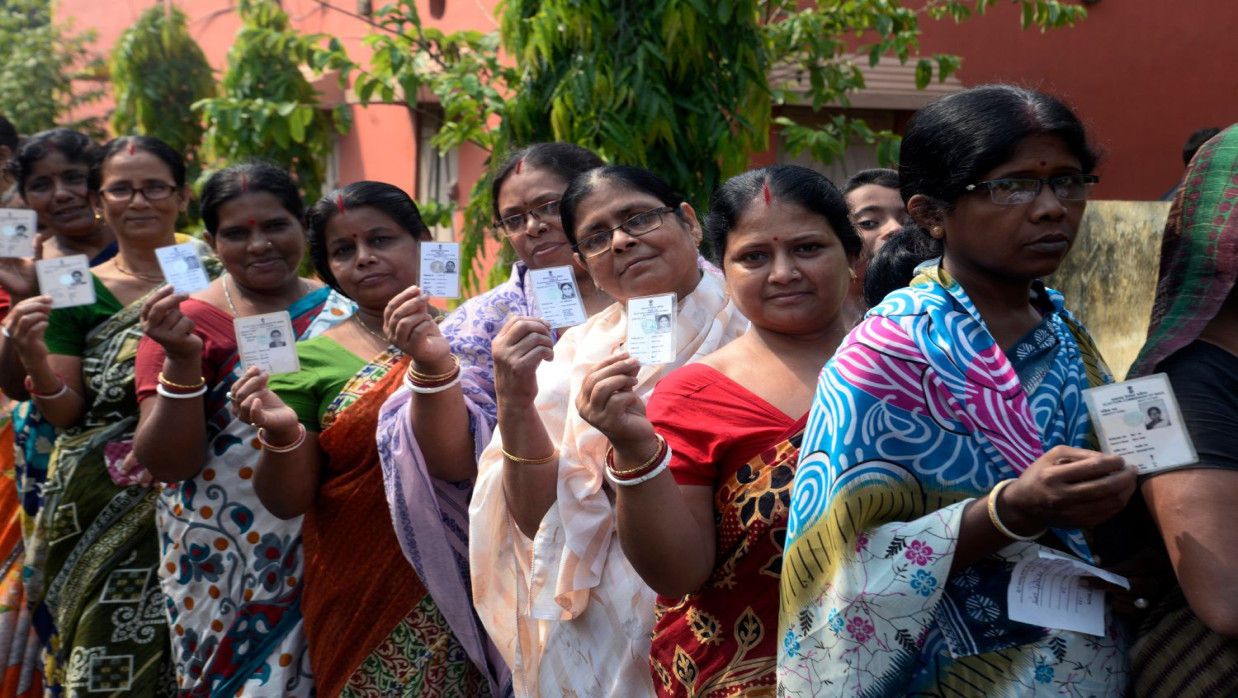
Another important factor influencing the election results is women voters. TMC has banked on welfare schemes for women beneficiaries over the years, creating a legacy of women supporters in the rural belt.
Analysts believe women voters will decide the winner in many tightly fought seats. Women voters will be deciding how they feel about not just development but also safety, respect, and political voice.
West Bengal has seen a consistent rise in women's voter turnout in the last ten years.
The Shadow of Communal Polarization
Communal polarization is a deeply fraught topic in Bengal politics. Bengal has long prided itself on avoiding mass communal mobilization. However, identity politics based on religious lines has crept into all parties' vocabulary in recent years.
Populist vote banks see fears over demographic change and border infiltration as reasons enough to let nationalist rhetoric fly high. Those in opposition fear Bengal risks letting go of secular principles it held dear for decades.
The results of this election will therefore determine not just what Bengalis get to govern them but also what they will accept being spoken in public across East India.
Electoral Uncertainty and the Limits of Exit Polls
Exit polls have given a close battle between the BJP and the TMC, with a marginal lead in vote share. Political analysts have also said that the figures fall well within the margin of error. Turned unreliable due to high voter deletion, Left-Congress cross-voting, rural volatility, etc. One thing that's predictable about this election is its unpredictability.
Implications for India’s Democratic Future
More than just the future of an Indian state hangs in the balance of the West Bengal election. With conflicts over institutional autonomy, federal freedoms, and pluralist spaces reaching a flashpoint across the country in recent times, Bengal has become the battleground for India’s democratic tomorrow. Should BJP win, they will complete their hegemonic project by becoming the representatives of a truly national political will. Should TMC win, it will empower regionalist parties to check hegemonic forces. Regardless of the victor, political roadmaps for action in India have been redrawn for years to come.
Regional Implications for South Asia
Neighboring Bangladesh will be closely watching what happens in West Bengal, too. Bengal being Bengal, there is little difference between East Bengal and West Bengal in terms of language and culture. If Bengal changes in terms of politics of identity, it will send ripples across the border. Bangladesh, too, was built on questions of pluralism, secularism, and linguistic freedom. So they will keep a close eye on what is happening here because of its implications for politics in South Asia.
Conclusion: A Defining Moment for Bengal and Beyond
The upcoming 2026 West Bengal Assembly election will be about more than just power politics. It's a battle for what Bengal - and India - stands for: pluralism or majoritarianism, democracy or dictatorship, federalism or separatism. Will India's long history of diversity and inclusive democracy survive the onslaught of centralist ideological nationalism? The future of Indian democracy-and potentially South Asia hangs in the balance.


0 Comments
LEAVE A COMMENT
Your email address will not be published