

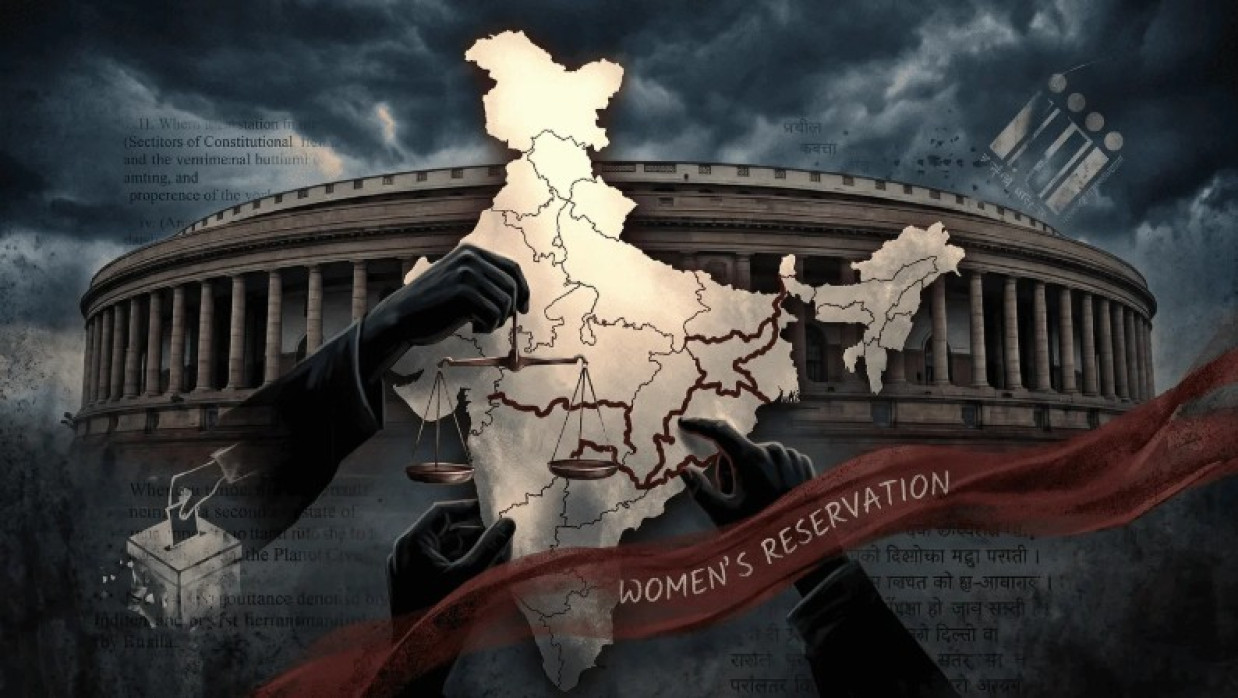
Buried inside the Constitution (131st Amendment) Bill, 2026, is a restructuring of Indian democracy so fundamental that its consequences will outlast every government that follows. The women’s reservation is real. But it is, in effect, a vehicle — a headline noble enough to carry something far more consequential through Parliament at speed, with minimal debate, in a specially convened session.
The freeze, and why it existed
To understand why this matters, you have to go back to 1976. At that time, India’s Constitution was amended to freeze the number of Lok Sabha seats allocated to each state at 1971 census levels. The freeze was deliberate and considered: the architects of that amendment understood that if seats were allocated purely on population, states that reduced their birth rates would be punished for doing so, while states with explosive population growth would be rewarded with more political power.
The freeze held for fifty years. It was supposed to be revisited after the first census following 2026. That moment has now arrived — and the government has decided to use it, not to honor the spirit of the original compromise, but to dismantle it entirely.
The sleight of hand in the bill
Here is what the bill actually does, stripped of legalese. Currently, the Constitution itself specifies which census figures are used for determining seat allocations. That specification is being deleted. In its place, Parliament — meaning whichever party holds a majority — will get to choose, by ordinary legislation, which census is used and when delimitation happens.
This sounds procedural. It is not. It means that the current government can use 2011 census data for the upcoming 2029 delimitation, giving northern states a massive seat boost. And it means that no future delimitation is automatically triggered by a census — the ruling party can simply choose not to conduct one if the demographic math stops working in their favor.
Who gains, who loses — the numbers
The data is unambiguous. Under the proposed delimitation based on 2011 census figures, the total Lok Sabha expands from 543 seats to 850. Here is what that looks like for the country’s two political halves:
The absolute numbers tell one story. The ratios tell a starker one. Currently, the northern bloc commands roughly 1.7 seats for every 1 seat held by the southern bloc. After delimitation, that ratio jumps to 2.49 to 1. In practical terms: a political party could form a majority government in India by winning a comfortable share of just five or six northern states, while being completely shut out of the South. The South becomes, mathematically, optional.
Penalizing success — and rewarding compliance
This is where the injustice cuts deepest. The South did not accidentally end up with slower population growth. It invested, deliberately and consistently, in education, healthcare, and the social conditions that naturally reduce birth rates. Tamil Nadu, Kerala, Karnataka, Telangana — these states pursued for decades exactly the development agenda that economists and demographers recommend. They succeeded. Their populations stabilized. Their economies grew.
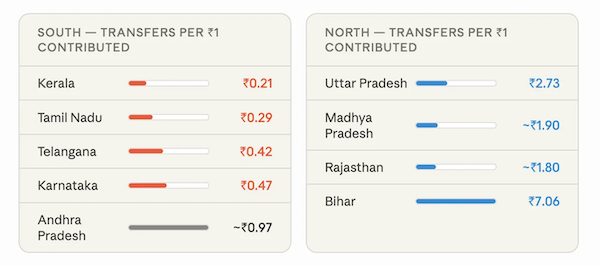
The fiscal evidence of that success is striking. Southern states are net contributors to the Indian federal system by a significant margin. For every rupee collected by the central government from these states, the return in central transfers and spending tells a damning story:
Currently, the northern bloc commands roughly 1.7 seats for every 1 seat held by the southern bloc. After delimitation, that ratio jumps to 2.49 to 1. In practical terms: a political party could form a majority government in India by winning a comfortable share of just five or six northern states, while being completely shut out of the South. The South becomes, mathematically, optional.
Andhra Pradesh stands out as the one southern state hovering near fiscal parity with the Centre — receiving roughly 97 paise per rupee contributed. This is not a coincidence. Andhra Pradesh’s current government, led by Chandrababu Naidu, is part of the NDA coalition at the Centre. The contrast with Kerala, Tamil Nadu, and Karnataka — all governed by opposition parties — is instructive. Fiscal transfers, it turns out, are not just a formula. They are also a lever.
The pattern is hard to ignore: states that align politically with New Delhi get closer to fiscal parity. States that resist get squeezed. Delimitation would make this leverage permanent — once you control the electoral map, you no longer need to negotiate.
This is the deeper problem. It is not just that the South is being penalized for good governance. It is that the system is being engineered to reward political submission over civic performance. Any state — north or south — that builds a strong economy, controls its population, and sends more to Delhi than it gets back, faces the same choice: fall in line, or lose both your money and your voice.
If you are familiar with American politics, the parallel is not subtle. Blue states — economically productive, urbanized, net contributors to federal revenue — have long complained that the Senate structurally amplifies the political weight of less populous red states. India is about to enshrine a far more extreme version of that same imbalance, not in an upper chamber, but in the lower house that determines who governs.
The constitutional architecture of the problem
Senior advocate Kapil Sibal framed it plainly: when the intent behind a bill is mischievous and the content of it is devious, the extent of damage to parliamentary democracy is enormous. The legal concern is not just about fairness — it is about the structural integrity of Indian federalism.
India’s Constitution is federal in character. The Centre’s power is not supposed to ride roughshod over state interests. But federalism only functions when no single bloc can permanently dominate the federal legislature. Once four or five high-population Hindi-speaking states can determine the outcome of any national election regardless of what the rest of the country votes, the federal compact is not under strain — it is over.
There is also a precedent worth noting. The delimitation exercise in Jammu and Kashmir, conducted ahead of the general freeze, was widely criticized as being engineered to produce favorable outcomes for the ruling party. It proceeded without significant national outcry. The 131st Amendment is, in many ways, that experiment scaled to the entire country.
This is not a Tamil Nadu problem or a Kerala problem. It is an Indian democracy problem. The logic that enables a government to structurally disadvantage one region today can be applied to any region tomorrow. The Andhra precedent shows exactly how it works in practice: comply, and get your money. Resist, and watch your transfers shrink while your seat count falls.
The message being encoded into the Constitution is one that every responsible government — at every level, of every political stripe — should find alarming: do the right things, lose influence. Fall in line, survive. That is not a federal republic. That is not a democracy in any meaningful sense of the word.
The opposition, civil society, constitutional lawyers, and citizens across party lines need to demand, at minimum, the following before this bill proceeds: open consultations with state governments; a clear commitment that delimitation will be based on the post-2026 census, not 2011 data; and a restoration of the constitutional guarantee that delimitation follows census automatically, and cannot be indefinitely deferred by parliamentary convenience.
“If this bill passes, federalism in India is not under threat. It is dead.”
That may be hyperbole. Or it may be the most accurate sentence written about Indian politics in 2026. The difference between those two possibilities is whether enough people — across the country, across parties, beyond the regions most immediately affected — decide to pay attention before the session ends.
The women’s reservation is real, and it matters. Indian women have waited long enough for a seat at the table. But the table itself is being quietly sawed in half. Reserved seats in a Parliament engineered to make half the country irrelevant is not empowerment — it is a consolation prize. India’s women, and India’s states, deserve better than that.
Data sources and notes: Seat allocation data from Constitution (131st Amendment) Bill, 2026 and Milan Vaishnav / Jamie Hintson, Carnegie Endowment for International Peace. Fiscal transfer figures: Kerala — Finance Minister K.N. Balagopal, budget speech 2024–25; Tamil Nadu — Lok Sabha parliamentary record (DMK MP, direct taxes 2014–22); Telangana — Union Finance Ministry data tabled in Parliament, Dec 2025 (₹4.32 lakh crore contributed vs ₹3.76 lakh crore received, 2020–25); Karnataka — CM Siddaramaiah, February 2024 protest; Andhra Pradesh — Telangana Today, Dec 2025, Parliament data (₹3.32 lakh crore contributed vs ₹3.23 lakh crore received, 2020–25); UP and Bihar — Drishti IAS citing 15th Finance Commission; MP and Rajasthan are estimates.
Ganpy Nataraj is an entrepreneur, author of “TEXIT – A Star Alone” (thriller) and short stories. He is a moody writer writing “stuff” — Politics, Movies, Music, Sports, Satire, Food, etc.
The article appeared in the americankahani
0 Comments
LEAVE A COMMENT
Your email address will not be published