

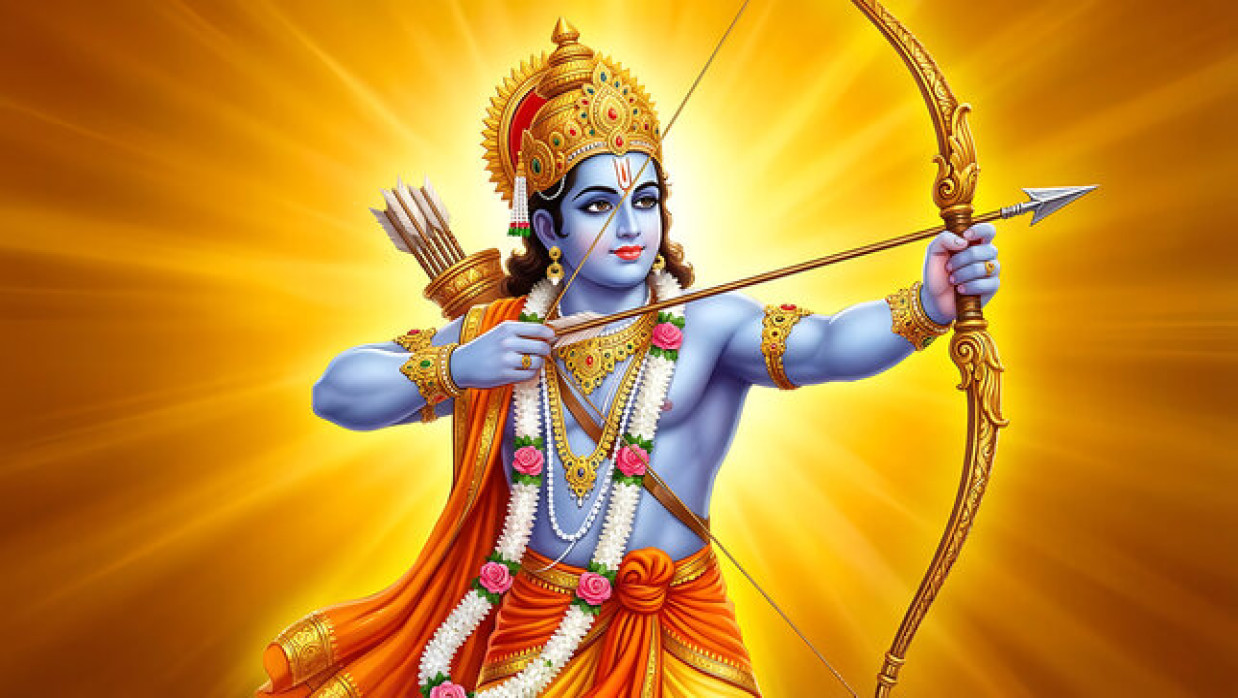
In the rich tapestry of Indian thought, faith, and storytelling, Rama stands as the most celebrated, adored, and endlessly reinterpreted figure. Yet he appears to us in two strikingly different guises. One is the exalted divine ideal fixed in the hearts of devotees, the vegetarian, flawless “Maryada Purushottam,” the perfect man of restraint. The other is the Rama we meet in Valmiki’s original Ramayana: a living, breathing human being shaped by appetite, longing, doubt, and the customs of his era. At its source, the epic never casts Rama as a god. It presents him simply as a man.
It is crucial to remember that Valmiki’s Rama is not a supernatural being but a Kshatriya prince of flesh and blood. His lifestyle in the opulent palaces of Ayodhya mirrored the royal world around him... lavish meals, fine wines, music, dance, and every pleasure of courtly life. The popular image of Rama as a lifelong ascetic who survives on fruits alone is a later invention, not the original portrait.
When divinity chooses to descend as a human, its “leela” unfolds within the customs, family, and historical moment of that birth. Krishna, though Kshatriya by blood, grew up among cowherds feasting on milk, butter, and curd; later, in the warrior city of Dwaraka, the Mahabharata shows no prohibition on meat or alcohol. Rama, born into the same Kshatriya lineage, had no reason to live by stricter rules.
The real confusion arises when we mistake the devotional practices of followers for the actual life of the deity. Devotees may embrace vegetarianism, fasting, and austerity out of love — and that devotion is beautiful. But it does not mean Rama himself followed those same disciplines. He was not bound by the later ideals his worshippers projected onto him.
Later retellings and regional versions , from the Adi Kanda through the Lanka Kanda — gradually transformed Rama into a serene, detached ascetic with matted locks and saintly calm. This polished image, however, strays far from Valmiki’s vivid narrative.
In Ayodhya, King Dasharatha himself repeatedly describes Rama’s life of comfort and delight: exquisite garments, royal chariots, and above all, a deep appreciation for fine food. Nor was Rama limited to milk and buttermilk. The royal culture of Ayodhya openly included alcoholic beverages such as varuni. When Bharata returns and mourns the city’s lost vitality, he recalls streets once fragrant with garlands, sandalwood ... and wine. That joyful spirit, he says, died when Rama left. Even in exile, Rama’s humanity remains visible. He and Lakshmana hunted deer and boar for sustenance, exactly as Valmiki describes. At Chitrakuta, when they consecrated their forest hut, deer meat was offered in the ritual and Rama personally served it to Sita. This is no ethereal saint; this is a man living naturally in his world.
References to alcohol appear as well. In the Uttara Kanda, Rama offers Sita a drink called maireya. Later, when he vows to renounce meat and wine during Sita’s absence, the very act of renunciation confirms that both had been part of his ordinary life.
Over the centuries, Rama’s image evolved dramatically. The complex, flawed, deeply human prince of Valmiki was recast as an immaculate divine symbol — the flawless embodiment of morality and devotion. This transformation was driven especially by bhakti literature, above all Tulsidas’s Ramcharitmanas. In these works, Rama became perfect, pure, and beyond reproach.
Poets like Krittibas Ojha and Tulsidas, writing in Brahmanical and Vaishnava milieus, consciously removed any trace of meat or alcohol from Rama’s story. Their Rama is morally flawless and untouched by worldly indulgence.
This shift was not merely religious; it was deeply social and historical. During the Bhakti movement, people yearned to draw God nearer by making him simpler, purer, and more accessible. In the process, the real, morally layered Rama of Valmiki was softened into an ideal. The uncomfortable episodes , particularly his treatment of Sita — were quietly set aside.
Yet Valmiki’s Rama refuses to be flattened. He is simultaneously a man of pleasure and a man of duty, a passionate husband and a stern king, tender yet constrained by the rigid codes of his society. He adores Sita, yet subjects her to the fire ordeal. These contradictions do not weaken him, they make him authentic. He is not flawless. He is human. And that very humanity draws him closest to us. Seen this way, Rama inhabits the same world of time, society, body, and emotion that we do. He knows hunger, weariness, sorrow, and error. His greatness does not lie in perfection but in his relentless effort to uphold dharma despite his limitations.
If we only worship Rama, we push him onto a distant pedestal. If we truly seek to know him, we must accept his full humanity. Only then does he feel vibrantly, undeniably alive.
In the many devotional traditions , Tulsidas, Krittibas Ojha, Kamban, the Adhyatma Ramayana, and countless regional retellings , Rama sometimes appears as a gentle family man, sometimes as the supreme object of worship. But even in Valmiki’s epic, he is rarely aggressive or wrathful. Moments of anger, jealousy, or doubt surface, yet they remain exceptions, never his defining nature. He almost never raises his bow without cause or without harm already done to him or those he loves. Even in the face of injustice, he often declares, “I have no wish to kill.”
Above all, Rama is Valmiki’s literary creation. Whether viewed as man or god, his core remains profoundly human. He crosses every barrier, welcoming Nishadraj Guha, Sugriva, Vibhishana, animals, and the outcast. He makes room for everyone in his heart. Had Muslims existed in his time, one feels he would have embraced them too. In our present age of division and communal tension, this inclusive, earthbound Rama feels more urgent and relevant than ever.
This is the Rama who truly belongs to us , the Rama of blood, breath, and human struggle, a man long before he became a god, and therefore forever nearest to our own hearts. And this is our Indian culture , where a human being, through the power of his own nature and qualities, sometimes rises to become a god… and sometimes a devil too.

0 Comments
LEAVE A COMMENT
Your email address will not be published