

Bangladesh Nationalist Party (BNP) was thrust into the governance of the country again following its landslide victory on February 12, 2026. However, there is a widespread speculation that the present BNP deviated from the nationalist ideology of its founder President Ziaur Rahman. It was no secret that the party leaders approached Indian ruling authority, at least from 2018, to enlist them as an alternative to the Awami League, which continued to slide in the public esteem. The Indians kept playing!
Earlier, the BNP was effectively ousted in a palace coup staged by then army chief General Moeen U Ahmed on January 11, 2007, the act popularly known as 1/11 betrayal. India was believed to be behind the treacherous act. Pitching the Islamist card, Delhi Chanykyas tagged along the US and a few Western entities, warning that if the BNP returned to power again, Bangladesh would turn to a bastion of fundamentalism, a phobia hyped by the US following the 9/11. A totally false flag! The South Asian nation has been a moderate Muslim country for centuries and never espoused any extremist ideologies, not even during the time of the Islamic Republic of Pakistan.
The India Factor
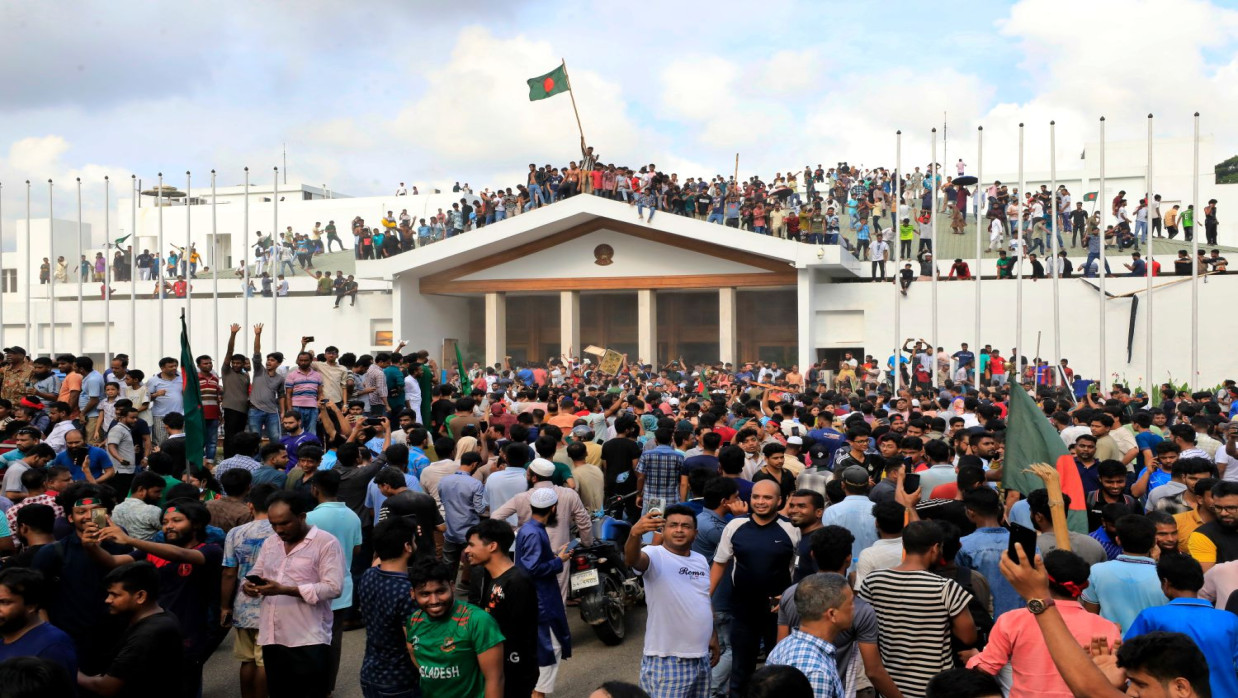
India’s interest in Bangladesh was elsewhere. Since the British left the subcontinent, the Hindu India was never at ease being sandwiched by its two (Muslim) adversaries. J N Dixit, a former Indian External Affairs Secretary, was candid when he said in his book Liberation and Beyond (1999) that separating the eastern part from Pakistan’s west was as old an Indian hidden agenda as their birth in 1947. What Dixit did not mention was that they had a hegemonic eye on its eastern neighbor for economic and geo-strategic reasons. Subsequent ground reality testifies the facts. The hawkish Pakistani civil-military leaders were equally responsible to create the situation that led to the conflict in 1971. The Awami League toed the Indian line and was happy to be a pawn in that game, from Tajuddin Ahmad to Sheikh Mujibur Rahman to Sheikh Hasina. With the fall of Mujib in 1975, New Delhi lost control over Bangladesh. But its intelligence agency, the Research and Analysis Wing (RAW), was not sitting idle. Reportedly, it maintains about 40,000 agents in Bangladesh to promote its agenda. In addition, it kept brainwashing Sheikh Hasina, the self-exiled daughter of Mujib in New Delhi. It succeeded in putting its disciple to state power in 1996. After a short break, the 1/11 put India back on the driving seat. The military controlled election in 2008 saw the Indian protege in full control. The fact that New Delhi received with open arms its fleeing protege from an angry student-people tsunami in Dhaka on August 5, 2024, also testify to their cozy and mutually beneficial relationship.
After August 5, New Delhi intensified its activities with their alternate front, the BNP, while the strategically lie-low Awami elements continued to be onboard. Dr. Pinaki Bhattacharya and other political activists never tired of themselves in warning about the vicious schemes of the Indio-Awami-BNP trio. It was believed that this unholy alliance helped the BNP in the elections on February 12. On the other hand, Professor Muhammad Yunus, the Interim Government chief since August 8, 2024, appeared to have been duped to believing that the BNP was upholding the values of the student-led uprising, popularly known as July 36. He also failed to fully control the opposing forces within and outside the system. At 85, the Nobel Laureate perhaps lost much of his past energy to tackle the intricacies and viciousness of politics.
Accomplishments of the Interim Government
Professor Yunus started off well. Embarking on a wave of local support and international goodwill, his accomplishments in the first year in office were significant by any standard. Benefiting from the recommendations of several commissions, he carried out a number of visible reforms in finance, banking, administration, healthcare, labor rights, women rights, the judiciary and electoral system, among others. Many wrongs of the past were righted. Perhaps, his team’s biggest achievements were in the improvement of law and order and political freedom from the fascist era police state. However, the most difficult task was to tackle the administration that was geared to run an authoritarian rule for nearly two decades. While a few prominent stalwarts of the fascist regime were neutralized, yet a vast number remained in place, many of whom were suspected to continue serving the interests of their former benefactors. Many criminals, including Sheikh Hasina, have been brought to justice, some receiving capital punishments, while the trials of many others are in progress. However, the future of these legal dispensations remains in question in view of a perceived differing perspective held by the (suspected RAW guided) new administration.
The Beneficiaries of the July Biplob
It goes without saying that the largest beneficiary of the July Biplob is the BNP, even though the party made no or little contribution to the movement, rather shying away from it when approached by the protesting students. Its Chairperson Begum Khaleda Zia, Acting Chairperson Tareque Rahman, Secretary General Mirza Fakhrul Islam Alamgir, top leader Salahuddin Ahmed (who was living in lavish style in Shillong, said to be under RAW hospitality), Lutfuzzaman Babar (a murder convict) and hundreds of others were made totally free from their multiple serious legal tangles of the previous era. The cases against Professor Yunus were also quashed. All or most of such cases were said to be politically motivated. Many fascist era judges and prosecutors were either retired or made to quit. The vacuum thus created was taken over by the BNP oriented jurists.
What is ironic is that the largest beneficiary of the July 36 Biplob, the BNP, is in denial of the revolution, its জুলাই সনদ (the July Declaration) and the definitive result (by 69% voters) of the Referendum on untenable or flimsy grounds. The (post-Zia/Khaleda) party continues to do so (deny) for August 15 (1975) which was responsible for upstaging Ziaur Rahman and the making of the BNP. It is like denying one’s parentage! Critics started saying: Betrayal: Thy Name is BNP!
Avail the Moment of Glory, Mr. Prime Minister
Mr. Prime Minister, the July 36 Revolution has afforded you a moment of glory. Avail it and honor it in the most befitting manner. This is a rare opportunity bestowed on you by the Almighty (SWT) to prove that you are the son of Shaheed President Ziaur Rahman and Desh Netri Begum Khaleda Zia. Don’t be swayed by the vicious and self-seeking people within and outside the party. Be guided by your own conscience. Your focus, Mr. Tareque Rahman, should be your people, your promise is to them and your country. You need to be on their side, fulfilling their long-held but suppressed aspirations. If the people are with you, no evil or vicious forces can harm you or distract you. But you must earn their trust, Sir, the way your great father did.
Remember what a great person Ziaur Rahman was! Recall the love and respect he had earned from the people. সারা বাংলার ধানের শীষে, জিয়া তুমি আছো মিশে (Zia is enmeshed in the sheaf of paddy of entire Bangladesh) echoed the hearts of millions after his tragic assassination. The never-ending streams of mourners crowded his Mazar for days, for months and for years (I was an eyewitness a year later, visiting the place at midnight). Globally, he is remembered with admiration. Begum Zia had dedicated her life to establishing democracy and people's rights. Millions had shown their love and respect in her passing. It is worth a million times to enjoy such feats, even in death! These are moments of glory, Mr. Prime Minister. I beseech you to earn it.
And first and foremost, Mr. Prime Minister, please honor the blood and sacrifice of the July 36. তাদের হৃদয়ের ক্রন্দন ১৮ কোটি প্রাণে বাজে (Their cries resonate in 180 million hearts). May Allah (SWT) be on our side!


0 Comments
LEAVE A COMMENT
Your email address will not be published