

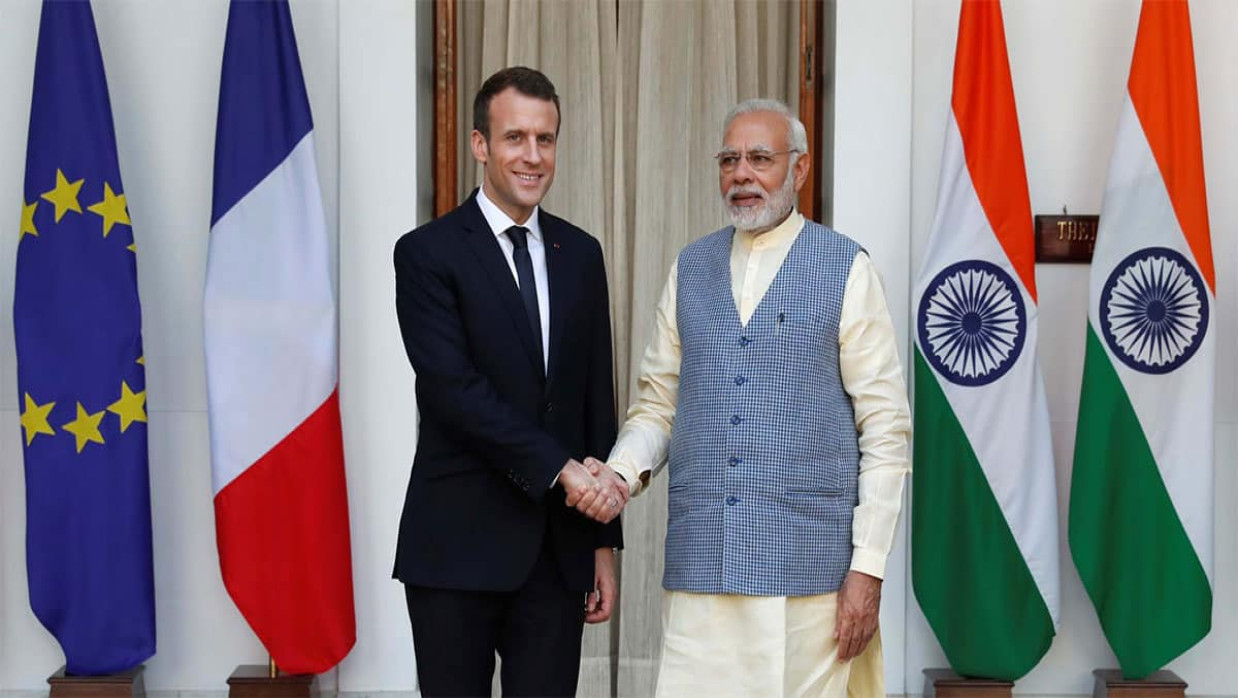
The year 2026 marked a defining milestone in India-France Relations with the elevation of their ties to a Special Global Strategic Partnership. The Long-Standing Partnership has oscillated between phases of dialogue and cooperation. A new phase of cooperation emerged in 1998 with France becoming the first strategic partner of India. With 25 years of commitment, the partnership has now evolved into a special global Strategic partnership, marked by President Emmanuel Macron’s visit to India for the AI summit .The cooperation is anchored by the development in Artificial Intelligence, strengthening of defence Capabilities, and enhancing people-to-people partnership. In an era overshadowed by conflicts and shifting alliances, nations increasingly seek dependable partners who can balance principles with pragmatism. Historically, India has maintained a Strategic bond with Russia, and France has been anchored within the NATO framework. Yet, the evolving nature of interest has compelled both countries to diversify their approach from dialogue to discipline. Europe’s growing recognition of the Global South has further underscored this shift to maintain the stability of the world order. In this context, the India-France special global Partnership will open the ways for both countries to explore more and does not capture only similarities in democratic ideals, Strategic confidence. It embodies mutual interest in technological advancement, defence cooperation, and energy conversion to sustainability. This will allow both countries to work closely together, encourage investment in defence infrastructure and power the industries of the future. This paper seeks to explore how the 2026 Special Global Strategic Partnership enhances bilateral collaboration, establishes future-oriented ventures in the defence, energy, and technological industries, and re-establishes the boundaries of contemporary partnerships in an increasingly fragmented International System.
Defence and Technological Synergy
The bilateral defence agreements signed between the two countries, ranging from fighter aircraft to submarines, are manifestations of a cooperative, not coercive, relationship. In 2024, to mark 25 years of strategic partnership, India and France unveiled the Defence Roadmap 2047. The roadmap places major emphasis on the co-design, co-development and co-production through joint research agreement between DRDO and Direction générale de l'armement (DGA). It sets out clear objectives to achieve defence and readiness and advances India’s pursuit of Strategic Autonomy under the Aatmanirbhar Bharat Framework. The roadmap 2047 envisions that by the 50th year of strategic partnership, this defence alignment will have fully reached its objectives. As the full outcome of this partnership is still in progress, it is essential to take deliberate measures to maximise its potential.
Furthermore, the agreement strengthens Bilateral Defence cooperation with procurement of 26 Rafale Jets for the Indian Army. This collaboration reflects a strong commitment, but lessons from past procurement must guide future actions to achieve effective outcomes. India views this development positively because it aligns with its goals of Defence Indigenisation, supporting its initiatives such as Make in India and strengthening its domestic capabilities through joint ventures with HAL and DRDO while maintaining Strategic autonomy . According to SIPRI data, between 2014 and 2021, India’s imports from France rose by more than 30 times, while Russian exports halved, highlighting diversification in India's arms procurement Strategy .France, on the other hand, sees India as a balancing power in the Indo-Pacific, where it has its own territories (Reunion, Mayotte, and New Caledonia). France’s motivation to collaborate with India stems from its aspiration to ensure a stable and enduring Indo-Pacific presence, especially given the unpredictability of China’s assertiveness .Through joint exercises such as Varuna and Garuda, both nations seek to demonstrate the depth of their strategic collaboration and their commitment to regional stability.
Partnership for the Sustainability
India and France have collaborated across a wide spectrum of areas, with a renewed emphasis on establishing strategic frameworks for Global Sustainability. In alignment with the Paris Agreement, India and France have emphasised their shared determination to keep global temperature rise below 2°C above pre-Industrial level, while advancing the global decarbonisation agenda through the Declaration de Chaillot. As sustainability drives the future, it must remain central to their cooperation. In this regard, the joint collaboration between NITI Aayog and the AFD Group has developed a new macroeconomic model to evaluate India’s path towards sustainable energy development . The model aims to ensure that both consumers and producers derive optimal utility and profitability while also accounting for potential global trade shocks. Going forward, both nations will continue to work in alignment, unlike the divergences often seen with the United States.
Strengthening Bilateral Innovation Ecosystem
The Year 2026 stands out as a year of innovation between India and France. In the AI Summit held in Delhi, President Macron stated that innovation should be inclusive and that “AI is not a game only the biggest can play”, a principle that reflects India’s aspirations and the objectives of this bilateral cooperation . In that context, the India-France Innovation Network was launched to connect innovators from both countries to collaborate on research, development, and testing. and evaluation of technologies in Artificial Intelligence (AI). To further enhance the outcomes, France has proposed bringing the VivaTech Fair to India. While these Initiatives provide a strong framework for fostering innovation, significant gaps remain between dialogue and implementation, particularly due to India’s current limitation in consumption capabilities, which will need to be addressed to fully realise the benefits of the partnership.
Economic Collaboration and
India and France plan to work constructively to expand their economic ties through a Special Partnership to maximise bilateral trade. In FY 2024-2025, India’s Exports to France stood at 1.82% and imports at 1.00% of total trade, with bilateral goods trades comprising about 1.12% of India’s Overall International trade. In the particular year, India imported a substantial volume of aircraft parts, accounting for 33.89% of total bilateral imports, indicating that economic cooperation is being institutionalized and integrated into the broader strategic vision between India and France . Both countries positively support tax reforms to strengthen trade ties. In that regard, India has removed France's most-favoured-nation status from the Double Taxation Avoidance Convention (DTAC). For the last 34 years, France has had this leverage to claim the benefit on the same income. This move by India shows the country's strategic calculation for the future agreement, as it decreases the scope for conflict and increases transparency in relations. Now, France's entitlements are limited to the provisions stipulated in the treaty.
Challenges and Future Outlook
While France has played a constructive role, particularly in submarine and fighter jet programs such as the Rafale, other suppliers have shown hesitation in sharing sensitive technologies. This underlines the importance of trusted defence partnerships and consistent policy reforms. Bridging the technology gap, investing in long-term R&D, and supporting SMEs in the defence supply chain will be essential for India to meet its goal of 70% indigenous defence production by 2027. The innovation ecosystem also suffers from fragmentation, and the transition from prototype to mass production remains weak. Moreover, offset policies have not fully delivered expected results, with many contracts failing to generate meaningful technology transfer [11]. Scholars agree that by combining domestic innovation with strategic partnerships, India can transition from being a major importer to a global defence manufacturing hub within the next decade, with Indo-French cooperation serving as a model for future co-development frameworks . Furthermore, institutional mechanisms, such as an Indo-French Strategic Technology Council, are proposed to manage intellectual property frameworks and ensure continuity in collaboration.
Conclusion
India considers France a reliable partner, and the bilateral partnership is progressing in a positive direction; however, there remains scope for further improvements. To optimise outcomes, both countries need to maximise their inputs that ensure their efforts translate into the highest possible returns. In the Context of India and France Cooperation, the partnership would benefit from being more action-driven rather than dialogue-driven. For India, this requires enhancing domestic capabilities to effectively absorb and operationalise technological and Strategic cooperation. Concurrently, France should demonstrate greater flexibility towards India, particularly in areas constrained by the European Union’s regulatory framework. While EU rules are stringent, certain adjustments, such as sharing source codes and enabling knowledge transfers in critical defence mechanisms, could significantly strengthen the partnership over the long term. Despite these challenges, the India-France Global Special Strategic Partnership, even at this early stage, demonstrates significant potential for deepening cooperation and engagement.

0 Comments
LEAVE A COMMENT
Your email address will not be published