

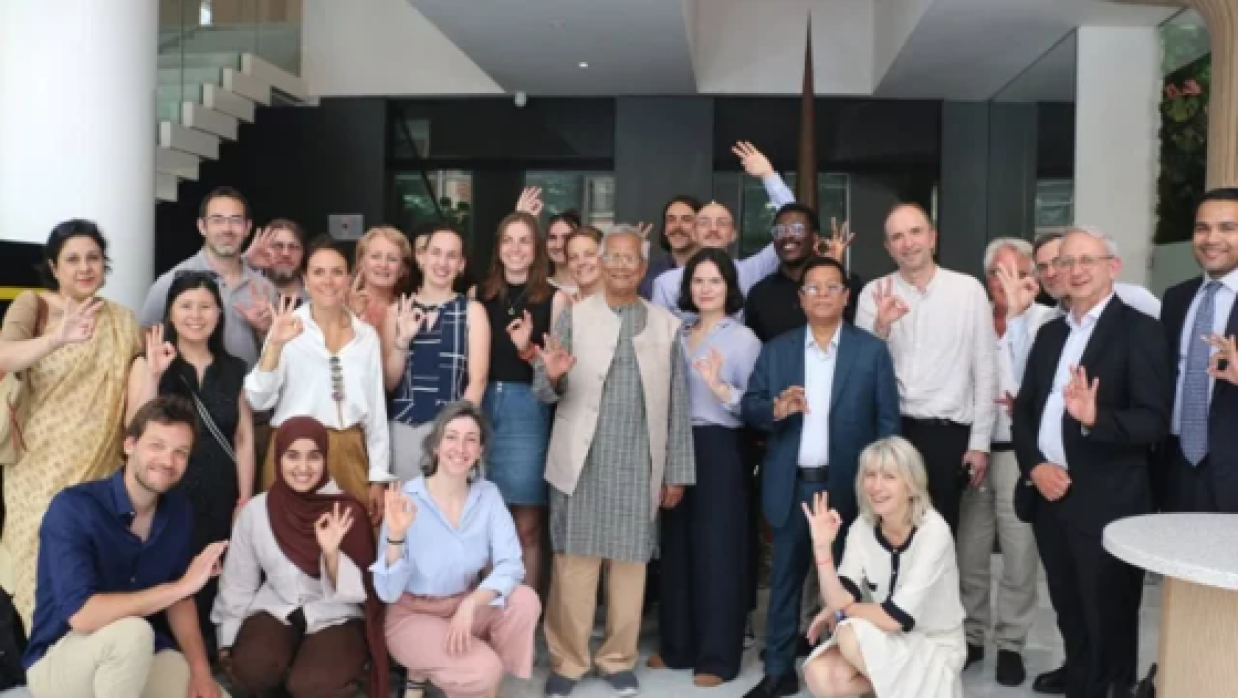
Dr. Muhammad Yunus, Nobel Peace Prize laureate and one of Bangladesh’s most internationally recognized figures, has returned home after completing a series of engagements in France and the Netherlands that once again highlighted his enduring influence on global development conversations.
Arriving in Dhaka on June 5, Dr. Yunus resumed his activities at his Mirpur office within days of returning. Yet, even before the details of his meetings became widely known, sections of social media and politically aligned commentators began circulating speculation, conjecture, and misinformation regarding the purpose and significance of his visit.
The contrast between the substance of the trip and the narratives surrounding it offers a revealing glimpse into the contemporary battle between facts and political messaging in an increasingly polarized information environment.
A Global Voice for Development and Social Innovation: For more than five decades, Dr. Yunus has occupied a unique position in international public life. As the pioneer of microfinance and the founder of the social business movement, he has become a globally respected advocate for poverty reduction, financial inclusion, entrepreneurship, and human-centered economic development.
Unlike other influential personalities whose sphere of influence is limited to their own country, Dr. Yunus works on a global platform comprising policymakers, development organizations, academic institutions, philanthropic foundations, business leaders, and members of civil society.
Dr. Yunus’s latest visits to Paris and Amsterdam were all part of this global work.
According to sources informed about the visits, the meetings focused on expanding cooperation on issues of human benefit and sustainable development, such as social business, agriculture, health, education, youth enterprise development, and community empowerment.
These meetings were neither unusual nor unexpected. They were consistent with the type of development-oriented diplomacy that Dr. Yunus has pursued throughout his career.
At a time when many countries are searching for innovative solutions to inequality, unemployment, climate vulnerability, and social exclusion, international interest in Yunus’s ideas remains strong.
The Reason Why the World is Still Interested in Yunus: The persistent interest in the ideas proposed by Dr. Yunus has much to do with reality.In both the developed and underdeveloped worlds, decision-makers face problems that traditional economic thinking has found difficult to solve. Inequality, lack of prospects for young people, environmental destruction, and distrust of authorities have led to the search for alternative development strategies.
The social business model championed by Dr. Yunus—one that combines entrepreneurial innovation with social impact—has gained renewed relevance in these discussions.
- His European meetings reportedly explored opportunities for collaboration in several key sectors:
- Social business and entrepreneurship;
- Sustainable agriculture and food security;
- Education and skills development;
- Healthcare innovation;
- Youth leadership and employment;
- Community-based economic empowerment.
These themes align closely with the United Nations Sustainable Development Goals and the growing international emphasis on inclusive and sustainable growth.
Far from being political, such engagements reflect a continuing effort to connect ideas, institutions, and resources in pursuit of social progress.
Development Diplomacy in an Interconnected World: The significance of Dr. Yunus’s international activities extends beyond the specific meetings themselves.
They represent what many scholars increasingly describe as development diplomacy the use of ideas, partnerships, knowledge-sharing, and social innovation to build international cooperation and address common challenges.
While traditional diplomacy tends to focus on governments and geopolitics, development diplomacy is centered on improving human life through cooperation among governmental agencies, non-governmental entities, scholars, and individuals in civil society.
Over the years, Dr. Yunus has cultivated one of the most extensive international networks of any Bangladeshi citizen. These relationships have connected Bangladesh to global conversations on poverty reduction, women’s empowerment, entrepreneurship, financial inclusion, and sustainable development.
Such networks generate opportunities for investment, research collaboration, innovation, and knowledge exchange. They also strengthen Bangladesh’s visibility and credibility on the international stage.
In a world increasingly shaped by soft power and global interconnectedness, these assets carry substantial strategic value.
The Politics of Misinformation: Unfortunately, high-profile international engagements increasingly unfold alongside another modern phenomenon: the rapid spread of misinformation.
Around the world, public figures frequently become targets of narratives designed to create confusion, generate controversy, or advance political agendas. Bangladesh is no exception.
In recent years, virtually every major international engagement involving Dr. Yunus has attracted waves of speculation on social media and partisan platforms. Routine meetings have often been portrayed as secret political initiatives, while development discussions have sometimes been reframed through highly politicized lenses. Such tactics are not unique to Bangladesh. Similar patterns have emerged globally, where information ecosystems are increasingly vulnerable to manipulation, selective framing, and coordinated disinformation campaigns.
Healthy democracies thrive on scrutiny, debate, and criticism. Public figures should be held accountable and their actions examined critically.
However, democratic discourse is weakened not strengthened when conjecture replaces evidence and narratives are constructed before facts are established. The factual reality of Dr. Yunus’s trip to Europe is simple enough he traveled there freely, interacted with people from outside Bangladesh, and discussed development and cooperation before returning home. The evidence available supports that account. Many of the more sensational claims circulating online do not.
Why Bangladesh’s Global Reputation Matters: The international recognition enjoyed by individuals such as Dr. Yunus represents more than personal achievement. It contributes to Bangladesh’s global image. Throughout modern history, nations have benefited from citizens whose international standing opened doors, created networks, and enhanced their country’s visibility. Scientists, diplomats, entrepreneurs, scholars, and humanitarian leaders often become informal ambassadors for their nations.
Dr. Yunus occupies such a role for Bangladesh. Whether one agrees with every aspect of his philosophy or not, his contributions to global conversations on poverty reduction, social entrepreneurship, financial inclusion, and development innovation have helped place Bangladesh prominently within international policy discussions. The respect he commands abroad reflects positively on the country itself. Attempts to diminish that influence through misinformation or politically motivated campaigns ultimately do little to advance Bangladesh’s national interests.
Looking Beyond the Noise: Bangladesh today stands at an important juncture.The country faces pressing challenges in economic modernization, youth employment, climate adaptation, educational reform, technological innovation, governance, and democratic development. Meeting these challenges will require informed debate, constructive engagement, and evidence-based decision-making. It will also require a public discourse capable of distinguishing genuine policy questions from manufactured controversies. The broader significance of Dr. Yunus’s recent European visit lies not in partisan interpretations but in its emphasis on dialogue, cooperation, innovation, and partnership-building.
These are precisely the kinds of international engagements that can generate ideas, resources, and opportunities that contribute to Bangladesh’s future development.
Facts Over Fiction: Ultimately, Dr. Muhammad Yunus’s return from Europe is a reminder that Bangladesh remains connected to important global conversations about development, entrepreneurship, social innovation, and human progress. While misinformation may temporarily dominate headlines or social media feeds, facts possess greater durability.
The facts show a Nobel laureate and internationally respected development leader engaging with global stakeholders on issues related to education, healthcare, agriculture, entrepreneurship, and youth empowerment before returning home to continue his work.
The ability to discern fact from speculation is possibly one of the most important skills in light of today’s growing world of information warfare and political polarization. It is especially crucial for Bangladesh, a democratic country that cannot afford to compromise its truth in favor of controversy.
“A lie can travel halfway around the world while the truth is still putting on its shoes.” — Mark Twain.


0 Comments
LEAVE A COMMENT
Your email address will not be published