

Editorial Introduction
India's engagement with Israel began as quiet pragmatism but has lately evolved into a louder partnership. However, the crisis in Gaza and rising hostilities in West Asia between Iran and the US have pushed India's ties with Israel back into the spotlight. Having long identified with the Global South and championed the Palestinian cause, will India now bend when pushed by necessity, convenience, or coercion? At what price to its own credibility, regional interests, and vaunted strategic autonomy?
A Historical Paradox: From Non-Alignment to Strategic Partnership
India's relationship with Israel was never straightforward. Despite its leadership in championing Palestinian rights and anti-colonialism throughout much of its independence, with strong ties with the Global South, New Delhi refused to establish diplomatic ties with the Jewish state until as late as 1992 due to fear of backlash from its Muslim population as well as its Arab allies.
Nonetheless, this official coolness didn't prevent India from clandestinely aligning with Israel during times of need. For example, Israel sent military aid to India during the 1962 Sino-Indian War. Since the fall of the Soviet Union in 1991, India has been looking elsewhere for its biggest supplier of military hardware. Israel stepped up as a friendly nation willing to sell India high-technology weaponry. Soon, low-key courting of Israel would lead to full-blown romance.
The Modi Era: From Discretion to Open Embrace
This changed under Prime Minister Narendra Modi. His overtures towards Israel were the clearest indication that India was shedding diplomatic hesitancy and moving towards alignment.
Narendra Modi first visited Israel as Prime Minister from July 4–6, 2017. It marked the first time an Indian Prime Minister had set foot on Israeli soil since the establishment of diplomatic ties in 1992.
When Modi doubled down on Israel with strong words of solidarity, global leaders took notice that India had stopped hedging its words. Realpolitik takes precedence over proclamations; India was seen as firmly in the US–Israel camp.
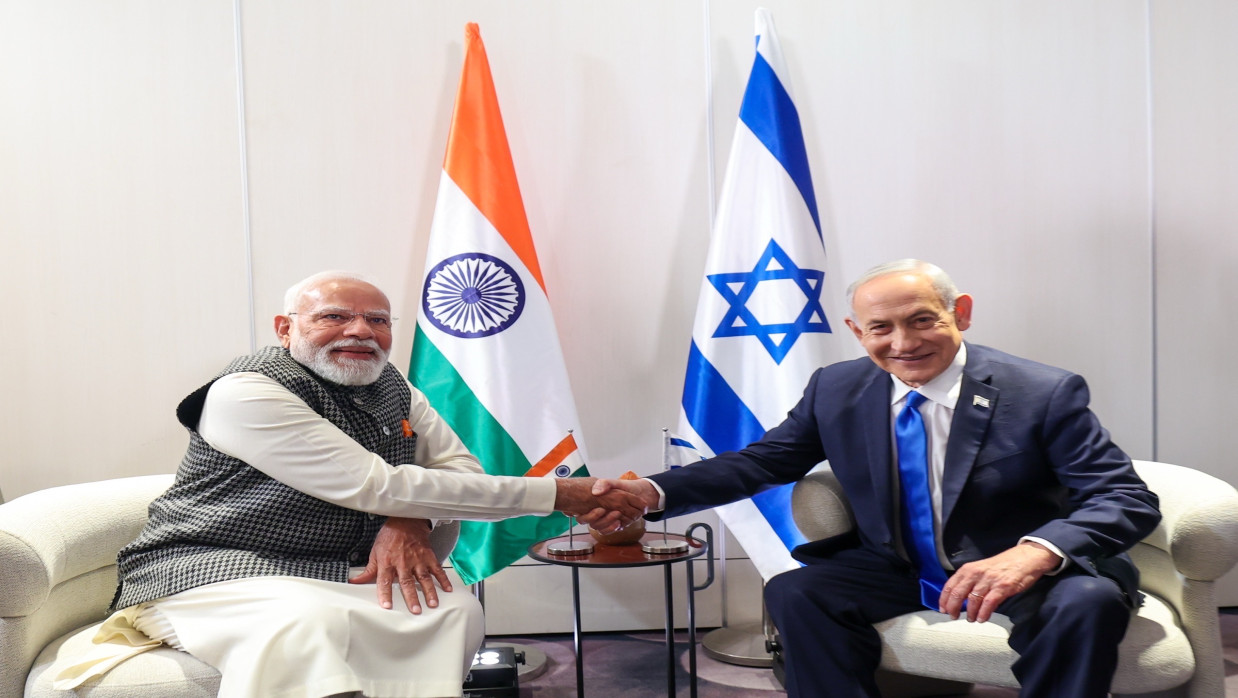
Narendra Modi's most recent visit to Israel took place from February 25 to 26, 2026. Netanyahu trended in India that day and the following day, when Modi was honored at the Knesset with a medal that Haaretz reported had never existed before.
Modi described Israel as the "Fatherland" and India as the "Motherland," before suggesting that the two countries were confronting a common enemy and a shared source of terrorism. For anyone familiar with Narendra Modi's politics, little explanation was needed to understand whom he meant. For two days, Modi was feted by Benjamin Netanyahu and even introduced to his family. Yet barely a day after the Indian prime minister returned home, Israeli forces, alongside the United States, launched strikes on Iran that reportedly killed the country's supreme leader, Ali Khamenei, along with more than 160 children at a local school.
Kashmir, and Gaza: Parallels of Occupation
Indian occupation of Kashmir saw further international backlash when Article 370 was revoked in 2019, followed by the lockdown of Kashmir. Kashmir remains militarized, with a communications blackout. People are unable to protest politically or exercise some basic human rights. India has been accused of apartheid for having democratic systems in place while suppressing the people of Kashmir. Comparisons have been made to Gaza and Palestine. Palestinians and Kashmiri Muslims are subjected to mass surveillance. Israel and India control Palestinian and Kashmiri airspace through military might. Both regions operate under the pretext of security. Human rights violations have been accused in both regions. The dehumanization of Palestinians and Kashmir Muslims has been on parallel trends. India has abandoned their support of Palestine and has been moving closer to Israel. They have collaborated on military and intelligence. Some believe the connection is deeper, reflecting each other's ideologies of ethnic majoritarianism and Hindutva.
But Iran is not Gaza. The theater of this new war could expand to consume the whole world. We are on the brink of nuclear calamity and economic collapse. The same country that bombed Hiroshima and Nagasaki could be readying itself to bomb one of the most ancient civilizations in the world. There will be other occasions to speak of this in detail, so here, let me simply say that I stand with Iran. Unequivocally. Any regimes that need changing, including the U.S., Israel, and ours, need to be changed by the people, not by some bloated, lying, cheating, greedy, resource-grabbing, bomb-dropping imperial power and its allies who are trying to bully the whole world into submission.
Strategic Alignment with the United States
India's Israel policy is also inextricably linked to its relationship with Washington. Israel happens to be America's closest friend in the Middle East and acts as a conduit for India-US engagement.
The burgeoning relationship between India and the US is finding footing across multiple areas, including a robust Indian diaspora, strong trade ties, and shared concerns about China. Bandwagoning with Israel sends signals of being a trusted partner.
But how does this impact India's age-old policy of "strategic autonomy"? New Delhi might like to believe it does foreign policy as it pleases, but its room to maneuver has certainly shrunk when it comes to pleasing Western allies during the Gaza war.
Defense Cooperation: The Backbone of the Relationship
Defense is the strongest contributor to the India–Israel relationship. Israel has contributed immensely to updating India's weaponry by providing drones, surveillance technology, and integrating precision-guided munitions into India's defense forces.
Military ties between the two nations began in the 1960s but expanded significantly after 1992. Israel has helped India upgrade much of its Soviet-era military equipment. Their military partnership has seen Israel become India's "force multiplier."
Joint development and private-sector partnerships have recently become strong contributors to ties. Indian private companies, including conglomerates such as the Tata Group, have begun manufacturing sophisticated military hardware jointly developed with Israeli companies under Prime Minister Narendra Modi's initiative, "Atmanirbhar Bharat".
India is also alleged to have received help from Israel in developing cyber tools for surveillance purposes.
Ideological Convergence: Nationalism and Identity Politics
Ideology also factors into the equation. India's ruling Bharatiya Janata Party (BJP) and its ideological mentor, Rashtriya Swayamsevak Sangh (RSS), have affinities with Zionism as an ideology. They share similar views on muscular nationalism, security-first politics, and hardline attitudes towards their perceived internal enemies. Israel represents for many in India's political elite a desirable example of nationalism that could match military might with proud nationalism.
Narratives of Israel as a victim of Islamic terrorism find resonance with similar narratives of terrorism and extremism in India and have resulted in somewhat dangerous equating of the two countries' nuanced politics with a terrorism versus security framework.
The Terrorism Narrative: Converging Security Doctrines
India and Israel also operate within similar terrorism discourses that emphasize security solutions over political solutions. In India, conflicts like the Kashmir insurgency and Naxalite-Maoist violence have been strictly viewed through a counterterrorism paradigm.
This common understanding has enabled intelligence cooperation, counterinsurgency, and surveillance measures. It has also led to India lobbying other nations to adopt its narrative, such as convincing Western governments to sympathize with India's anti-terrorism actions.
The danger with such discourses is that they depoliticize conflicts, preventing any chances for lasting peace and only further entrenching violence.
India, Iran, and the Limits of Balance
India's relationship with Iran could be its biggest window into how its foreign policy vision operates today. New Delhi-Iran relations have historically been close, built on energy requirements and strategic interests, such as access to Afghanistan and Central Asia.
But in the latest US–Israel–Iran crisis, India did everything but stick up for Iran. Taking days to dispatch diplomatic statements on unfolding developments, offering tepid responses to attacks on assets like the Iranian oil tanker, or cracking down on sanctions told Iran loud and clear we're not with you this time.
This development matters because Iran figures prominently in India's maritime and energy security, most notably at chokepoints such as the Strait of Hormuz. Any turbulence in Hormuz directly affects India's economy, causing inflation, jeopardizing energy imports, and more.
India tried walking a tightrope between two sets of friends, Israel and the US, and Iran, and in doing so revealed its lack of diplomatic flexibility.
Global South Leadership Under Strain
India has historically considered itself the champion of the Global South. It has spoken loudly about the virtues of equality, sovereignty, and non-interference. But India's conduct during the Gaza war has alienated developing countries.
In forums like BRICS, India has refused to join Brazil, Russia, China, and South Africa in strongly condemning the West's behavior towards both Russia and Israel. India may find itself increasingly isolated in organizations it hopes to lead.
India's alignment with the West has damaged its reputation among countries in Africa, the Middle East, and Asia that seek a principled voice.
Economic and Strategic Consequences
India risks losing more than diplomatic capital by pursuing this line of action. West Asia plays a major role in determining energy prices. If Iran feels cornered, it could attack the Strait of Hormuz, through which the majority of India's oil imports pass. Any disruption would have major consequences for India's economy, which already suffers from high inflation.
India's burgeoning ties with Iran will also suffer if Gulf states grow skeptical of New Delhi's intentions. Investments, job flows, and market access are also likely to be impacted.
Strategic Autonomy: Myth or Reality?
What is at stake here is India's strategic autonomy. India has always sought to assert its independence in its foreign policy choices.
India has been too constrained lately due to multiple pressures and because it has been following interests that dictate its policies. India appeared in bed with the US–Israel axis; if India wants to continue claiming strategic autonomy, it had better think long and hard about its foreign policy. Because being strategically autonomous is not enough, one must also think ahead.
Conclusion: A Partnership Under Scrutiny
India's affinity for Israel, when looked at closely, is this strange mix of realism and liberalism with a dash of fascism thrown in for good measure. Both Zionism and RSS-BJP have been attracted by European fascism. Indian Hindu nationalists find common cause with the Zionist movement and ironically also with the Zionist Swastika, symbols of religious and caste supremacy. Their character lies at the intersection of history, geopolitics, and New India's pursuit of an interest-first-at-all-costs foreign policy. It symbolizes India's shedding of millennial urges to posture as a moral arbiter and its acceptance of the hard truth that interests drive the world.
At what cost, though? By hitching its wagon so publicly to Israel's star at a time when the country's human rights violations are off the charts, India has sacrificed its credibility, coherence, and any claim to global leadership it might have ever had.
How does India climb down from here? It's simple. If India wants its foreign policy to last, it will need to balance principles and power politics, short-term objectives with long-term vision, and friends with non-alignment.
Being part of great power politics is all well and good. But if India aspires to be more than that, if it aspires to lead, it will need to find that voice of independent moral reasoning it once lost again. It will need to care about what matters. And it will need to think long-term.
There will always be an India–Israel relationship. But it shouldn't become India's interest.

0 Comments
LEAVE A COMMENT
Your email address will not be published