

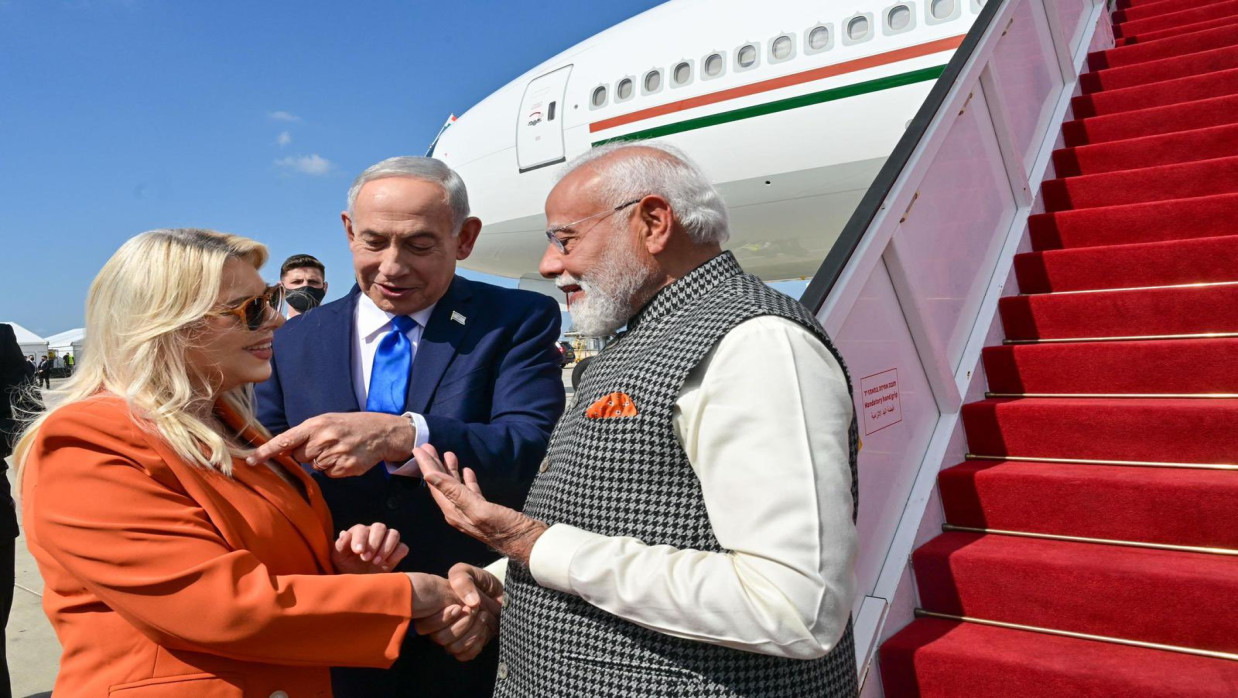
As the region’s fault lines shift decisively from an Israeli-Palestinian conflict to an Israeli-Iranian confrontation, and India’s strategic ambiguity is tested by real events, New Delhi faces not merely a recalibration but a potential collapse of one of its most carefully constructed diplomatic architectures.
When India established full diplomatic relations with Israel in January 1992, it did so quietly and with studied ambiguity. There were no fanfares, no summit declarations, no strategic partnership announcements. The move was deliberate in its modesty, designed to avoid disturbing the foundational commitment to Palestinian self-determination that had anchored Indian foreign policy since the Nehruvian era. What followed over the next three decades was one of India’s most sophisticated diplomatic constructions: the policy of de-hyphenation - the determined effort to keep relations with Israel and Palestine on separate, parallel tracks, refusing to let friendship with one automatically mean antagonism toward the other.
Today, that architecture lies under extraordinary stress, not merely tested but, in the judgment of many observers, functionally compromised. On February 25-26, 2026, Prime Minister Narendra Modi visited Israel, addressed the Knesset, and declared that “India stands with Israel, firmly, with full conviction, in this moment and beyond.” He upgraded bilateral ties to a Special Strategic Partnership and returned home with the first-ever Knesset Medal awarded to a foreign leader. Two days later, on February 28, 2026, the United States and Israel launched Operation Epic Fury, a coordinated campaign of strikes across Iranian territory that killed Supreme Leader Ali Khamenei, along with several senior commanders of the Islamic Revolutionary Guard Corps, and triggered retaliatory missile exchanges across the Gulf. The region crossed a threshold it had approached for years: from proxy conflict to open interstate war.
The question is no longer whether India can maintain equidistance between Jerusalem and Ramallah. The deeper question, made urgent by events of the past week, is whether India has already, through omission, silence, and proximity, effectively abandoned its claim to equidistance in the Israel-Iran confrontation. And if so, what remains of de-hyphenation as a framework for Indian foreign policy?
A Policy Built for One Era
To understand what is changing, one must first appreciate what de-hyphenation was designed to do, and why it worked as well as it did for as long as it did.
The Cold War constrained India’s options severely. Non-alignment demanded solidarity with the postcolonial world, and Palestine was its most visible cause. India was among the first non-Arab states to recognise the Palestine Liberation Organization and extended full diplomatic recognition to the Palestinian state declared in Algiers in 1988. Israel, aligned with the West and carrying the baggage of its early support for Apartheid South Africa, was kept at arm’s length.
Domestic politics reinforced this orientation: India’s large Muslim population, the Congress Party’s secular compact, and the arithmetic of the Arab world’s petrodollars all counselled caution.
The end of the Cold War opened space for recalibration. The Oslo Accords gave diplomatic cover: if the PLO itself was negotiating with Israel, India’s deepening engagement with Tel Aviv could no longer be read as betrayal. By the time the government of Atal Bihari Vajpayee began accelerating defence ties in the early 2000s, the architecture of de-hyphenation was taking shape: robust cooperation on security, agriculture, and technology with Israel; continued political and material support for Palestinian statehood; and an insistence that the two relationships existed in separate registers and need not contaminate each other.
The Narendra Modi government made this explicit. Modi’s 2017 visit to Israel, the first by an Indian Prime Minister, was deliberately uncoupled from a visit to the Palestinian Authority. He visited Ramallah separately the following year. The symbolism was unmistakable: India would no longer allow its relationship with Israel to be held hostage to the Palestinian question, and vice versa.
The genius of de-hyphenation was that it refused to treat West Asia as a single moral ledger on which every entry had to balance. But the Iran factor has introduced a new accounting, one that is strategic, not moral, and far harder to finesse.
Timeline
Pre-1992 - India supports the PLO and Palestinian statehood; diplomatic distance from Israel maintained through Cold War and non-alignment framework.
1992 - Full diplomatic normalisation with Israel, quietly and without fanfare; the foundational move toward de-hyphenation.
1999 - Israel provides emergency supplies of precision-guided munitions and UAVs during the Kargil War, building deep mutual trust despite India being under Western sanctions.
2000s - Defence and technology cooperation with Israel deepens steadily; Israel becomes one of India’s largest arms suppliers.
2017-18 - Modi visits Israel without visiting Ramallah - a first, then makes a standalone visit to Palestine the following year. De-hyphenation made explicit.
October 2023 - The Hamas attack on Israel and the subsequent Gaza campaign accelerate the consolidation of the Iran-Israel confrontation and erode India’s room for ambiguity.
September 2025 - India votes with 142 nations at the UN General Assembly in favour of a resolution endorsing a two-state settlement of the Palestine question, reaffirming formal commitments.
February 25-26, 2026 - Modi visits Israel, addresses the Knesset, declares India’s solidarity “firmly, with full conviction,” and upgrades ties to Special Strategic Partnership. No visit to Palestinian leadership is made.
February 28, 2026 - The United States and Israel launch Operation Epic Fury. Strikes kill Supreme Leader Khamenei and trigger retaliatory Iranian missile attacks across the Gulf. India offers “deep concern” and calls for dialogue; it does not condemn the strikes.
March 4, 2026 - An Iranian naval frigate, IRIS Dena, returning from participating in India’s International Fleet Review at Visakhapatnam, is sunk by a US Navy submarine in international waters south of Sri Lanka. The crew had attended India’s exercise as guests. India’s response is silence. Former Indian military officers and diplomats describe the episode as a “strategic embarrassment” and “a blow to India’s regional credibility.”
March 5, 2026 – India’s Foreign Secretary Vikram Misri offered condolences on the death of Iranian Supreme Leader Ayatollah Ali Khamenei, signed the condolence book at the Iranian embassy in New Delhi.
The Iran Factor: A New Variable, Now Acute
What the architects of de-hyphenation did not, and perhaps could not, fully anticipate was the emergence of Iran as a third pole in India’s West Asia calculus, one whose gravitational pull is strong enough to distort the neat geometry of the Israel-Palestine dyad.
India’s interests in Iran are substantial, layered, and in some respects irreplaceable. Iran has been a critical energy supplier and a strategic partner for continental connectivity. The Chabahar Port project, in which India has invested considerable diplomatic and financial capital, offers the only viable overland route to Afghanistan and Central Asia that bypasses Pakistan. The centuries-old commercial and civilisational ties between the Indian subcontinent and Iran give New Delhi compelling reasons to preserve its relationship with Tehran, reasons that extend well beyond transactional convenience.
Those reasons are now colliding with the consequences of India’s political choices.
Iran’s closure of the Strait of Hormuz following the outbreak of hostilities has disrupted the passage of nearly roughly 20-21 million barrels of oil per day, roughly a fifth of the world’s daily supply. India, which imports more than eighty percent of its crude oil and obtains close to half of that supply from the broader Gulf region, is acutely exposed. Global oil prices have surged by approximately twelve percent since the strikes began, with Brent crude trading above eighty dollars per barrel and natural gas prices rising by more than forty percent. Goldman Sachs estimates an eighteen-dollar-per-barrel risk premium in current market pricing, equivalent to the expected impact of a month-long full closure of Hormuz. India has been warned it may face natural gas shortfalls that could compromise electricity generation as summer approaches. The government officials, however, have tried to downplay the concerns.
The Indian diaspora adds another dimension of vulnerability. Approximately ten million Indian nationals live and work across Gulf countries, and their remittances, amounting to over fifty billion dollars annually, or nearly thirty-eight percent of India’s total remittance inflows, are at risk if the conflict disrupts the labour markets of the Gulf economies. S&P analysts have warned that if the conflict persists beyond six weeks, the impact on the Indian economy will be material.
The Chabahar project, meanwhile, faces an uncertain future. Iran had already described the absence of fresh allocations in India’s 2026 budget as “a disappointment for both New Delhi and Tehran.” Indian officials insist the 2024 ten-year contract remains operative, but operational continuity is hard to guarantee in conditions of active war and deepening Iranian hostility toward India’s perceived alignment.
The Silence That Speaks
The specific texture of India’s diplomatic response to Operation Epic Fury has itself become analytically significant, not for what has been said, but for what has been withheld.
India’s Ministry of External Affairs issued a statement expressing “deep concern” and calling on “all sides” to pursue dialogue and restraint, while also calling for respect for the sovereignty and territorial integrity of all states. The statement did not acknowledge the manner in which the United States abruptly terminated two months of nuclear negotiations with Iran, reportedly breaking off talks when an agreement was, according to Oman’s foreign minister, nearly complete. India, unlike Russia or China, did not characterise the strikes as a violation of international law. Even as the strikes killed more than a thousand Iranian civilians in their first six days, the MEA remained notably silent. It eventually issued condolences over the death of Iranian Supreme Leader Ayatollah Ali Khamenei, but the delay did not go unnoticed. For New Delhi, however, the hesitation may have reflected a “calculated diplomatic move”.
Prime Minister Narendra Modi spoke by phone with the leadership of the United Arab Emirates after Iranian retaliatory strikes hit Emirati territory, strongly condemning the attacks and expressing solidarity with Abu Dhabi. The asymmetry in New Delhi’s public messaging is notable: there was little acknowledgement of Iranian casualties, while the strikes affecting a close partner of both Israel and the United States drew an immediate and explicit response. The asymmetry gets further accentuated as PM Modi spoke with the leaders of the several other Gulf countries - Saudi Arabia, Jordan, Bahrain, Oman, Kuwait and Qatar - raising similar concerns.
Several explanations help illuminate this posture. One possibility is that India’s earlier sympathetic tone toward Tehran’s position may have been interpreted, rightly or wrongly, as politically accommodating. Such perceptions could risk emboldening Iran’s retaliatory posture toward U.S.-aligned Gulf states. As the regional escalation widened, New Delhi may have felt compelled to recalibrate its messaging, particularly once the security of a key Gulf partner was directly affected.
Equally important are India’s substantial interests in the Gulf. Millions of Indian nationals live and work across the region, including in the United Arab Emirates, and instability there carries direct economic and humanitarian implications for India. In that sense, the strong condemnation of attacks on Emirati territory can also be read as a signal of reassurance to Gulf partners and a reflection of New Delhi’s concern about the safety of its diaspora and the broader risks that a deepening regional conflagration could pose to Indian interests.
At the same time, New Delhi being perceived as an enabler of Iran’s geopolitical ambitions would sit uneasily with its broader foreign-policy posture. India has long attempted to balance its relationships across West Asia, maintaining engagement with Iran while deepening strategic partnerships with the Gulf monarchies, Israel, and the United States. Any suggestion that India was tacitly accommodating Iran’s retaliatory strategy would risk undermining this carefully cultivated equilibrium and complicating ties with key Gulf partners. In that context, the swift condemnation of strikes on Emirati territory can also be interpreted as an effort by New Delhi to dispel any perception that it is aligned with, or sympathetic to, Iran’s regional power projection.
Amid criticism from sections of the Opposition over India’s perceived “silence” on Iran’s losses in the ongoing conflict involving the United States and Israel, some voices within the Opposition adopted a more measured stance. Shashi Tharoor, a Member of Parliament from Kerala (an Indian state sending significant workers to the Gulf countries) and a senior leader of the Indian National Congress, acknowledged the complexity of the situation and the constraints faced by any government in conducting foreign policy. While many critics interpreted the government’s cautious response as a betrayal, Tharoor noted that it is easier for those outside government to demand stronger statements, whereas those in power must deal with the diplomatic and strategic consequences. As he remarked, “I find it difficult to sit here outside the government and say I want the government to say all these things because the government then has to live with the consequences.”
Modi’s Knesset address, delivered two days before the war began, acquired, in retrospect, an uncomfortable ambiguity. The Indian opposition Congress party has publicly raised the question of whether Modi was briefed about the coming strikes during his meetings with Netanyahu, and described the visit’s timing as giving the appearance of “tacit approval.” Israel’s ambassador to India told The Indian Express that the operational opportunity for the strikes came “only after Prime Minister Modi left”, a clarification that may have been intended to reassure New Delhi but has had a limited effect on the political optics.
A former Indian diplomat told The Diplomat magazine that Modi may well have had foreknowledge of the strikes. The Modi government has not responded to that allegation.
These are not peripheral details. They are evidence of the degree to which the space for de-hyphenation, never infinite, has now dramatically contracted.
The IRIS Dena Episode and What It Reveals
If a single incident captures the transformed strategic environment, it may be the sinking of IRIS Dena. The Iranian frigate had travelled to India for the International Fleet Review 2026 held at Visakhapatnam, an exercise hosted by India as a gesture of multilateral naval engagement, and was returning home through the Indian Ocean when it was torpedoed by a US Navy submarine on March 4. The ship was unarmed. Its crew had been India’s guests days earlier.
India’s response was to say nothing of substance.
Former Indian military officers and diplomats, speaking on record, have called this a “strategic embarrassment”, “a blow to India’s maritime diplomacy”, and “a blow to New Delhi’s regional credibility.” The episode laid bare the extent to which India’s vaunted strategic autonomy may, in practice, be bounded by an unwillingness to confront Washington, even when American military action directly implicates Indian diplomatic relationships and costs Indian credibility with a country it has, for decades, called a close partner.
The contrast with India’s 1994 experience is instructive. When Pakistan sought to have India hauled up at the UN Commission on Human Rights over Kashmir, it was Iran that intervened to block the resolution, a decisive act of solidarity that New Delhi has never forgotten, and that senior Iranian officials have pointedly recalled in recent days. India’s silence now, in the face of Iran’s devastation, registers in Tehran as a historical betrayal.
The Strategic Triangle Under Strain
India-Israel: Defence imports, technology cooperation, counter-terrorism intelligence sharing, agricultural technology, space and cybersecurity collaboration, deepened now by the formal elevation to Special Strategic Partnership. India is Israel’s largest weapons buyer; Israel is India’s third-largest arms supplier, a relationship cemented decisively during the Kargil War when Israel delivered emergency precision munitions under conditions of Western sanctions. Ideologically, the governing BJP’s comfort with Israel’s national-security discourse, and the domestic political space created by India’s Hindu nationalist turn, have further dissolved the old inhibitions.
India-Iran: Energy imports, the Chabahar port project, access to Afghanistan and Central Asia, and historical civilisational ties. These interests are substantial but are now under severe operational strain, from the war itself, from Iran’s soft closure of the Strait of Hormuz, from the diplomatic fallout of India’s silence, and from the unsettled question of what political authority will govern Iran if the conflict precipitates regime change.
India-Palestine: Long-standing formal support for statehood, humanitarian assistance, development cooperation, and diplomatic solidarity in multilateral forums. India voted in September 2025 for the UN resolution on Palestinian statehood. Its External Affairs Minister has reiterated the two-state commitment. But the Israel-Iran war has effectively displaced the Palestine question from the centre of regional politics, and India’s advocacy for Palestinian statehood, however sincere, now operates in a strategic context where its principal interlocutor on security matters, Israel, is actively reshaping the regional order.
De-Hyphenation’s Collapse: Two Theses Revisited
Two competing hypotheses about India’s trajectory were available before the events of late February 2026. They must now be re-examined against the evidence.
The shift thesis held that the Iran-Israel rivalry had become the structurally dominant conflict in West Asia, and that India was gradually being drawn into a looser alignment with Israel, the United States, and the Gulf Arab states, through I2U2, through the India-Middle East-Europe Corridor (IMEC), and through the deepening of the India-Israel defence relationship. On this reading, de-hyphenation was already evolving into something asymmetric, with the Iran track being progressively subordinated.
The continuity thesis argued that India had simply added a third track to its de-hyphenated diplomacy, maintaining functional relationships with Israel, Iran, and Palestine simultaneously while insulating them from one another. India’s continued investment in Chabahar and its historical refusal to join Western sanctions regimes against Tehran were cited as evidence that it had not chosen sides.
The events of the past week have substantially resolved this debate, in favour of the shift thesis, though not in a planned or deliberate way. India has not explicitly chosen the Israel-US axis. But it has, through a series of decisions that include Modi’s Knesset visit, the absence of condemnation for Operation Epic Fury, the asymmetric phone call to UAE leadership, and the silence over IRIS Dena, effectively communicated a preference that Tehran, Beijing, and much of the Global South have noticed and interpreted.
The continuity thesis is not dead. India continues to profess support for Palestinian statehood. It has not joined sanctions against Iran. It insists on Chabahar’s viability. But the operational gap between profession and practice has widened to the point where India’s claim to equidistance is increasingly difficult to sustain as a serious diplomatic proposition.
Whether this is strategic drift, calculated alignment, or a reflection of the BJP government’s ideological comfort with the Israeli model, the effect is the same: India is no longer the neutral interlocutor it once aspired to be.
What the Future Demands
The escalation of 2026 has already demonstrated how rapidly the Iran-Israel confrontation can reorder the strategic environment of West Asia. A prolonged war, particularly one that destabilises the political structure of Iran, draws NATO allies deeper into the conflict, or produces sustained disruption to the Strait of Hormuz, would threaten energy flows critical to India’s economy, imperil the safety and livelihoods of ten million Indian nationals in the Gulf, undermine the Chabahar connectivity vision, and force India to manage, simultaneously, a macroeconomic shock and a diplomatic reckoning.
For New Delhi, the immediate challenge is to limit the damage from a posture that has already been read, rightly or wrongly, as partial. Three imperatives present themselves.
First, India must urgently re-establish functional channels with whatever political authority emerges in Tehran. If the conflict produces a transition in Iranian governance, whether through regime change, negotiated settlement, or the consolidation of a successor leadership, India cannot afford to begin that relationship from a position of perceived hostility. Chabahar, and, with it, India’s entire continental connectivity strategy toward Central Asia, depends on a working relationship with the Iranian state in whatever form it takes. The time to lay the groundwork for that engagement is now, not after a new dispensation has consolidated its grievances.
Second, India should use its position as the current chair of BRICS, which has notably declined to issue a collective statement on Operation Epic Fury, to pursue multilateral diplomatic engagement. Individual BRICS members, including South Africa, have condemned the strikes. India’s reticence within the grouping reflects its accommodation of American preferences but costs it credibility with the Global South partners whose support it will need in other forums. A more active Indian diplomatic voice, oriented toward de-escalation rather than alignment, would recover some of that credibility without requiring India to condemn its defence partners.
Third, India must honestly reckon with the limits of strategic autonomy as a doctrine. That doctrine was always premised on a multipolar world in which multiple great powers competed for Indian alignment and could, therefore, be played off against one another. The Iran-Israel war has accelerated a polarisation in which the space for non-alignment is contracting. If Washington is willing to impose trade tariffs on India for buying Russian oil while conducting a war that directly disrupts India’s energy security, the structural conditions for classical strategic autonomy are less favourable than India’s foreign policy establishment has assumed.
This does not mean India must abandon the pursuit of independence in its external relations. It means India must build that independence on harder foundations: genuine diversification of energy supply, accelerated development of domestic defence manufacturing to reduce arms import dependence, and a foreign policy discourse that is honest about the trade-offs involved in each strategic choice, rather than relying on the comfortable fiction that all relationships can be maintained in separate, insulated compartments.
The Deeper Reckoning
De-hyphenation was never merely a diplomatic tactic. It was a framework for understanding the region itself, premised on the assumption that the principal contradiction shaping West Asian politics was the unresolved conflict between Israel and Palestine, and that India could hold a space between them by treating each relationship as categorically distinct.
That assumption was already under strain before February 2026. The events of the past week have decisively overtaken it. The region’s strategic architecture is now defined by a broader contest over regional order, one that pits Iran and its network of partners against a loose alignment of Israel, the United States, and several Arab states. Within that contest, there are no truly neutral positions. There are only more and less acknowledged ones.
For India, this shift does not invalidate the moral and political commitments that historically underpinned its support for Palestinian statehood. The aspirations of the Palestinian people retain their independent significance, and India’s advocacy of a two-state solution continues to reflect a genuine commitment to international law and self-determination.
But strategically, the centre of gravity has moved. The conflict that now most directly implicates India’s core interests - energy security, maritime stability, regional connectivity, the safety of its diaspora, and the credibility of its claim to a distinctive voice in global affairs - is the confrontation between Israel and Iran. And India has, whether by design or by drift, already moved closer to one side of that confrontation than its stated doctrine would suggest.
The challenge ahead is not simply to preserve de-hyphenation, but to acknowledge honestly that it has already, in significant measure, been de-hyphenated by events. India’s task now is to construct a new framework, one capable of engaging all major actors in a multi-polar regional order while recovering the credibility, with Iran, the Arab world, and the Global South, that the events of late February and early March 2026 have placed at risk.
Whether New Delhi can successfully make that transition will determine not only the future of its West Asia diplomacy but also the resilience of its larger foreign-policy project: the pursuit of strategic autonomy in an increasingly polarised world. That project now requires not just tactical adjustments but an honest assessment of where Indian power and Indian interests actually lie, and what it will cost to defend them.


0 Comments
LEAVE A COMMENT
Your email address will not be published