

The rise of “tradwife” content in India is unfolding at a moment when the realities of women’s lives tell a far more disturbing story, from dowry related murders to domestic violence. Across Instagram and YouTube, young married women often in their late teens and early twenties, present pastel-tinted domesticity as aspiration: early marriage, unpaid domestic labour, and ritualised femininity wrapped into bite-sized reels and soft-focus vlogs. What appears to be harmless “day-in-my-life” content is emerging at a time when women’s safety both at home and online is deteriorating, making its cultural impact far from benign.
The Tradwife content in general portrays a female performing household duties and enforcing the gender binary. Researchers have found that the Tradwife content particularly aligns with right and far-right values and often shows women taking archetypal wives and mother roles. In India, research has found a steep rise in misogynist memes, deepfake pornographies and rape-threats to women in the digital sphere. Amidst the spewing of poisonous anti-feminist hatred by men, this new community of female content creators have vernacularised the right-wing Tradwife phenomenon to cater the Indian audience.
Their content constantly targets feminist notions like economic independence, right to work, and autonomy, as well as dogmatically follows patriarchal traditions. There is a blatant ignorance towards crimes against women within the institution of marriage in the videos that appease to Hindu upper-class, upper-caste sensibilities, that core voter group of Hindutva right-wing parties.
This article will answer three questions: (i) what kind of content are they creating? (ii) what discourse is it producing? And (iii) how this discourse impacts the Indian socio-political landscape?
What kind of content are they creating?
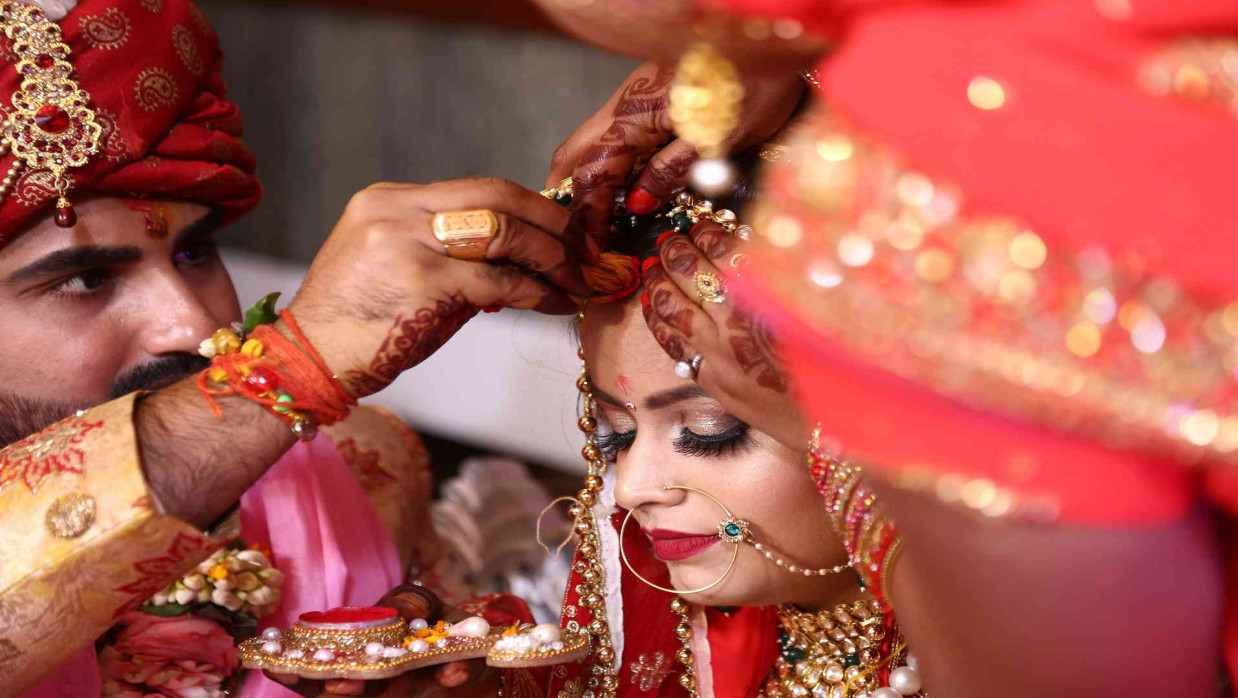
The upsurge in young female married influencers on Instagram showcasing what their typical day looks like through short form content like reels and mini vlogs have been garnering millions of views. These videos (especially vlogs) usually have titles that clearly state the age and marital status of the creator. The standard format shows a typical day of an Indian stay-at-home wife spending leisurely time at home, after completing their traditional wife/ daughter-in-law duties. One such popular influencer Japneet Siman Sethi who has 51.7k followers, runs a mini vlog series titled “A day in my life as a 22yrs old married girl” with her voiceover in the background describing her day. The typical day for her includes cooking meals for her husband and in-laws, taking naps, doing her beauty regimen, going out with her family and editing the vlogs. She is seen wearing her red chooda (bangles), a symbol of marriage, at all times, including during her workout sessions. Even when she has acne-flared skin, she puts on heavy make-up. Although it is her choice, she does it because she has recently married and hence it is important to look put together even when at home. Apart from her mini vlogs, in several other reels she has actively voiced her opinions defending her choice of being a ‘housewife’, causing a heated debate online with other women who found it regressive and reactionary.
Another content creator Tanishkka Tiwari who has 31.3k followers uploads videos of her day to day life. She is 22 years old and has been married since the age of 19. Apart from cooking and cleaning, the most consistent part of her day is doing puja. In such videos, she is mostly seen wearing salwar suit and sindoor (very prominently).. The sindoor in Hindu tradition is a symbol of a woman’s marital status. Feminists have, however, long critiqued sindoor for being a patriarchal symbol indicating woman’s “unavailability to other men, and the ownership of her body by her husband.”
There are similar other accounts like amayaaaa06 with 32.6k followers who wear all kinds of dresses but not without her chooda (bangles). She is seen cooking, going shopping, taking salon services at home and leading a very comfortable life. She explicitly mentions in a lot of her videos that she is a 20 year old Baniya bahu (daughter-in-law).
What discourse is it producing?
All of these influencers/content creators project the perfect picture of a traditional Indian wife and daughter-in-law. They live with their in-laws, take up the traditional cooking-cleaning duties, perform religious rituals, and take care of their husband and his family. In those videos, marriage becomes a performance where each element, from their dress to their actions, feel staged to align to the conservative audience.
The glorified picture of a happy married life, alongside their young age being reiterated in each video, sells the dream of an aspirational early marriage to their young women viewership. These videos highlight only the incentives of marriage where the wife or the daughter-in-law is pampered with expensive gifts, shopping sprees, and international vacations. There is almost a consumerist, capitalist logic to marriage that these videos attempt to propagate where the end goal is to make-believe that being married is naturally the easiest and most rewarding progression in a woman' s life.
In return, the women only have to perform the minimal duties of cooking the meals and performing pooja. They also get to have house help to lessen the burden of maintaining the household. However, this image is deeply problematic and biased as it conveniently leaves out the darker side of early marriages.
When young women like the ones making those videos transition into a new home with a new family, they often face difficult socio-psychological issues like isolation, loneliness, reduced autonomy as well as health risks that might come with early pregnancy. These young brides are more susceptible to further mental, emotional and physical abuses as they are not financially independent.
These videos often appeal to the upper-caste, upper class Indian society as it rarely acknowledges the caste-class privilege ingrained in their lifestyle. Comfort, in India, is deeply embedded in the class-caste nexus and is intricately connected to the question of access. By never reflecting on their privileged positions for being able to choose to not work, they sell a neo-liberal dream to young women. There is a complete erasure of the fact that women do disproportionate domestic labour on an unpaid basis regularly and in this economy, they even have to do jobs to help the family.
Tradwife Mass Culture and the Conservative India
The Tradwife discourse, by appeasing the brahmanical majoritarian conservative values, is becoming part of the larger Hindutva right-wing mass-culture that propagates gendered roles as well as normalises the Hindu traditional way of living. Mass culture, as Max Horkheimer points out, socialises individuals and leads to the erasure of an alternative imagination, which in this case is a progressive feminist future. The Tradwife culture is consciously choosing the glorious past over the progressive future and thus, actively formulating newer meanings amidst gender struggle for equity.
This choice however comes at a cost for women as Tradwife content creators often refuse to highlight the socio-political realities of women and marriages in India. According to the National Commission for Women (NCW) data in the first quarter of 2025, domestic violence has been the most pressing cause for complaints. In India, around thirty percent of women have faced some sort of intimate partner violence. With marriages in India comes the issue of dowry and between 2017-2022 over six thousand women have been murdered where the main reason was found to be dowry.
The Tradwife content that glorifies marriage often fails to take into account the crimes that are being committed within the institution of marriage and portray a fairytale romanticised image. They blame educated women who have chosen to not get married early and the working professionals for the apparent higher divorce rates in their videos.
This image, however, has an uncanny similarity with the image that Hindutva nationalist have of women- the glorious nurturing mothers and obedient wives, whose entire life and identity revolves around the lives of the male members of the family. Hindutva ideologues have also historically opposed modern women who according to them have destroyed Indian culture by exposing their bodies. Unsurprisingly, Bharatiya Janata Party often claims distribution of LPG cylinders as women empowerment thus fortifying the notion of gendered space.
It is therefore important that consumers of such videos are critical of both the performance and the motive of these videos, which might look harmless initially but carry a deeper ideological threat to the progressive politics.


0 Comments
LEAVE A COMMENT
Your email address will not be published