

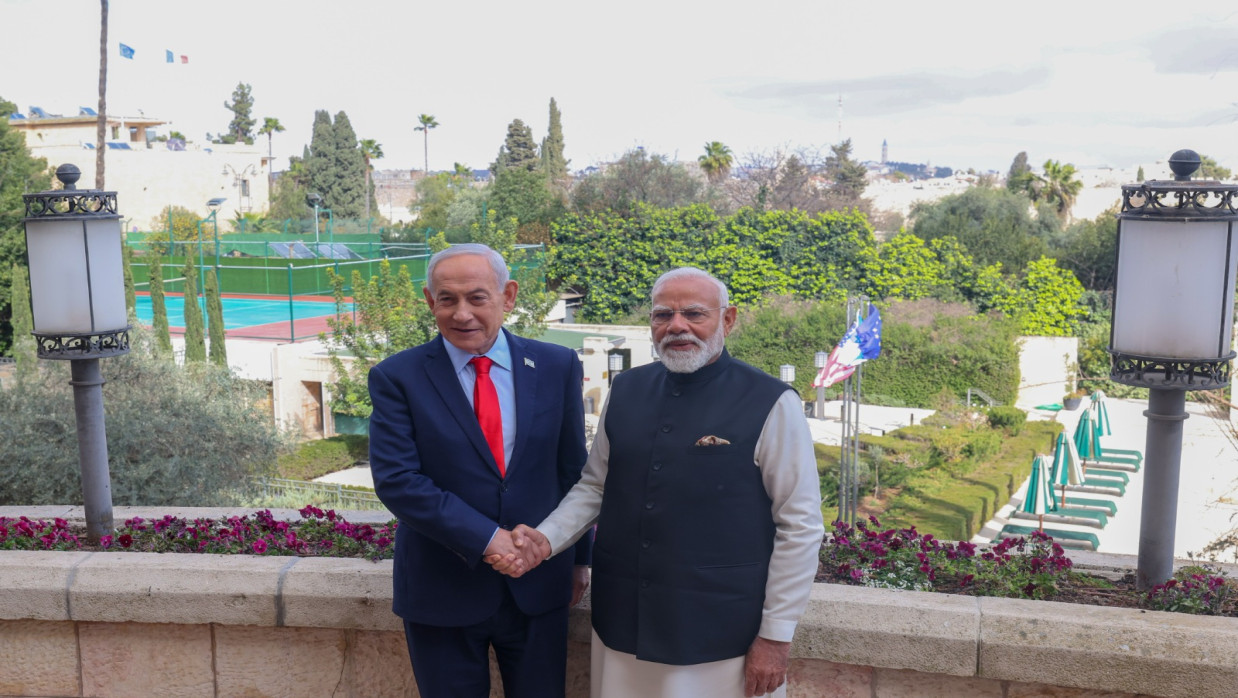
Prime Minister Narendra Modi’s visit to Israel comes at a moment of extraordinary volatility in the Middle East. With the war in Gaza reshaping regional alignments and tensions simmering between Israel and Iran, the optics of deepening India–Israel ties are bound to reverberate far beyond bilateral diplomacy. The visit is not merely ceremonial; it reflects a broader recalibration in India’s external posture — one that may carry implications for India-Iran relations, Gulf sensitivities, and even the welfare of millions of Indian expatriates across West Asia.
For decades, India maintained a carefully balanced Middle East policy. It supported the Palestinian cause rhetorically, cultivated strong civilizational and energy ties with Iran and the Arab Gulf, and steadily expanded pragmatic cooperation with Israel in defense and technology. This triangulated approach allowed New Delhi to engage multiple actors without appearing fully aligned with any single camp.
However, the evolving geopolitical climate has altered perceptions. India’s overt embrace of Israel — particularly in defense, surveillance, and counterterrorism cooperation — is increasingly visible. In isolation, this is not unusual; many countries maintain strategic ties with Israel. But in the context of heightened regional polarization, symbolism matters as much as substance.
One immediate question concerns India-Iran relations. Tehran has historically valued its civilizational and economic ties with India, exemplified by cooperation on connectivity initiatives such as the Chabahar Port. Yet Iran is acutely sensitive to shifts in regional alignment, especially when they appear to strengthen Israel’s strategic depth. If India is perceived as tilting decisively toward Tel Aviv during a period of Israeli military operations in Gaza, Tehran may reassess the reliability of its partnership with New Delhi. Diplomatic trust, once diluted, is difficult to restore.
Beyond Iran, the broader Middle East is watching closely. Arab states have pursued varying approaches toward Israel — from normalization agreements to guarded engagement — but public opinion in many of these societies remains deeply sympathetic to the Palestinian cause. India’s expanding partnership with Israel may be interpreted differently at the governmental and societal levels. While Gulf governments may continue pragmatic ties with New Delhi, public narratives could evolve in ways that complicate India’s image as a historically balanced actor.
Another dimension involves India’s vast diaspora in the Middle East. Millions of Indian workers reside in countries such as Saudi Arabia, the United Arab Emirates, Qatar, and Kuwait, forming one of the largest expatriate communities in the region. Their remittances constitute a vital pillar of India’s economy. Although host governments typically separate geopolitical issues from labor relations, shifts in public sentiment or heightened regional tensions can indirectly affect expatriate environments. Perceptions — fair or otherwise — that India is aligning too closely with one side in a deeply emotive conflict could create diplomatic sensitivities that New Delhi must carefully manage.
The broader strategic debate revolves around whether India’s Israel engagement represents a confident assertion of autonomy or a risky overexposure. Supporters argue that India is acting as any rising power would — diversifying partnerships and strengthening defense capabilities. Israel is a leading source of advanced military technology, cybersecurity expertise, and agricultural innovation. In a turbulent global order, aligning with technologically advanced partners is viewed as rational statecraft.
Critics, however, contend that timing and optics transform pragmatism into provocation. They argue that visiting Israel amid ongoing humanitarian crises risks undermining India’s longstanding moral positioning on Palestine. India once invoked the legacy of anti-colonial solidarity and non-alignment; today, detractors claim, it appears to prioritize strategic transactions over normative balance.
The notion that India could be perceived as a “new threat” in the Middle East may be exaggerated. India does not project military power in the region nor seek to reshape its political order. Yet perception often shapes policy responses. If regional actors begin to interpret India’s alignment as part of a broader geopolitical bloc structure, it may complicate India’s ability to serve as a bridge between competing camps.
Changing global politics further intensifies this dynamic. The Middle East is no longer solely influenced by US dominance; China, Russia, Türkiye, and regional powers are actively recalibrating their roles. In such an environment, overt partnerships can have cascading effects. India’s challenge lies in ensuring that enhanced cooperation with Israel does not erode its credibility in Tehran, Riyadh, Doha, or Abu Dhabi.
Modi’s Israel visit may be interpreted as either a confident diplomatic stride or a calculated risk. What is certain is that the Middle East — and India’s own diaspora — will be observing closely. In an era where symbolism travels faster than policy, perception management may prove as critical as strategic intent.


0 Comments
LEAVE A COMMENT
Your email address will not be published