

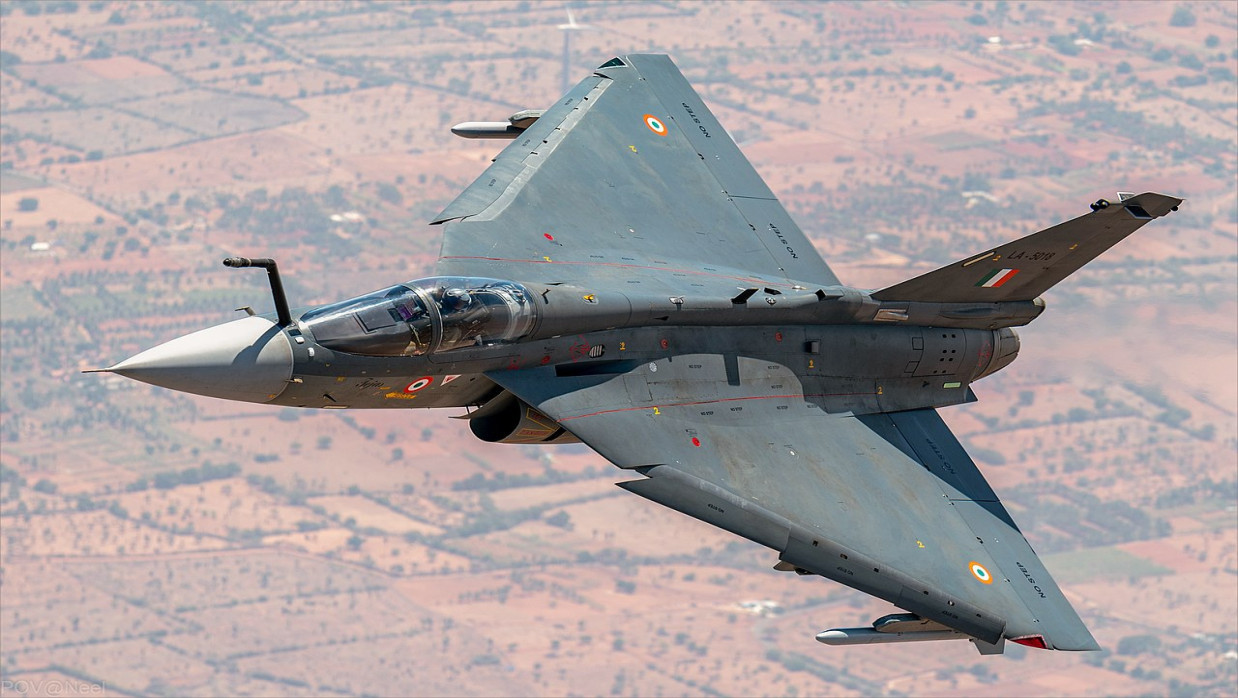
India’s Tejas fighter aircraft has long been marketed as the crown jewel of Atmanirbhar Bharat—a symbol of indigenous innovation, technological maturity, and strategic autonomy. Promoted relentlessly by New Delhi as a lightweight, multirole combat aircraft capable of competing in global markets, Tejas was meant to announce India’s arrival as a serious aerospace power. Instead, the programme increasingly stands as a cautionary tale of how political narratives can outpace engineering realities.
The illusion fractured spectacularly on 21 November 2025, when an Indian Air Force (IAF) Tejas Mk-1A crashed during an aerial demonstration at the Dubai Airshow—one of the world’s most prestigious defence exhibitions. The incident was not only tragic, claiming the life of a pilot, but strategically devastating. Unlike accidents that occur quietly during test flights, this crash unfolded before a global audience of defence officials, procurement delegations, and industry analysts. In a single moment, India’s export ambitions were undermined in real time.
The Dubai crash was not an aberration. It followed another Tejas crash in 2024, reinforcing concerns about the aircraft’s safety record and system reliability. Yet Hindustan Aeronautics Limited (HAL), the programme’s principal manufacturer, once again rushed to describe the incident as an “isolated occurrence under exceptional circumstances.” Such explanations ring hollow when patterns, not anomalies, define the trajectory of a programme.
At the heart of Tejas’s troubles lies a disconnect between ambition and execution. Despite being branded as indigenous, the aircraft remains critically dependent on foreign components—most notably the US-supplied GE F404 engine. This dependence has proven costly. Supply chain uncertainties, export controls, and production delays have repeatedly disrupted timelines, exposing the fragility of India’s self-reliance narrative.
The numbers tell their own story. After years of development and repeated upgrades, only around 40 Tejas aircraft have been delivered to the IAF. Meanwhile, 141 Tejas Mk-1A orders remain pending, caught in a limbo of delayed engines, production bottlenecks, and unresolved technical issues. An aircraft that struggles to meet domestic induction targets is hardly positioned to succeed in competitive export markets.
Yet New Delhi aggressively pitched Tejas abroad. Countries such as Argentina, Malaysia, Nigeria, Egypt, and Armenia were courted with promises of affordability, modern avionics, and reliable performance. Armenia, in particular, was reportedly in advanced discussions for up to 20 aircraft valued at approximately $1.2 billion. The Dubai Airshow crash has now cast a long shadow over these prospects. For potential buyers—especially air forces with limited budgets and no tolerance for operational risk—the incident raised uncomfortable questions about pilot safety, lifecycle costs, and long-term support.
The reputational damage extends beyond Tejas itself. It strikes at the credibility of India’s defence-industrial ecosystem. HAL’s history of delayed programmes, quality control issues, and post-crash damage control has long been a concern within India’s own strategic community. The tendency to prioritize political optics over transparent technical assessment has only compounded these problems.
Defence aviation is unforgiving. Aircraft are judged not by press releases or slogans, but by sortie rates, safety records, maintenance hours, and combat readiness. No amount of branding can compensate for unresolved design flaws, supply vulnerabilities, or inconsistent performance. When a fighter crashes at an international airshow, the verdict is delivered instantly and globally.
The Tejas programme did not have to end this way. Indigenous development is inherently complex, and setbacks are part of any serious aerospace effort. What distinguishes success from failure is institutional honesty, technical rigor, and the willingness to correct course without spin. By choosing narrative management over accountability, India has weakened confidence not only in Tejas, but in its broader claims of defence self-sufficiency.
In the end, the Dubai Airshow crash was more than an accident—it was a moment of strategic exposure. The myth of Tejas as a mature, export-ready platform has been punctured, and rebuilding trust will take far more than revised brochures and optimistic timelines. Until performance matches propaganda, Tejas will remain less a symbol of self-reliance and more a reminder that in military aviation, reality always flies ahead of rhetoric.


0 Comments
LEAVE A COMMENT
Your email address will not be published