

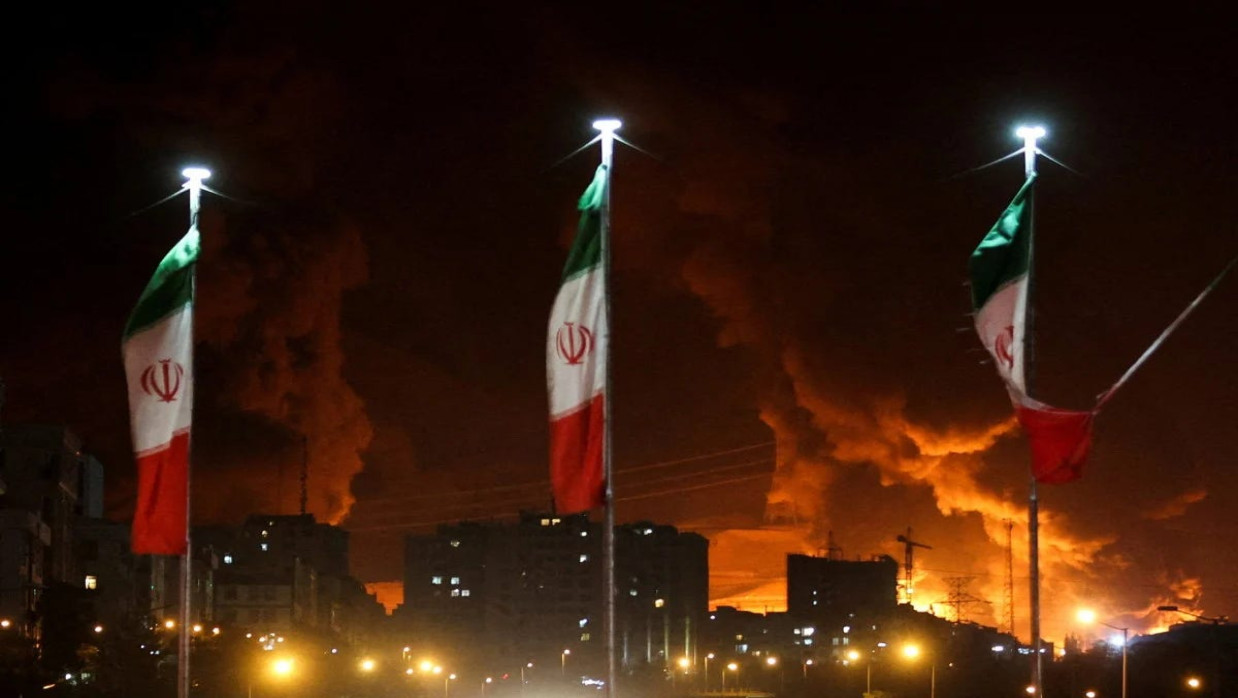
Despite warnings by Middle East experts to Donald Trump that a new military attack against Iran might trigger a much larger conflagration that risks enveloping the entire region, the US and Israel attacked on Saturday following weeks of threats of a major assault, with Iran counterattacking against US bases in the Middle East as well as other targets. It is possible, although unlikely, that the US could conclude a relatively painless military victory, or that the Islamic regime, with Supreme Leader Ayatollah Ali Khomeini and other top officials dead. That will depend on whether the government in Tehran can survive the onslaught and figure out ways to mount an asymmetric response.
Trump’s dominant characteristic until now has been a readiness to trust his own instincts rather than rely on the experts. After the quick and – so far – painless ouster of Nicolás Maduro in Venezuela, he may believe it will be painless again. He and the MAGA crowd are obsessed with what they see as the “Deep State,” or in simpler words, the Washington Establishment. Mostly, they are frustrated that what used to be considered the Establishment now sees them as uncouth outsiders, ignorant of history and with little understanding of international relations or diplomacy. This time around, Trump might do well to listen to the experts.
The difference between the Trump administration and what remains of the US State Department is decades of experience. Despite its traditional nickname, Foggy Bottom, the State Department, is all too aware of what can happen when an administration. A not-too-distant example of how things can go wrong is the case of George W. Bush’s efforts to topple Iraq’s Saddam Hussein.
No next step
As Bush discovered, using America’s overwhelming military superiority to defeat a weakened Iraqi regime wasn’t difficult. The mistake that the administration’s key strategists, Donald Rumsfeld and Vice President Dick Cheney, made was to stop the State Department from drafting a plan for what was likely to happen once Saddam’s regime was gone. Rumsfeld’s concern was that victory in Iraq would be hamstrung by bureaucratic red tape. What he failed to realize was that the procedures he distrusted had been put in place to prevent the kind of disaster that eventually consumed Iraq because of a lack of planning.
 |
Not just Trump, but Republican administrations in general have long felt impatience at what they saw as an overly cautious approach by State Department experts and America’s professional intelligence agencies. They have always felt a temptation to shoot first and clean up the mess later. Unfortunately, what Hollywood scriptwriters might have mythologized about the Wild West of the late 1800s rarely works in real life. In today’s world, considerably more is at stake.
As it turned out, Bush’s ‘Operation Iraqi Freedom’ triggered a war that lasted nearly eight years from 2003 to 2011 and cost the lives of more than 4,400 U.S. servicemen, along with another 37,000 wounded. The actual fighting cost somewhere between US$700 billion and US$800 billion. Helping American veterans recover from the war added another U$2 trillion to US budgetary costs.
Conquering Iran would be a much more serious undertaking than subduing Iraq. Iraq has a population of 45 million. Iran’s population is 92 million, double Iraq’s. Although Iraq had caused Britain problems during colonial days, it had never really engaged in a serious Middle East conflict until the Iran-Iraq war, which ended in a stalemate. Iraq’s army could intimidate smaller countries in the region, but it didn’t really amount to that much as an organized force. Iran, on the other hand, eventually proved itself to not only have an impressive military capability but also an effective strategy and an astonishing capacity to develop formidable allies including Hezbollah in Lebanon, Hamas in Gaza, and the Houthis in Yemen.
Iran trains Hezbollah
During an Israeli incursion into Lebanon in 2006, Israeli troops were surprised to discover that the Hezbollah troops had become much more formidable than in the past. They had received professional training from Iran. Faced with unexpectedly high losses, the Israelis pulled out of Lebanon.
When Saddam mounted his invasion of Kuwait in August 1990, I was in Saudi Arabia. The concern was that Saddam’s military force would simply knife through Kuwait and grab the oil fields in northeast Saudi Arabia. There was literally nothing to stop him. The U.S. flew the 82nd Airborne Division into Saudi Arabia to provide a blocking force. What no one knew at the time was that the U.S. paratroopers only had enough ammunition to hold out for 48 hours. The rest was a bluff. The U.S. flew in fighter-bombers and stationed them on the Saudi runway. Reporters flying into Saudi Arabia were paraded past the stationed aircraft in order to create the impression that the U.S. presence was much stronger than it actually was.
Saddam looked like toast, but this time around the real bluff was American. It took six months, from August until January, before the U.S. felt that it really had enough force in place to take out Saddam’s army. When the American onslaught finally happened, Iraqi prisoners-of-war, delighted to be removed from the action, asked their American captors, “What took you so long?”
It is pretty obvious that that would not be the case in Iran, particularly if the administration thinks that what Iran really wants is to go back to the Pahlavi monarchy. Trump, who likes to act on instinct, has suggested that the US might engage in “regime change” by knocking out Iran’s Supreme Guide, Ali Khamenei, who is due to retire pretty soon anyway. Eliminating Khamenei and the current government, however, would simply clear the way for Iran’s brutal Revolutionary Guard to seize power without Islamic pretensions. The result could be another version of Saddam Hussein, only this time the dictatorship would be equipped with the basic knowledge needed to acquire a workable bomb.
Disintegration likely
If the IRG were not able to take power, the country would very likely disintegrate into outright civil war with competing tribes and clans killing each other, convinced that supremacy is necessary for their own survival. The result would very likely be an exodus of refugees spreading throughout the Middle East. That would destabilize the entire region, which still remains the source of a significant portion of the world’s energy supply. Stopping the flow of energy would lead to the spread chaos throughout the entire world. In any case, as we learned in Iraq, bombing does not make dangerous troublemakers disappear; it simply encourages them to move somewhere else.
The mistake that was made in the Iraq war by Bush’s plenipotentiary, L. Paul Bremer, was to dismiss Saddam’s administration and the Iraqi Army’s officer corps without bothering to consider what they would do next or where they would go. That mistake cost thousands of American lives, not to mention the destitution of what remained of Iraq.
George W. Bush had at least had a few advisers, who, if occasionally misguided, were unquestionably intelligent. Donald Trump is not even there. We now have a director of national intelligence whose qualification is the fact that she is a former U.S. Army nurse. She has no experience with intelligence at all, and it is questionable whether she even knows what intelligence is. We have a secretary of defense whose qualification is a bit of brief service as a part-time member of the National Guard followed by part-time work as a weekend anchorman on Fox News. The Trump administration is flying blind. As far as any real national defense goes, the U.S. is naked.
A British friend once said that America’s approach to the rest of the world is like handing a loaded shotgun to a toddler and waiting to see what happens next. That description fits Trump perfectly. It is a safe bet that anyone who knows the Middle East will rejoice if Trump pulls yet another TACO and finds an off-ramp, sidestepping what could turn out to be another unnecessary disaster in a region that has known plenty of them. If he gets it wrong, Trump will have lost, but we will all be losers along with him.
The article appeared in the asiasentinel



0 Comments
LEAVE A COMMENT
Your email address will not be published