

Trump’s designs on Greenland, doubts about NATO, and a landmark deal with India reveal how far Europe has moved from its postwar certainties.
James Kanter and Rana Ayub
There are weeks where decades happen, and to coin a phrase, months where centuries happen.
For Europeans, this January may mark just such a seismic shift.
The attempt by Donald Trump to snatch away Greenland shows that the Europeans won’t be spared on his quest to control the Western Hemisphere.
Trump is widely seen as likely to make another grab for the island, controlled by Denmark, despite a truce brokered at the World Economic Forum in Davos. The era of imperial land grabs is back.
Take also Europeans’ rapidly collapsing faith in the NATO military alliance. Given Trump’s designs on Greenland, and given Trump’s admiration for Vladimir Putin, the United States is no longer seen as a trustworthy guarantor of European security.
The alliance’s famous mutual assistance clause — that an armed attack against one NATO member shall be considered an attack against all may not be a dead letter, but it is getting awfully close. A significant drawdown of U.S. troops from Europe is not far off.
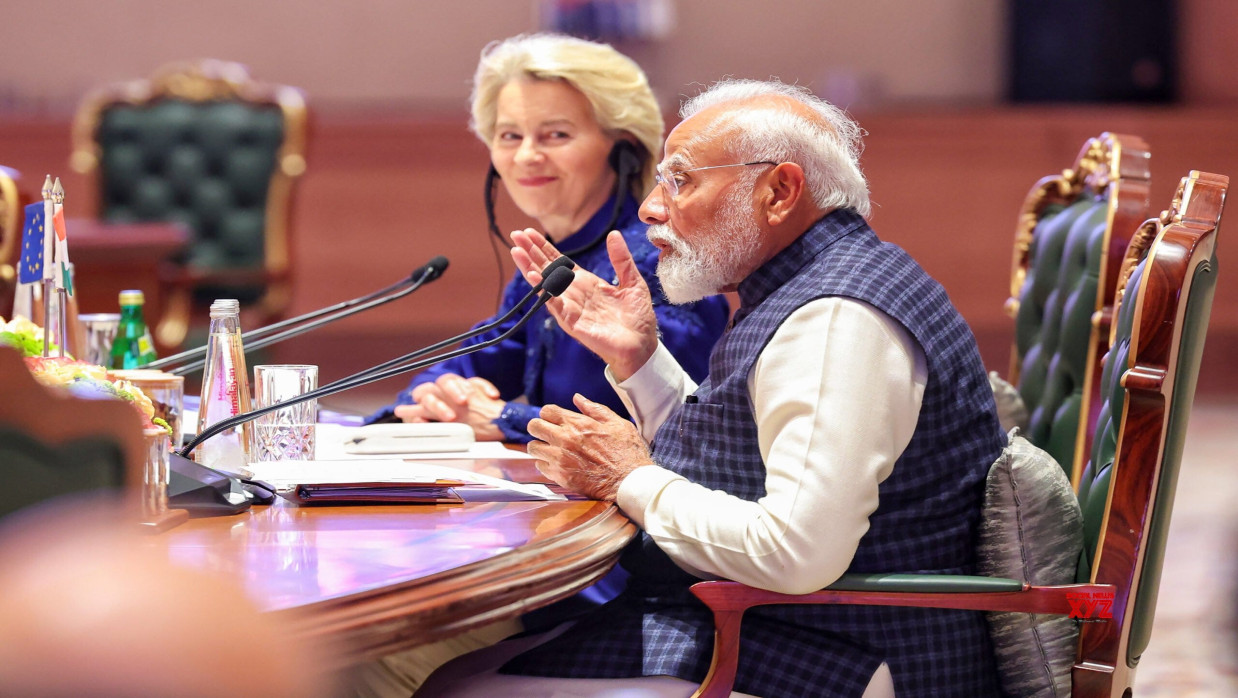
Then take the lavish ceremonies in New Delhi, where European Commission President Ursula von der Leyen and European Council President Antonio Costa are signing trade and defense accords with Narendra Modi.
Not in the same league of historic junctures, you say?
Think again.
The developments around Greenland, NATO, and India are part of a wider snap-to-reality among Europeans: that the European Union, which sprang from the ashes of the Second World War, and which now encompasses 450 million citizens from the Baltic to the Balearics, could fail.
A new global reality has finally barged into view, and Europeans now are confronting the possibility of being pushed to the margins of a newly assertive American empire and left powerless against a revanchist Russia and a technologically superior China.
After the better part of a century, the Atlanticist outlook , that Europe is safest when tied to North America, is coming to an end.
In such epochal moments, what is needed is a new story and new friends.
For Europe, its new story is refashioning global trade, away from Donald Trump’s chaotic tariff wars, by joining forces with middle powers that also have an interest in diversifying away from reliance on China.
As for the new friends, they include the Indians, with whom Europe has just signed what von der Leyen called “the mother of all trade deals,” as well as the Mercosur nations, where a deal between the Europeans and the likes of Brazil and Uruguay soon could be in place.
The EU’s emerging web of trade alliances already includes Canada, Japan, Mexico, Indonesia, and, of course, the U.K., where a deal was eventually brokered post-Brexit.
Call it the new multilateralism or “what the new world order could look like,” as Der Standard described it.
Yet the EU’s push for relevance is not without misgivings. Critics warn that doing business with India risks indirectly supporting Putin’s war in Ukraine, while others fear Brussels may dilute its own climate standards by quietly relaxing how India is brought into the EU’s carbon border adjustment mechanism through a planned “technical dialogue.”
In the United States Treasury Secretary Scott Bessent accused the EU of shooting itself in the foot by doing a deal with a country like India that buys Russian oil that helps finance Vladimir Putin’s war in Ukraine.
There is also discomfort in Europe that its new friends include Mr. Modi himself, whose ultranationalist Hindu government persecutes religious minorities using discrimination and violence. India, after all, is not just another middle power. It is the world’s largest democracy — or at least it once was.
This is where Europe’s so-called Machiavellian Moment again hurtles into view.
The term, borrowed by author and historian Luuk van Middelaar to denote Europe’s realization that it must defend itself, refers to an instant when it must exchange its more lofty ideals, aimed at creating a more perfect future, for amoral strategies to survive a perilous present.
India’s democratic backsliding, the erosion of minority protections, the tightening grip over media and institutions, and the fusion of religion and state power are well documented.
Yet these concerns are now treated as secondary to strategic necessity. Values, once the EU’s calling card, are being quietly subordinated to survival in a world where allies are chosen less for who they are than for what they can offer.
Like Viktor Orbán of Hungary, Modi is associated with a rise in the kind of right-wing national populism and ethnonationalism that the EU supposedly deplores.
Yet there also is an awkward truth here.
The EU has itself moved sharply rightwards in the past two years, and any queasiness at doing deals with autocrats may be lessening, especially when those autocrats represent an alternative to theUnited States.
Indeed, pragmatism and longstanding ties, rather than values, may be the order of the day.
Von der Leyen, the European Commission president, told Modi over dinner that the EU and India are “natural strategic partners” who together “can build a new Golden Road” between their continents.
Costa, the European Council president and an overseas Indian citizen with his roots in Goa, told Modi that the “connection between Europe and India is something personal.”
As to whether Europe will be able to defend itself effectively in future without the United States, or even with an assist from its new friends among the middle powers, like India, that remains an open question.
Europe does a brisk business in weapons sales with India, and the EU-India Free Trade Agreement signed in Delhi also comes with the launch of an EU-India Security and Defense Partnership.
The pact will increase “resilience against all forms of threats,” said von der Leyen, and it will cover areas from maritime security to cyber and hybrid threats, and space.
Kaja Kallas, the EU’s foreign policy chief, did remind her counterparts in Delhi that ties between Russia and India still “cast a shadow” over the cooperation. But that seems unlikely to move Modi.
Rana Ayyub's Newsletter is a reader-supported publication. To receive new posts and support my work, consider becoming a free or paid subscriber.
India has its own foreign policy prerogatives, and one of them is buying cut-price Russian oil to help power the Indian economy and lift its vast population out of poverty — no matter that it supports Putin’s war efforts. The agreement with the EU has arrived at a fortuitous moment for Mr. Modi. His much-touted vishwaguru posture, projecting India as a rising moral and strategic leader, has faced criticism at home, with opposition parties arguing that India’s foreign policy has yielded diminishing returns.
An unpredictable Donald Trump has kept India on edge with tariff threats, Pakistan has sought renewed favor in Washington, and China has tightened its strategic embrace of India’s neighbors. Welcoming Ursula von der Leyen as chief guest at the Republic Day parade thus allowed Modi to project reassurance, to voters and rivals alike, that India remains a sought-after global partner.
Whether this new pragmatism will ultimately secure Europe’s sovereignty or merely postpone its reckoning remains unclear. What is certain is that in a world where power is again trumping principle, Europe has begun to act less like a normative beacon — and more like a geopolitical survivor.
James Kanter is a former Europe correspondent for the New York Times and the founder and editor of the political podcast: EU Scream.
The artcile was reproduced from Rana Ayub's Newsletter


0 Comments
LEAVE A COMMENT
Your email address will not be published