

“There is nothing democratic about fascism.”
The rise of Giorgia Meloni, leader of the Brothers of Italy party, and her rabidly nationalist grandparents. I assumed fascism belonged in her family’s past. Italy and Germany were home to fascism’s most infamous examples, the bloody totalitarianism of Nazi Germany, Mussolini’s march on Rome. Fascism was a European sickness. But fascism cannot be quarantined within national borders or to a single historical epoch.
Fascism Understood
Fascism is typically treated as Europe’s unique pathology: the tragic flourish of militarism that marched across the continent between the world wars. That story is comforting, but incomplete. Modern fascism wasn’t just a regime type that flowered briefly in Italy and Germany between WWI and WWII; it was a political technology. Fascism was modular. Its ideas and aesthetics spread worldwide and mutated to fit local conditions. It concealed itself in political movements both blatant and banal.
Fascism travels beyond Europe, above
Legions of Nazis descended upon New York’s Madison Square Garden in February 1939 to proclaim ‘Heil Hitler’ before thousands of Americans. Fascism is dangerous today because it endures.
Fascism Mutates
Europe was fascism’s laboratory, but not its limit. Around the world, would-be strongmen took note of fascism’s seizure of power. They adopted its playbook while jettisoning its constraints. European fascists presumed white supremacy and could pay lip service to antisemitism without becoming fully racist. Authoritarians in Russia, China, India, and beyond ignored Europe’s racial hierarchy to focus on what they could emulate.
Consider the early years of the Muslim Brotherhood, founded by Hassan al-Banna in present-day Egypt in 1928. Al-Banna was inspired by Islamic revivalism, anti-colonialism, and anger toward Egyptian King Farouk. His movement was Islamicist and political, not fascist.
But like fascism, the Brotherhood understood politics as a cultural battle. It modeled itself after European movements with uniforms, youth wings, and strict hierarchies. It attacked parliamentary politics. It saw society not as given, but as malleable. In dozens of countries over the past century, authoritarian leaders have followed suit.
India: Fascism’s Fifth Column
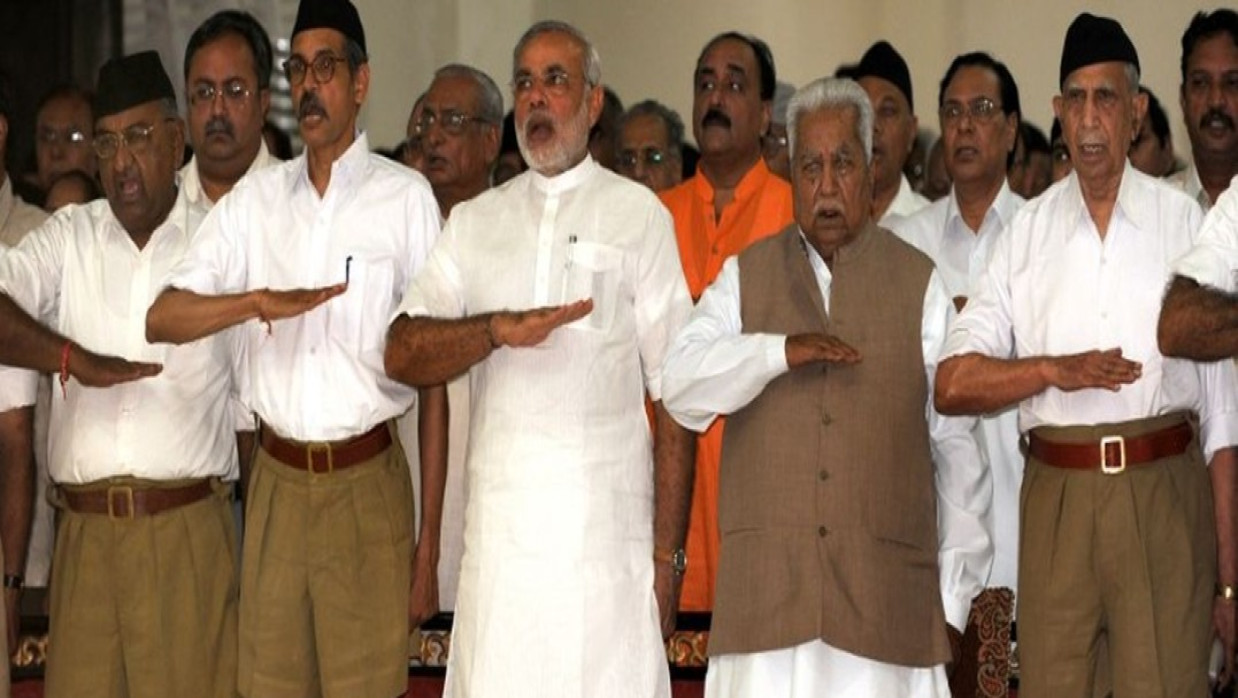
India is no exception. RSS militias goose-stepped through India’s streets during the very years that Axis powers stormed across Europe. The RSS, or “National Volunteer Organization,” was founded in 1925 by Keshav Baliram Hedge. It developed under the spiritual and intellectual guidance of Vinayak Damodar Savarkar, a secular Hindu who argued that India’s national identity was Hindu, not civic.
“Indian nationalism is only another name for Hindu nationalism,” Savarkar proclaimed.
His ideas were incubated in controversial jailhouse letters he wrote to his Hindu nationalist mentor during a British imprisonment. They matured into the musings of a freedom fighter in the fascist era. Savarkar spent years living in Axis Rome, and he studied European movements closely. He visited the blossoming Mussolini regime and lauded Italy’s fascist regeneration. In private correspondence, Savarkar pressed future RSS leaders to build their own “Fascist organization.”
Mussolini smiles as he talks with Benito Mussolini, surrounded by Italian Fascist party leaders and members, at Palazzo Venezia in Rome on November 10th, 1933.
RSS militants trained in India during World War II
They heeded the call. While Savarkar kept a low public profile on fascism, the RSS internalized key components of fascist thought. Drill, uniforms, strict hierarchy, and aggression: the RSS made them central to voluntarism that would otherwise have fit comfortably within democratic politics. The RSS wanted a Hindu India, and fascism showed it how to fight for culture.
As Savarkar and the RSS influenced decades of Indian politics, they inevitably left their mark on Indian Prime Minister Narendra Modi. Modi was raised in an RSS hostel, cut his political teeth in the RSS, and remains bound to the RSS as prime minister. Critics argue Modi maintains cordial ties with India’s newest RSS alumni even while they incite mob violence.
Fascism echoes through each.
Modi today mirrors Europe’s fascists in method if not ideology. His party rallies resemble religious festivals. His power is premised on divisive nationalism and centralized strength. Independent institutions, critics say, are starved of resources or politicized. Hindu-Muslim relations have deteriorated, with religious minorities facing tightened surveillance and societal restrictions. Hate crimes have increased. When Hindus attack Muslims, police frequently decline to respond.
The world saw elements of this in 2020, when Indian security forces cracked down on anti-CAA protesters in Delhi, killing at least one. They watch today as China imprisons Uighur Muslims by the millions.
To study European fascism is to know what happens when fascism adapts successfully. It learns new languages and local traditions. It wears the clothes of patriotism and culture while strangling democracy within.
Fascism Today
Fascism can thrive within democracies.
Today, dozens of countries allow fascism to ferment within open political systems. In Hungary, Turkey, and Ecuador, fascists have been met with political party bans that may backfire by driving extremists underground. In Brazil and India, meanwhile, fascists operate within democracies and rise when polarization and tribalism tear countries apart.
Brazilian President Jair Bolsonaro presided over his country in the style of European strongmen. His party, Alliance for Brazil, vowed to “make Brazil Great Again,” similar to Make America Great Again (MAGA), and depicts immigrants as dangerous criminals. Political opponents are jailed. Religious minorities are harassed. Bolsonaro and Donald Trump are true friends.
“I wouldn’t say I’m a fascist,” Bolsonaro told reporters in 2019. “But if I were, I wouldn’t hide it.”
Fascism’s Future
It is a mistake to think fascism ended in 1945. While fascists may not always call themselves fascists, we can still spot fascism by what it does to a country’s politics. Fascism is embodied by politicians who harness societal frustration and impose unity from above.
In recent years, voters around the globe have elected fascists who offered easy answers during difficult times. Fascists ran for office openly in Germany and began printing swastika-shaped money while Hitler was in prison. Today, American extremists trained their rifles on Congress while concocting plans to kill police officers. These extremists do not represent America. But they do represent fascism’s future.
Authoritarian fascists have been elected to power throughout Europe, Asia, and South America over the past few years. In some countries, like Hungary and Poland, these fascists amended democratic constitutions to help solidify their hold on power. Fascists entering democratic systems may not destroy democracy overnight. But they do raise fundamental questions about how democracies die.


0 Comments
LEAVE A COMMENT
Your email address will not be published