

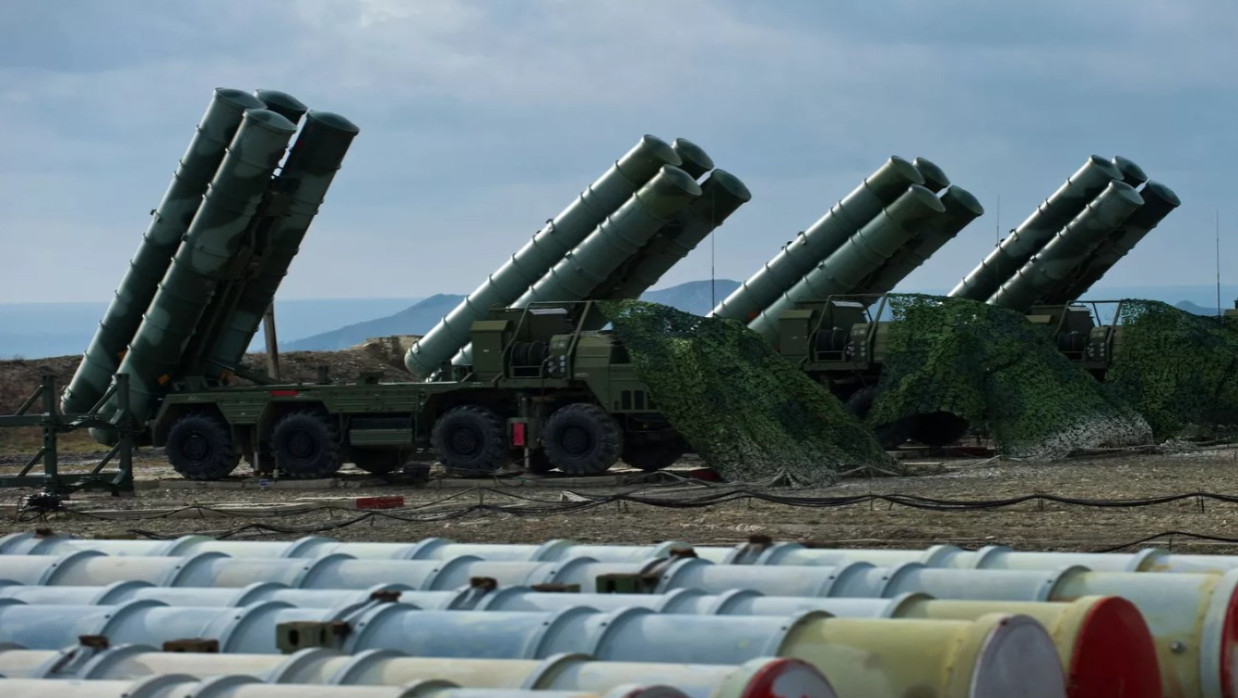
The world's top Air Defense Systems, which were previously hailed as unbreakable barriers, have revealed alarming weaknesses in a time when missile technology is developing at an alarming pace. Devastating strikes were able to reach inhabited regions in June 2025 because Israel's Iron Dome, a sign of technological supremacy, was unable to provide complete protection from Iran's missile bombardment. Similarly, during Pakistan's response to Indian missile attacks in May 2025, India's S-400 system, one of the most sophisticated air defenses, apparently malfunctioned, with reports that a crucial system was destroyed. Following the resounding defeat to India on technological front, New Delhi plunged into another arm race in South Asia. So far, India has conducted consecutively four missile tests within two months that includes Prithvi-II, Akash Prime, Agni-Pralay, quasi-ballistic tactical missile, Agni-5 and I.
Since inception, India has been employing tactics to undo Pakistan, as it never accepted the very creation of the latter. In this quest India left no stone unturned be it coercive diplomacy or the use of hard power. The aggressive military doctrines followed by their execution turned out to be the corner stone of Indian posture against Pakistan. The integration of advanced and disruptive technologies into its military fabric and further toxicating it with the integration of civilizational nationalism catalyzes the risk of escalation in the region. Its revisionist posture remains intact despite a humiliating defeat in May 2025.
The revival of Sudarshan Chakra project by Narendra Modi in his Independence Day speech highlights an attempt to shift focus towards modernization drive, initially proposed by A.P.J. Abdul Kalam in 1995. However, the project remained dormant until Dr. V.K. Saraswat, DRDO chief from 2009–2013 (now a member of NITI Aayog), revived and popularized it. During his tenure, Saraswat laid out a two-phase plan: Phase I would counter ballistic missiles from Pakistan with ranges up to 2,000 km, while Phase II would address longer-range Chinese missiles up to 5,000 km. Interception was to be achieved at two levels—within the atmosphere (below 100 km altitude) and in outer space (above 100 km). Although Saraswat optimistically projected operational readiness by 2013, the system stalled after his retirement and has only now been revived by Prime Minister Modi. The purpose is to strengthen India’s multi-layered air defense system, which had fallen short during the May 7–10, 2025, escalation. With repeated reminders from the Trump administration regarding the shot down of Indian fighter jets, that New Delhi is reluctant to accept. India is investing in air defence system, to overcome the humiliation and bring focus towards its modernization drive. In this regard, Sudarshan Chakra project is hailed to integrate surveillance, cybersecurity, and air defense technologies, it would be a comprehensive AI-powered missile defense system deployed across the airspace by 2035. Integrated Air Defence Weapon System’s (IADWS) flight test conducted at coast of Odhisa on August 2025 applauded as a part of the Sudarshan Chakra. IADWS aim to repel threats reaching from drones to incoming aircrafts and missiles. This multilayered defence system comprises of three key components, including the Quick Reaction Surface to Air missiles, advanced Very Short Range Air Defense System missiles, and a laser based Directed Energy Weapon.
Technological advantage can be overcome where countries are making investments in cutting-edge defense technologies such as lasers, space-based interceptors, and AI-driven systems to guarantee strong defense as missile threats change. Given the complexity of modern warfare, depending on antiquated or constrained technologies, as the Iron Dome is no longer adequate.
Iran's June 2025 bombardment exposed the Iron Dome is unprepared to withstand sophisticated or large-scale missile attacks, even if it has proven effective against short-range threats. The S-400's purported susceptibility to Pakistan's hypersonic missiles also highlights the difficulties presented by new technologies. These challenges are made worse by technical problems including saturation points and radar vulnerabilities. While India aims to build a nationwide shield, recent conflicts demonstrate the limitations of such systems lies in technological feasibility. Israel’s Iron Dome, one of the most advanced in the world failed to provide complete protection during the Israel–Hamas War & Israel-Iran war raising doubts about India’s ability to secure a much larger territory with diverse threats. Moreover, adversaries are unlikely to remain passive. To defend large area, destroying ballistic missiles in their boost phase, three to five minutes after launch, while their engines are still running and before reentry vehicles have been detached from the missile payload. The launch can be more easily detected from space at this phase due to the missile's exhaust, while India’s satellite coverage is limited.
Furthermore, its Prithvi Air Defence and Advance Air Defence system are designed for mid-course or terminal phase interception. Despite the failure of air defence system in Israel-Iran war, India replicating the same system, Sudarshan Chakra, appears to be a prestige driven with the objective to align itself with the major powers, such as the NATO countries' deployed multilayered defence system, Israel’s Iron Dome and the US’s ambitious plans for the Golden Dome. Under the garb of its economic might and so-called military might, India appears to be coming up with a more volatile, revisionist, and punitive war-fighting strategy against Pakistan. It plans for what to be a preventive offense against Pakistan for a matter that could be resolved at the table. India believes itself to be among the major powers and consequently aspires to become a permanent member of the United Nations Security Council, which poses a significant security dilemma for Pakistan.
Sudharshan Chakra would be a major shift in South Asian strategic equation, increasing pressure on the other sides to deploy additional missiles to counter it. It will intensify a new missile race in the region. The Indo-Pak-China security triangle is likely to intensify. China, committed to supporting Pakistan’s sovereignty, is expected to bolster Pakistan’s missile production, integrated air defense, and cyber-electronic warfare capabilities. With hypersonic systems operating in “near space” (20–100 km altitude) and no global defense against them, India’s proposed BMD shield risks rapid obsolescence.
By opting for a politically symbolic but technically questionable “Sudarshan Chakra,” India may have lowered the threshold of conflict escalating regional instability and increasing the possibility of strategic miscalculation. The announcement risks triggering a dangerous arms race, compelling Pakistan and China to develop countermeasures. Thereby Sudharshan Chakra project aimed to boost India’s defence posture against Pakistan and China ended up further complicating India’s defense calculus, initiating an endless arms race in South Asia.


0 Comments
LEAVE A COMMENT
Your email address will not be published