

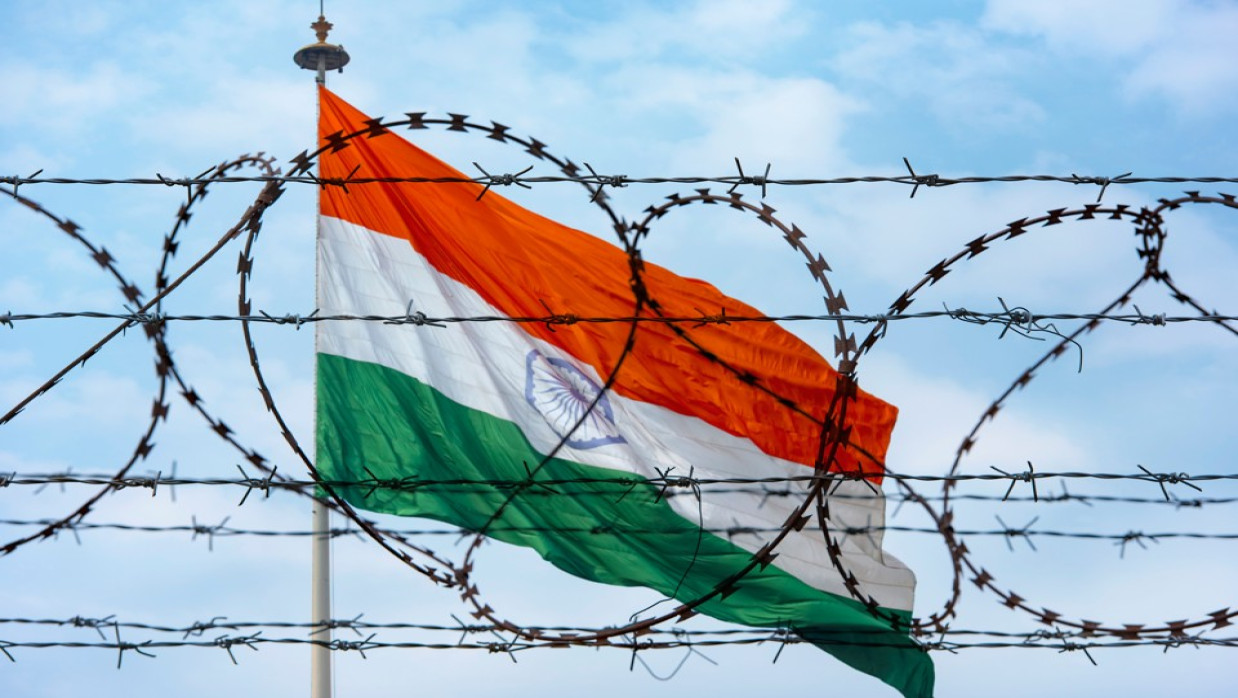
While navigating through compulsions and constraints on way to the current foreign policy of India, one finds the present leadership in the country clearly supporting a multipolar world order, notwithstanding the US’ still recognised unparalleled supreme ascendance with self-obsessed approach in international relations. That is gravely endangering the national interests of relatively weak and developing nations clubbed as Third World including India though it is now identified as the fourth largest economy in the world. That inevitably discourages the consolidation of the global and regional institutions in the multipolar world and also hurts the solemn spirit of multilateral negotiations leading to much loss to the Third World nations.
Against this backdrop, India’s national development goals need freedom of decision-making and independent actions to be pursued by its foreign policy characterized by the doctrine of nonalignment, so as to procure and preserve its national interests and discourage alignment of nations in rival blocs, thus consolidating the spirit of multi-polarity in international relations and ensuring its active participation in all multilateral instruments promoting peace, progress and security in all over the world.
While the changing world today often poses considerable challenges or even threats to very survival of a state due to one reason or the other, given the structural compulsions and constraints in the international relations as pointed out by a great realist of our times John Mershemier, India’s ancient moral traditions and rich cultural heritage characterized by peace, love, tolerance, non-violence, non-conceit, justice, freedom altogether manifesting vasudhaiv-kutumbkam and sarve bhavantu sukhinah… etc. always underscore its magnificent policy of humanism and globalism for welfare of the entire humanity while upholding strategic autonomy with respect to country’s independent foreign policy, particularly marked by the doctrine of non-alignment. Although this policy is often rejected as obsolete or irrelevant after disintegration of erstwhile USSR and the demise of Cold War during closing years of 1980s, yet the rising membership of the Non-aligned Movement (NAM) sustains its relevance even in the current multipolar world order.
As a matter of fact, India and most of the non-aligned countries never compromised with the policy of non-alignment notwithstanding reasonable mutual differences among them over their respective national interests. However the reasons behind systemic balance, evolving consistently out of the Law of Nature sweeping across the entire nature itself – that a great Greek philosopher Aristotle underscored during ancient times circa 4th and 3rd century BC, apart from sages and seers in ancient India as well – always acts to restore the hitherto maintained position – both at individual and national level – and to reestablish peace and security in all over the world.
Indeed the collective conscience of the entire humanity always reflects the hidden wishes of the supreme divine that essentially acts to restore the hitherto established balance and order in the world. Fortunately India’s foreign policy always adheres to the Laws of Nature to respect supreme conscience as world peace and welfare of all including itself. But most of the powerful nations in the West, especially America, run after their short-term national interests, while ignoring the collective conscience or larger interests of the global humanity, thereby leading to immense troubles and disorder and untold trauma and agony to the people at large and their common humanitarian concerns, manifesting through global peace, progress, prosperity and security.
Evidently those concerns may diminish in the common interest of all nations – big or small – as evil and painful impacts of structural compulsions in terms of super and major power monopoly over global financial institutions like WTO, World Bank and its soft loaning agency IMF along with awful military architecture operating through military alliances like NATO, WARSAW Pact now disbanded, ANZUS, Bagdad Pact etc., accompanied by their huge arms and weapons build up including nuclear weapons so as to frighten and compel the poor and developing countries to obey these super and major powers.
These apart they have also formulated several discriminatory treaties regarding disarmament and arms control besides other treaties restraining proliferation of nuclear weapons like NPT, CTBT in a discriminatory manner keeping their arm’s supremacy intact and have also maintained their full control over few prominent groupings viz. NSG, FMCT besides having the same monopoly in the UN Security Council by enjoying Veto Power, thereby establishing a hierarchical power structure in the world wherein these Third World countries have no scope to stand firm against discriminatory designs propounded by them (Big Powers), as illustrated by John Mershemier.
Against this backdrop, the above mentioned structural compulsions significantly result into rising economic inequalities and military threats altogether engendering their security concerns as witnessed in the recent short military flash out between the US and Iran and also Venezuela, besides long continuing Russia-Ukraine war and Israel-Hamas bitter armed conflict taking an ugly turn with most horrible terror outfits viz. Hezbollah in Lebanon and Houti from Yemen taking sides in favour of Hamas and opening new war fronts against Israel.
These are grave dangers indeed to the established peace and security set up in the world. And prevailing tensions between China and the US and also Taiwan, apart from simmering tensions between North Korea and South Korea including China’s mounting imperialist and militarist assertions in the Indo-Pacific and over entire South China Sea and beyond are ample proof of injustice and exploitation perpetrated upon small and weaker states by powerful nations. And that is a clear violation of Peace Treaty of Westphalia, 1648 enshrined afterwards in the United Nations Charter, thus laying the golden and historic foundation of sovereign equality of nation-states.
Thus a consistently rising China and Russia in association with Teheran, North Korea, Pakistan and few more undemocratic rogue states – both economically and militarily – against the unprecedented supremacy of the United States and also that of its allies in the Western Europe and Scandinavia, continue to assert passionately often in an unconventional way to secure their respective national interests, thus posing tremendous threats to the long established liberal-democratic order dominated by Anglo-European nations.
While curious penchant for imperialist policies of the past centuries in the world still attracts President Trump 2.0 to consolidate its unchallenged global hegemony, suffering cracks due to aforesaid Russian and Chinese ascendance in international and global affairs, the cumulative effect of aforesaid imperialist assertions by America may perhaps hurt the hitherto solid Anglo-American Unity and the NATO alliance led by Washington itself to consolidate democracy throughout the world in general and the distinct liberal-democratic order in particular.
Fortunately the US predominance in international relations even prior to the final closure of the first-World War after Versailles Treaty 1919, has had a tremendous impact as idealism or world-peace on the evolving course of international relations especially characterized by the American President Wilson’s Fourteen Point Idealist action-program along with creation of the League of Nations with a view to establish lasting peace in the war-torn world. But the consequent power-politics due to successful Russian Revolution and Bolshevik Revolution staged under Lenin in February and October 1917 respectively thereby overthrowing the Czarist imperial government in Petrograd now known as St. Petersburg cautioned America due to ideological rivalry of capitalism and communism, on the other hand.
And that led to the US inclining towards realism and the consequent decades resulting into the onset of the second-World War drastically changed the pith and substance of its foreign policy to gradually consolidate into realism, instead of the earlier idealism during later decades till today, thus reflecting its self-absorbed outlook towards the world, exclusively focused on the American national interests with incidental reaping by other states, if so trickles down. And India had mostly suffered from this US’ approach towards South Asia in particular with few exceptions, wherein Pakistan derived maximum benefits to nurture its ISI, Army, Hardliner Mullahs and Terror Networks – all united under a single committed goal to destroy India anyhow come what may be.
All these threats together tend to shift the so-obtained liberal-democratic order towards a likely new world order dominated by prominent developing economies of third world viz. Brazil, South Africa, India, Argentina and more, along with the upcoming economic association Shanghai Cooperation Organization (SCO) comprising China, Russia, Kazakhstan, Kyrgyzstan, Tajikistan, Uzbekistan, India, Pakistan, Iran, and Belarus, as that was recently witnessed in the latest SCO’s 25th summit held during 31 August 2025 to 01 September 2025 at Tianjin in China.
In fact, the SCO founded in 2001 has now emerged as an effective economic forum for the poor and developing countries known as Third World, striving hard to rebuild themselves after suffering centuries long discrimination and exploitation, thus forging the spirit of south-south cooperation advocated much earlier by the Non-aligned Movement whereof India is a prominent founding member and firm believer in the doctrine of non-alignment reflecting the eternal-moral values and ideals. And one must not forget that these universal values viz. equality, liberty, justice, brotherhood, non-violence and peace etc. are the only cardinal features which are blessed to instil solace, comfort and security among all to make the world safe and secure and the human lives meaningful with substance in true sense of the term. In this scenario, India’s foreign policy continues to strive ahead with suitable modifications and rising self-esteem and confidence as witnessed in the aforesaid SCO 2025 meet and Trump’s compromising gestures with India’s PM Narendra Modi on tariff issue, reminding once again the earlier cordial relations between India and the US during his first presidential years.
In fact, the SCO meet has almost altered the global scene with likely floating of a new common currency wherein the newly emerged Troika comprising Moscow, Beijing and New Delhi has considerably challenged the US’ hitherto maintained global supremacy sustaining Washington’s self-absorbed approach in international relations and global affairs. Though the previous Troika comprising the US, China and India supposed to form a Tripolar World could not go ahead during post-cold war decades due to mutual disagreement over economic and trade issues especially between the US and China, how can the aforesaid new Troika proceed forward as Russia itself has been a victim of China’s imperialist aggressions at Moscow’s border and so is India, apart from ideological differences between Moscow and Beijing arising immediately after the second-World War.
While the US economy is already trailing behind due to suffering huge financial deficits vis-à-vis many highly developed strong economies like Japan, Germany, France, Australia, China etc. wherein amazing developments during recent past in the field of science and technology, super computers, cyber warfare, military weapons viz. long-range missiles carrying huge payloads including nuclear and arms technology etc. are some of their landmark achievements surpassing many powerful nations including America, all these developments have inevitably led to a new multipolar world order replacing the erstwhile US’ led unipolar world emerged after disintegration of the erstwhile USSR, at the end of 1980s and the demise of Cold War during early 1990s.
While India continues to carry its flagship policy of non-alignment intact in the international relations, it essentially needs more and more American support to enter into the United Nations Security Council and many other prominent forums viz. G-8, AUKUS, Nuclear Supplier Group, Fissile Material Control Regime etc., apart from securing latest scientific technologies related to energy security particularly nuclear energy and other non-conventional sources of energy, super computer, information technology, space and ocean exploration, weather and monsoon studies, critical engineering technology, and latest medical advancements, besides military modernisation and development of latest arms and weapons technology etc..
These besides, India faces grave threats on Mac-Mohan line or international borders with China due to Beijing’s expansionist assertions leading to both neighbours drifting apart and Pakistan exported cross-border terrorism besides organized violence by international terror-networks including mega-drug cartels and big economic offenders etc., and fighting them inevitably demands Washington’s clear and manifest support not only for itself but for overall peace and security of South Asia, West Asia and Central Asia too.
Thus the so emerging global scenario demands from the international community to unite against the speedy erosion of the glorious tenets and cardinal values of the liberal, progressive and democratic international order that largely characterized the West’s Anglo-American international system consolidating the spirit to lead to origin of the League of Nations and subsequently the United Nations after the end of the Ist and IInd World War respectively. And that unity is further required to uphold the glorious Charters of above-mentioned global institutions, highlighting the collective voice as conscience of the international humanity reflected in the above-mentioned universal principle: “sovereign equality of nation-states”, which itself emerged out of the Peace Treaty of Westphalia, 1948, to restrain balkanization of Europe and laying down a strong foundation of a lasting peace in the Europe. Again the international community must revive this solemn spirit by exploring a pro-people alternative that challenges exploitative capitalism of all shades and forms and the US led passion for brute imperialism by disowning the interests of West or Europe from its glorious position, thereby leading to re-emerging unipolar world order.
Further, to counter the US’ imperialist designs co-extensive with Russian and Chinese expansionist and neo-colonial goals, the nation-states in the Global South and many Non-Aligned Movement’s member-states must strengthen the spirit of the aforesaid south-south cooperation and various other instruments of regionalism and globalism, besides investing in worker-centric policies and rejecting neo-liberal frameworks sustaining Western economic interests at the cost of specific local development. These besides a renewed focus on strengthening multilateral institutions such as BRICS and the NAM and regional-trade agreements outside the US influence is necessary.
Also the global trade and tariffs policies must be restructured to prioritise fair labour-practices, environmental-protection and economic justice for developing nations apart from restraining the emerging differences between the US and the west-European states in the overall interests of peace, security and liberal-democratic and progressive traditions of the West including NATO alliance, instead of serving the undemocratic and autocratic policies of both Russia and China and their cohorts especially North Korea, Hungary, Lebanon, Pakistan, Syria, Yemen and Iran and many such rouge states.
Although any foreign policy making in this uncertain era of globalization, global violence and American hegemony, mostly revolves around power-seeking and power-maintenance exercise, yet that has not been India’s exclusive concern in brute sense of the term, aimed at procuring sole selfish goals. Instead the current Indian leadership continues to consistently assert its independent course of decision making regarding framing and execution of its foreign policy while interacting with most of the external powers including America, Canada, Turkey, China, Pakistan and others for accomplishing its national interests.
Also India supports the growing reality of a multi-polar world, as it does, of a multi-polar Asia besides participating actively in global negotiations for common interests of international community. Evidently, the emerging realist approach in India’s foreign policy underscores independent goals to be achieved by the country and for that its independent foreign policy characterized by nonalignment and non-conceit ensuring independent decision-making and freedom of action with a view to accomplish its vital national interests on the one hand and discouraging alignment of nation-states in rival groups by supporting multilateralism and active cooperation in all global negotiations for forging world peace and overall development, on the other.


0 Comments
LEAVE A COMMENT
Your email address will not be published