

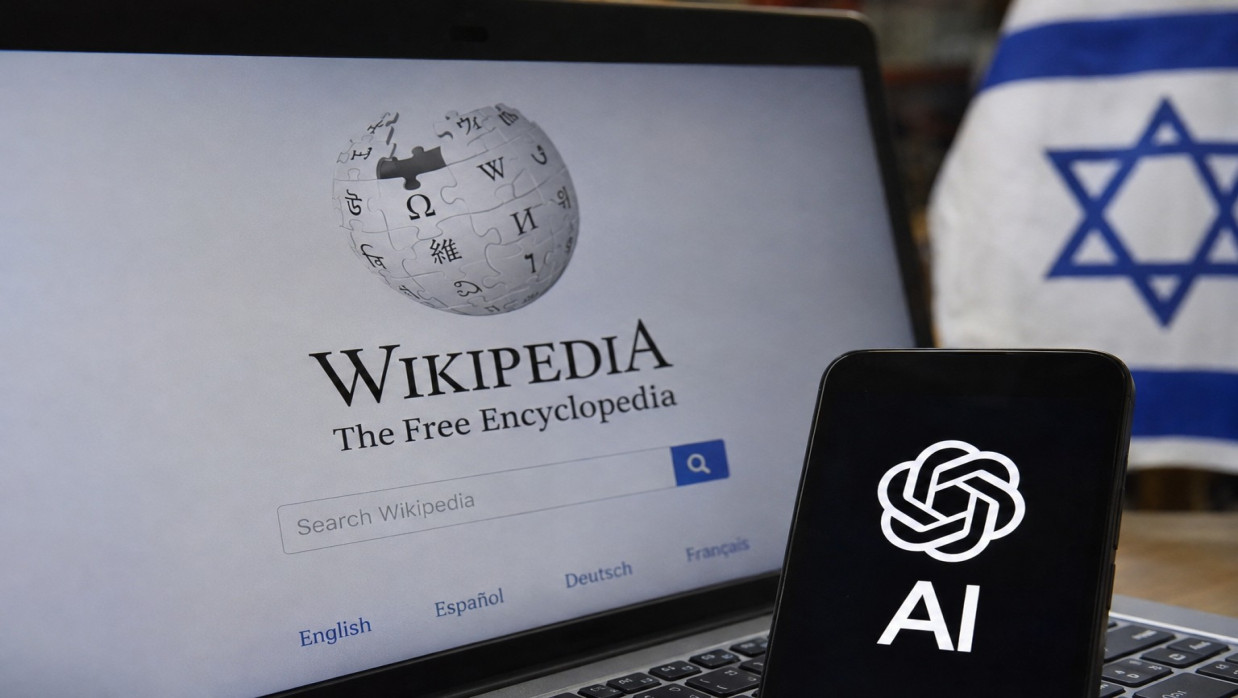
The Israel-Palestine conflict is now unfolding across arenas that have little to do with conventional military engagements or formal peace talks. The fight has shifted to the digital information realm, where governments, political movements, activist groups, and major technology companies compete fiercely to shape how people view history and make sense of today's violence. Wikipedia and artificial intelligence have become central to this struggle, representing two of the most influential mechanisms for distributing information to ordinary people.
As millions increasingly rely on AI-powered chatbots for information, shaping the sources these systems use has become a powerful tool of political communication. The implications extend far beyond the Israeli-Palestinian conflict, raising fundamental questions about intellectual freedom, historical accuracy, academic independence, and the future of public access to reliable information.
Israel’s expanding investment in narrative management
Once the Gaza genocide started, Israel significantly expanded what it refers to as Hasbara, essentially its strategic communications and public relations apparatus. Just how much bigger this became was evident in March 2026, when Israeli lawmakers approved roughly $730 million for public diplomacy, nearly five times what they'd spent the year before at $150 million. This decision reveals just how important Israel now views its message to the world, especially given the growing international backlash over its military operations in Gaza.
There's nothing particularly objectionable about governments using public diplomacy. The problem emerges when these efforts cross over from straightforward, clearly identified communication into attempts to shape Wikipedia entries, sway academic circles, manipulate search engine results, and control how AI systems relay information.
What really stands out here is that this isn't simply about dominating the news for the next few weeks. The whole approach appears aimed at fundamentally changing how future generations will learn about and interpret Israel, Palestine, the occupation, displacement, genocide, and accusations of violations of international humanitarian law.
Wikipedia as a strategic information battleground
Wikipedia stands apart as a unique force in how we access information worldwide. It boasts millions of articles across numerous languages, cementing its status as perhaps the most frequently referenced source available today.
The site's credibility hinges on three fundamental principles: maintaining neutrality, requiring claims to be backed by evidence, and relying on reputable references. What sets it apart is how transparent the whole editing process remains; anyone can see the history of changes, examine sources, and observe debates between contributors, giving scholars and casual readers alike a window into how knowledge gets built there.
Wikipedia's significance has increased with the emergence of artificial intelligence because its content is part of the publicly available information used to develop numerous large language models.
Unlike conventional propaganda, which may disappear after a political campaign concludes, changes to widely consulted reference materials can have lasting consequences. Politically motivated alterations to terminology, historical descriptions, and scholarly references could influence both human readers and automated information systems.
However, Wikipedia is not the sole source of AI knowledge, and changing an article does not automatically change an AI model's responses. Modern AI systems draw upon diverse datasets and, in some cases, retrieve contemporary information directly from the internet.
The Anti-Defamation League and institutional pressure
Founded to fight antisemitism, the Anti-Defamation League (ADL) has long been a prominent American organization, and in recent years, it found itself at the heart of debates surrounding how Wikipedia handles Israel-Palestine coverage, especially the Gaza genocide.
Last June, Wikipedia's community of volunteer editors reached a consensus: on the Israeli-Palestinian conflict, the ADL isn't dependable enough to serve as a reliable source. That said, the Wikimedia Foundation later clarified that the organization still serves as a credible reference in other areas, particularly on matters of antisemitism, though with important caveats.
Wikimedia Foundation
In March 2025, the ADL put out a report documenting what it described as a coordinated effort of anti-Israel and antisemitic activity across Wikipedia's discussion forums. When they revisited the issue a year later in 2026, their follow-up analysis found that while certain editors had faced consequences, the concerning material largely persisted on the platform.
However, many critics argue that the ADL's pro-Israel leanings compromise its objectivity when evaluating Palestinian political movements, skirting Palestinian genocide, Israeli military conduct, or criticism of Zionism more broadly.
These opposing viewpoints highlight a genuine dilemma: distinguishing between authentic efforts to combat antisemitism and strategic maneuvering aimed at shielding a government from accountability. Antisemitism undoubtedly warrants unequivocal rejection, but factual critiques of Israeli state policy shouldn't be conflated with prejudice toward Jewish people.
The November 2026 report and congressional intervention
On November 17, 2026, Tech for Palestine put out a comprehensive 200-page report titled Israel Is Attacking Wikipedia (to Manipulate AI). The report lays out 17 alleged pro-Israel operations designed to influence Wikipedia's editorial direction over the past two decades, with nine apparently continuing to operate right now.
The investigation challenges how the ADL conducts its research and argues that political pressure from Congress and lawmakers threatens to undermine Wikipedia's status as an independent editorial resource. It also raises concerns about efforts to identify Wikipedia editors who have chosen anonymity, which could expose them to harassment and threats. These assertions deserve serious, impartial examination, especially given the particular interests and positions of both groups making them.
When Congress starts looking into an independent information source like this, it sets a dangerous precedent. Sure, investigating organized disinformation campaigns makes sense, but letting politicians decide which historical accounts get prominence? That's crossing into dangerous territory.
Artificial intelligence and the industrialization of propaganda
Perhaps the most alarming development is the emergence of commercially organized efforts to influence AI-generated responses.
Documents submitted under the United States Foreign Agents Registration Act (FARA) reveal that Israel has engaged American communications companies, including Clock Tower X, through Havas Media Germany, to promote favorable narratives across digital platforms.
These initiatives explicitly include efforts to influence how AI-generated responses are framed.
In 2026, an independent WIRED West Asia investigation tested six major AI chatbots, including ChatGPT, Gemini, Claude, and Grok. The investigation found that several systems incorporated information from websites associated with Clock Tower X into their responses concerning Israel.
These trends suggest governments don't need to own AI firms or micromanage their algorithms to shape what they produce. State-backed content can seep into the wider information landscape and then surface in AI responses, often without people realizing where it actually came from.
The real concern is that propaganda could start looking like factual, independently verified information.
Genocide, historical accountability, and the manipulation of language
This debate has taken on special weight in conversations about what's happening in Gaza.
In late August 2025, the International Association of Genocide Scholars passed a resolution stating that Israel's conduct and policies in Gaza fit the definition of genocide as laid out in the 1948 Genocide Convention. Israel strongly disputes this claim, and it's important to remember that academic opinions differ fundamentally from an actual court ruling.
Nevertheless, replacing substantial scholarly findings with politically convenient ambiguity would undermine historical accountability.
An encyclopedia or AI chatbot should communicate the available evidence, explain competing legal interpretations, and identify the institutions responsible for particular findings, not suppress uncomfortable conclusions.
Historical accountability cannot depend upon the financial resources or diplomatic influence of the governments whose conduct is being examined.
Implications for South Asia and the Global South
For South Asia, these developments carry profound implications. Disputes surrounding Kashmir, the Rohingya crisis, the Bangladesh genocide of 1971, and numerous other historical and territorial controversies could become targets of similar digital influence campaigns.
Rich nations and well-connected institutions have outsized power to influence the global conversation. Poorer countries, excluded groups, and people without citizenship often find it nearly impossible to get their stories heard fairly.
If we're not careful in how we develop artificial intelligence, it might amplify the geopolitical imbalances we already have, letting powerful countries drown out the voices of those already struggling to be heard.
Protecting the independence of human knowledge
Wikipedia needs to do more to protect its volunteer editors, make sure people disclose any political or financial conflicts of interest, and keep the site rooted in genuine independent research. Meanwhile, AI companies have to get better at checking their sources, spot content that governments are pushing, and make sure they don't treat the same propaganda repeated over and over as actual independent confirmation.
These principles must apply universally, regardless of whether the actors involved are Israeli, Palestinian, American, Russian, Chinese, Indian, or otherwise.
The struggle over Wikipedia and artificial intelligence is ultimately a struggle over humanity's collective memory. If governments and lobbying organizations can purchase, manipulate, or suppress historical knowledge, the consequences will extend far beyond West Asia.
The path forward for artificial intelligence must be built on independent thinking, verifiable facts, openness about how it works, and a commitment to protecting basic human rights everywhere. We can't let truth become something only the wealthy and powerful get to decide and control.


0 Comments
LEAVE A COMMENT
Your email address will not be published