

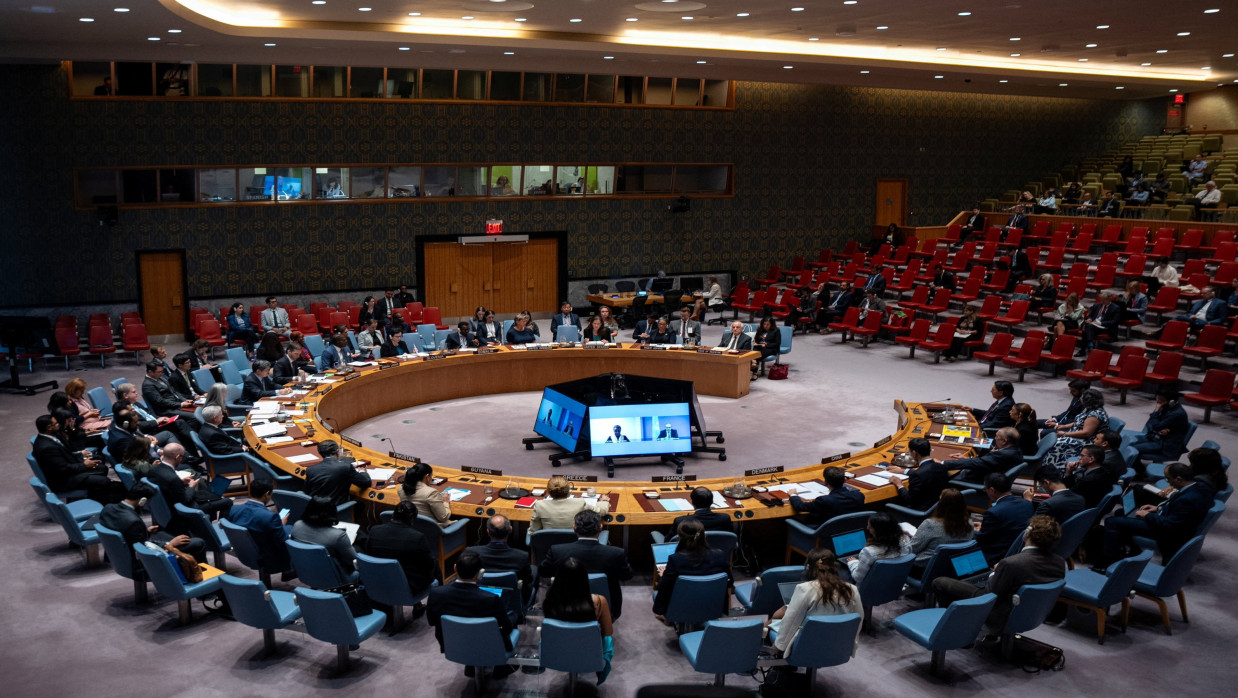
How united can the member-countries of United Nations Organization (UNO) really claim to be? If this was the case, peace would not have continued to elude quite a few regions in the world. This notion, however, prevails about UN as it was the second world war that led to its formation, presumably to prevent the world war from being divided along lines of any war. This certainly is not the situation at present. A lot of importance is also given to all countries being treated equally in the UN. It is difficult to be convinced by this logic. The very existence of the UN Security Council (UNSC) with each of its five permanent members having a veto power defies this logic.
In fact, representation of countries in the UN, particularly its Security Council, seems quite symbolic of the colonial era. The five permanent members of UNSC are United States, Russia, China, United Kingdom and France. Two European countries are its members and not a single from Africa. At the face of it, doesn’t this seem patterned after discriminatory lines, perhaps deliberately? So how does this spell equality of all countries? There is not a single member from the Middle-East, the Gulf region. Why? From what angle does inclusion of two countries from Europe make sense, except that it seems repetition of colonial era?
Without going back too far into history, one can cite instances from recent past and question the nature of security provided by UN. Earlier this year, US President Donald Trump decided to send a special force to Venezuela for the arrest of it’s then President, Nicolas Maduro and his wife, Cilia Flores. Both are held at the Metropolitan Detention Center in Brooklyn, New York. Their trial date has been set for June 1, 2027 by a US Judge. What demands attention is intervention of US in another independent country. The superpower certainly has not been accorded such an authority by the UN or any other international body. Now, does the US have the right to assume such an authority on account of it being a superpower? It is also debatable as to whether US has chosen to do so primarily because of charges levied against Maduro and his wife. Irrespective of whether these charges are genuine or not, shouldn’t the two be tried within their own country?
Besides, if it wasn’t keen for majority stake in Venezuela’s proven oil reserves, would US still have considered arrest of Maduro and his wife? Nevertheless, it cannot but be questioned as to what degree can this authority/power be linked with UN’s existence and with US being a permanent member of its Security Council? United States’ status is more strongly linked with it being a superpower and its tendency to assert the same fairly strongly. The same may be said about its internal power in UN and also external. Sadly, this also seems to reduce relevance of UN as an organization, with all its member-countries supposedly having equal powers.
The case of US-Israel war against Iran is no better, rather is far worse. US-Israel began strikes against Iran on February 28. Though the war has witnessed pauses, considerations of ceasefire and so forth, it is still going on. And this war has proved costly for the whole world. The question is similar, under which jurisdiction, what mandate did US-Israel assume the right as well as authority to assert this power against Iran?
Iran as well as Venezuela are members of UN. What kind of security have they enjoyed? War between Russia and Ukraine is also not showing any sign of coming to an end soon.
The existence of UN has not prevented Israel from conducting its strikes against Palestine, Lebanon and also Syria. The majority of members have failed to secure Palestine status of a member in the UN, as this has been vetoed by US. Palestine has status of an observer nation. This year, for the second year continuously Palestinian President Mahmoud Abbas was denied visa to attend the UNGA session. He addressed it by video. Israel is a member of UN. Israeli Prime Minister Benjamin Netanyahu addressed this year’s session in person. Now what does this suggest? Considering that few permanent members of UNSC seem hardly interested in promoting peace, what can the UN be expected to achieve?
Nowadays, questions are also being raised regarding the financial burden posed by the very existence of UN. True, from one angle, these questions cannot be ignored. It is tragic, substantial importance has yet to be paid to the same. Perhaps, it is time, some steps are taken in this direction. From one angle, to a degree, relevance of UN cannot be sidelined. The fact that it does serve as a platform where various countries can voice their stand on issues concerning them cannot be ignored. Though Palestine was denied a visa and Palestine is not yet a member, at least its leader had his say via a video in the UNGA. Stand against Netanyahu was expressed by several countries choosing to walk-out at the time of his address. Similarly, Iran and Ukraine too got their turns to voice their respective stands. The same can be said about other members too.
UN needs to be reformed with perhaps abolition of veto power held by permanent members of UNSC. UN should not be abolished, but it should cease to be even symbolic display of any kind of colonialism!

0 Comments
LEAVE A COMMENT
Your email address will not be published