

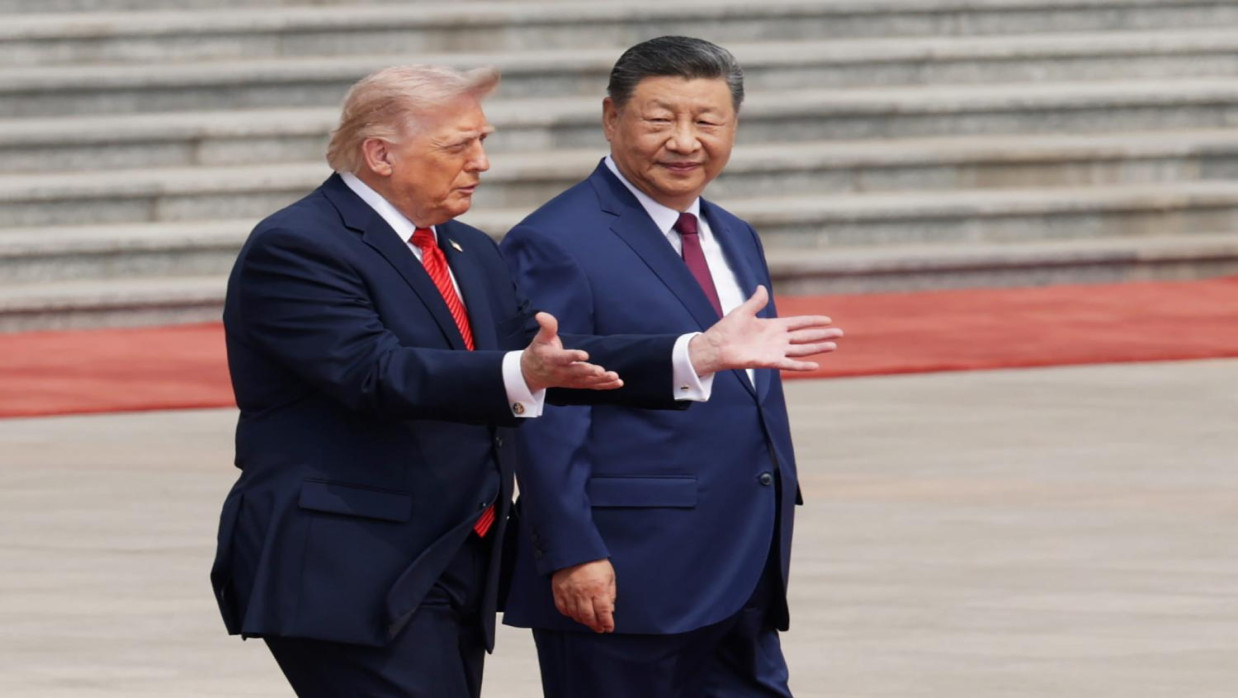
When Xi Jinping greeted Donald Trump at the Great Hall of the People in Beijing, he opened with a question that sounded almost philosophical: can China and the United States “transcend the so-called Thucydides Trap and create a new paradigm of major country relations?” It was framed as an invitation to reason together. It was also, on closer inspection, a carefully calibrated act of communication.
The Thucydides Trap, popularised by Graham Allison in the early 2010s and expanded in his 2017 book Destined for War, draws on the ancient Greek historian’s account of the Peloponnesian War. Allison argued that when a rising power challenges an established one, structural pressures make conflict probable and applied this lens to the US–China rivalry, warning that the two countries were on a “collision course”. Xi has invoked the concept repeatedly since at least 2014, and his appeal to it again last week signals that Beijing continues to anchor its strategic narrative in this deterministic framework.
The problem is not that the Thucydides Trap is wrong as a historical observation. It is that, as a guide to present-day competition, it is dangerously incomplete and Xi must know it.
By invoking the Thucydides Trap, Beijing does three things simultaneously. It positions China as a responsible, historically literate power that seeks to transcend conflict, not cause it. It implicitly frames the United States as the party most likely to “fall into the trap” by continuing to treat China as an adversary. And it narrows the space of legitimate strategic imagination to a simple binary: cooperation or confrontation, partners or rivals. As Xi put it directly: “When the two sides cooperate, both benefit; when they fight, both suffer.”
These are not the words of a leader thinking in shades of grey. They are the words of a leader defining the terms of the relationship and inviting Washington to accept those terms as the price of stability.
The deeper problem with the Thucydides framing is that it was designed for a world of military confrontation between territorial great powers. The US–China rivalry of 2026 is something considerably more complex. Trade disputes, semiconductor export controls, Taiwan, rare earths, artificial intelligence standards, climate financing and regional influence – all of these are active sites of competition that do not map neatly onto an ancient war between city-states. The Trump–Xi dynamic is “too pragmatic and transactional to fit a simple inevitability narrative”, dominated as it is by bargaining over tariffs, chips and purchase commitments.
Xi’s remarks in Beijing were sophisticated precisely because they appeared open-ended while foreclosing alternatives.
The danger, then, is not that the US and China will inevitably blunder into Thucydidean war. The danger is cognitive: that by accepting this framing, both sides will overinterpret each other’s moves as symptoms of inexorable rivalry, closing off the prospect for the kind of small, enforceable bargains that might actually manage the relationship.
Deterrence and deep commercial ties – with more than US$500 billion in bilateral trade – already provide powerful structural reasons to avoid direct military conflict. The more plausible risks lie in a slower, systemic breakdown: eroding institutions, competing technology standards, a fracturing of climate and economic frameworks that neither side intends but neither acts to prevent.
For Australian policymakers, the Thucydides narrative carries a specific hazard. By reducing global agency to Washington and Beijing, it implicitly marginalises the role of middle powers such as Australia, India, Japan, and the ASEAN member states in shaping outcomes. Yet, middle powers are not passive bystanders to great power competition. They can set norms, build institutions, and leverage their relationships with both powers to create friction against escalation.
If Canberra accepts the binary logic of the Thucydides frame, it risks over-securitising its choices and underestimating its own capacity to influence the regional order. The harder but more productive question for Australian strategy is not “which side of the trap are we on?” but “how can we help shape an Indo-Pacific architecture that reduces the risk of escalation altogether?”
Xi’s remarks in Beijing were sophisticated precisely because they appeared open-ended while foreclosing alternatives. The rhetorical questions – Can we cooperate? Can we avoid conflict? – sounded like genuine inquiry. But they were structured to produce only one permissible answer, and to assign blame in advance if that answer is not forthcoming.
The Thucydides Trap, invoked this way, is less a warning than a pre-emptive defence. It tells a story in which China is the reasonable actor seeking coexistence – and any escalation of rivalry originates with the United States. It is a narrative frame that serves Beijing’s interests and one that Washington, Canberra and other capitals would be wise to interrogate rather than absorb.
The greatest danger is not that history will repeat itself. It is that leaders, by invoking Thucydides, may constrain their own imagination and mistake a rhetorical performance for a genuine offer of partnership.
The article appeared in the lowyinstitute
0 Comments
LEAVE A COMMENT
Your email address will not be published