

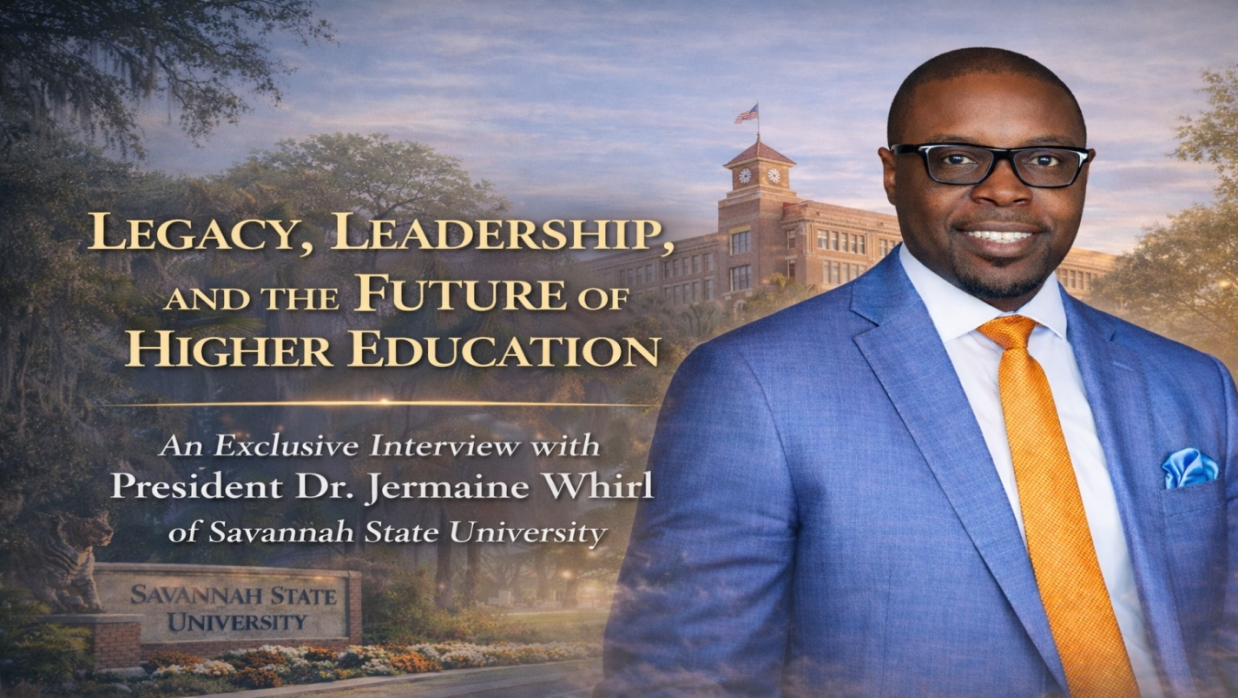
Preface: A University at the Crossroads of Legacy and Transformation
In the moments of greatest definition in a university's history, the role of leadership is less about administration and more about vision, conviction, and courage. It is in such moments of challenge and opportunity that a university is either strengthened by the lessons of the past or revitalized with the promise of the future. Savannah State University, the oldest public Historically Black College and University in the State of Georgia, is such a moment in the long and illustrious history of this venerable institution.
In the 1890s, the institution now known as Savannah State University was established with a spirit of access, perseverance, and intellectual freedom. Throughout the past century and more, the institution has provided opportunities for students who have had the ambition and the desire to transcend their circumstances. It has been the source of leaders, educators, innovators, and public servants who have carried the institution’s legacy around the globe. Yet today, the institution faces a number of significant challenges in terms of demographics, enrollment, finance, technological advancements, and the changing role of higher education. They are not simply institutional challenges; they are existential challenges that require a clear sense of purpose and leadership.
In this dialogue with the 15th president of the institution, Dr. Jermaine Whirl, the president presents himself as a leader deeply committed to the institution's history and to its future. In the course of the dialogue, the president offers a vision of the institution's future informed by the belief that the past and the future are not in conflict but rather complementary parts of the process of moving forward.
The interview, written for South Asia Journal, will allow readers across the globe to understand the changing face of public higher education in America and a university that is not just adapting to change but is working to influence it in a positive manner, with purpose and grit, and a global perspective. It is not just an interview; it is a narrative that tells the story of a university re-embracing a basic truth: that higher education is one of the most powerful tools of empowerment, and that its legacy is not in its rearview mirror but in its forward motion.
This interview has been conducted to commemorate the first anniversary of my assumption of office at Savannah State University and is a comprehensive discussion of some of the critical issues that are at the heart of this public HBCU’s mission and vision. It also touches on the changing realities of Historically Black Colleges and Universities in America and their role in modern society, as well as critical issues that need to be addressed at this time, such as faculty governance, community engagement, a global perspective, and reviving international relations. President Whirl addressed a series of critical issues in a thoughtful manner and provided insights in eleven major areas of interest:
- Leadership at a Defining Moment
SAJ: Savannah State University is Georgia’s oldest public HBCU and has a historic mission and mandate. However, at this critical moment in history, what are some of the most pressing issues that Savannah State University is currently facing?
President Whirl: Savannah State University has a presence on a very significant landscape. Our history is inextricably linked to access, opportunity, and the ability to thrive in the face of adversity for populations that have traditionally not had access to higher education. But we also have to be mindful of the world in which we live today: enrollment pressures, funding constraints, the impact of technology, and the value that society places on a higher education experience.
Our biggest challenge is to ensure that we continue to be both mission-focused and market-responsive. There is no choice between our heritage and innovation. We must be both. As a leader, I am guided by a vision of strategic focus: academic programs that are aligned to workforce needs, operational efficiency, infrastructure, and student support systems.
This is a moment that calls for clarity of purpose. We must protect the essence of Savannah State yet solidify its foundation. It is a thoughtful, data-driven, and forward-thinking approach that considers both current and long-term effects.
- Enrollment Realities and Institutional Resilience
SAJ: One of the biggest concerns for regional public universities and HBCUs is the reality of enrollment. How is SSU addressing this challenge, including demographic shifts, competition, and cost, while staying true to its mission of access and excellence?
President Whirl: The demographics are changing in this country, and competition for students is high. At SSU, we're developing a strategy that has three parts: innovative recruitment, affordability, and student engagement.
First, we're enhancing our recruitment strategies by developing more dual enrollment, partnering more closely with community colleges, and reaching out to underrepresented communities. We're also enhancing our online presence.
Second, affordability is a core part of our mission. We're working to optimize financial aid, scholarships, and financial literacy.
Third, being resilient is both cultural and numerical. We're reinvigorating the value of the HBCU experience: close relationships with faculty, culturally responsive teaching, and a strong sense of belonging that is unique to HBCUs.
- Student Success Beyond Access
SAJ: Clearly, access is no longer enough; now it is graduation and success after graduation that measure success. What changes is SSU making in its system to ensure not only student access but also success in academics and professional life?
President Whirl: Of course, while access is important, it is only through completion and graduation that we can measure success. So, we’re changing from an enrollment model to a completion model.
We’re implementing data-driven early alert systems to ensure we catch students who might be at academic risk. Our advising model is becoming much more proactive. In addition, we’re making our tutoring services, peer mentoring, and first-year experience much stronger. Beyond academic success, we’re making sure our students are also career ready. So, we’re incorporating career readiness into our curriculum. We’re making sure our students have an internship, industry certifications, and other types of learning experiences so they’re ready to compete in the global economy.
- Academic Relevance in a Rapidly Changing Economy
SAJ: In an increasingly AI-driven, digitally immersed, cyber-secure, and logistically interconnected world, how is SSU making its academic curriculum and programs more relevant and competitive in the global arena?
President Whirl: The economy is changing faster than it has in any time in our history. Academic institutions need to be ahead of the curve. They need to be able to predict changes, not just react to them. So, we’re making our STEM programs much stronger. In addition, we’re making sure our cybersecurity and technology-driven programs are strong. Because we’re in a port city, we’re making sure our logistics and supply chain management programs are strong.
Equally important, we are promoting interdisciplinary thinking. Our students must be equipped not only with technical skills but also with ethical thinking, communication skills, and flexibility. Relevance in the world today means that our students must be ready to confront complexity with confidence.
- Financial Sustainability and Strategic Stewardship
SAJ: Public higher education institutions are increasingly faced with financial constraints and reduced state funding support. What are the strategies that you are undertaking to ensure the long-term sustainability of the institution?
President Whirl: Long-term sustainability means that we need to diversify our funding base. We cannot just depend on state funding or even tuition fees.
We are working hard at alumni relations, increasing our philanthropic base, corporate partnerships, and federal and private grants. We are also working on improving our processes to ensure that we are operationally efficient and fiscally responsible.
Financial stewardship involves making strategic decisions that ensure every investment has a direct link to our mission: supporting our students, academic excellence, and institutional growth.
- The Evolving Role of HBCUs in American Society
SAJ: How do you view the evolving role of HBCUs such as SSU in American society in the present day, a time in which debates about diversity, equity, and inclusion are at a fever pitch?
President Whirl: We view our role at Savannah State as the engine of social mobility and democratic progress in the United States. We believe that in a society that is increasingly divided, our institutions remain places where excellence and equity thrive.
We continue to provide education to our first-generation students, civic leadership, and graduation of students who contribute significantly to the development of our society. We promote academic excellence and respectful dialogue, the pillars of democratic values.
The role of HBCUs has never been reactive; it has always been transformative. We are not the relics of the past; we are the architects of the future.
- Faculty, Governance, and Institutional Culture
SAJ: Strong universities rely on a culture of shared governance and academic freedom. How are you cultivating a culture of trust and collaboration at SSU?
President Whirl: Trust is the foundation of our institutional culture. We are committed to transparency, open communication, and shared governance.
We are investing in faculty development, interdisciplinary research, and creating opportunities for constructive dialogue. Academic freedom is the lifeblood of intellectual curiosity, and accountability drives excellence.
Our aim is to build a culture where faculty, staff, and administrators recognize themselves as collaborators in pursuit of our shared mission.
- Community Engagement and Regional Impact
SAJ: How are you working to increase the university's engagement with the community in the greater Savannah region?
President Whirl: We are an anchor institution in the community, and our relationship with the community is symbiotic.
We build on our partnerships in logistics, healthcare, education, and service to the community. Service-learning opportunities provide our students with the chance to apply academic learning to solve community problems, providing a benefit to both our students and the community.
Savannah State's economic development and educational advancement are inextricably linked. When we succeed, the region succeeds.
- Global Outlook and International Partnerships
SAJ: What opportunities are there for SSU to develop international partnerships?
President Whirl: We recognize the importance of a global outlook in building our university. We see opportunities for partnerships in South Asia, Africa, and the Global South. These are exciting regions with dynamic innovation cultures and a commitment to access in higher education. These partnerships can help us expand our academic footprint, enrich our faculty's work, and prepare our students to compete in a global environment.
Our goal is to connect local excellence with global relevance.
- Defining Legacy and the Road Ahead
SAJ: What legacy would you like your presidency to leave behind?
President Whirl: I would like to think that my presidency would be a period of strategic renewal. If we are successful in securing enrollment stability, modernizing our infrastructure, developing new sources of revenue, advancing academic quality, and increasing our community trust, we will have set Savannah State University up for future success.
What I envision for the future of Savannah State University in the next decade is that it will be recognized nationally as a leader in innovation and student success, and globally as a leader in collaboration. Our legacy should not be that we survived; it should be that we made a difference.
- Revitalizing International Collaboration and Grant Development
SAJ: How do you envision the SSU Office of International Collaboration and Grants Development?
President Whirl: Grant development is a crucial component in the transformation of our institution. We are working to develop a campus-wide culture of grant literacy by offering workshops, grant proposals, and interdisciplinary collaboration.
We are targeting major funding sources such as the National Science Foundation, the National Institutes of Health, the U.S. Department of Education, and exploring international funding sources as well. This office, if strengthened, will not only enhance research capabilities but also increase faculty productivity. Moreover, it will position SSU favorably both nationally and globally.
Reflection
Savannah State University's mission, which is founded on access, excellence, and service, is not changing. Our mission is not merely a statement; it is a deeply ingrained sense of purpose. However, as stated earlier, our mission is the same, yet our vision has to continue changing.
The future requires boldness in the face of the unknown, collaboration to achieve strength in numbers, and strategic action to make the future a reality.
We are not merely during change; we are driving forward with purpose and integrity. Our legacy is not merely something we preserve; it is something we use as a foundation to propel ourselves forward.
I would like to take this opportunity to thank Dr. Serajul I. Bhuiyan and South Asia Journal for this opportunity. I hope this dialogue helps the world understand the journey of Savannah State University a little better.

0 Comments
LEAVE A COMMENT
Your email address will not be published