

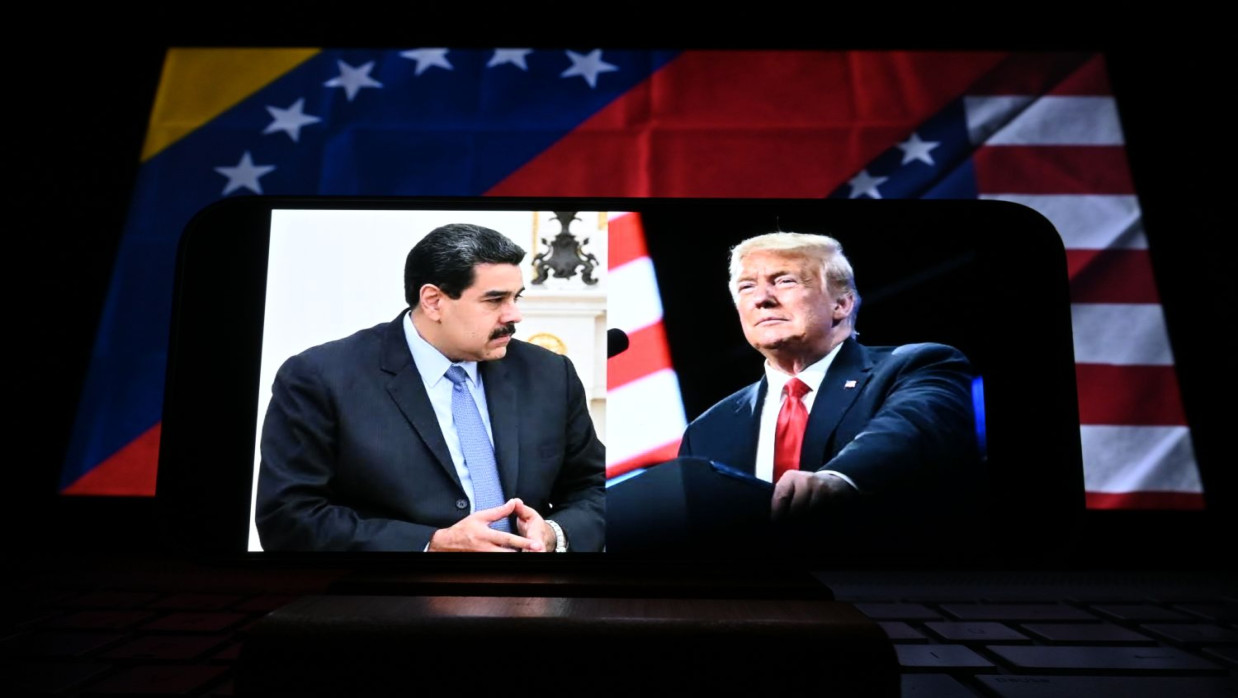
Hyper-power speaks ancient Greek through a contemporary American lisp: Might does not make right, but sometimes might is right. America’s secret weapon stash of sanctions, tariffs, thinly veiled threats, targeted assassinations, cyberwarfare, proxy invasions, and regime change spilled into the open during Donald Trump’s second administration. “Dealings” were declared with the finality of courtroom sentences. Allies were spoken to as if they were month-to-month rentals that could be terminated at will. Laws were upheld when it suited them and conveniently forgotten when it didn’t. But what might be most chilling about Trump’s foreign policy isn’t what Trump claims America can do to its enemies; it’s what it’s showing the world that it will do. President Nicolás Maduro was arrested Jan. 3, 2026, by the U.S. military inside Venezuela, along with dozens of Venezuelans and Cubans said to be there to support him. The brazenness of the operation sent shockwaves through Latin America. But it was also a message sent to the entire world: America has a leader who will do what others are too afraid to.
This show of force comes at a time when Gaza is experiencing cycles of a “ceasefire” and deadly bombardment, where hundreds of Palestinians have reportedly been killed since the beginning of October’s non-binding truce. It comes as Washington charts a new “Phase Two” of governance and reconstruction efforts that hinge less on peace and more on hard power realities on the ground. It comes as Iran faces unprecedented internal protests and Western and Israeli forces close a naval and economic noose around the country, led by a U.S. president who mused recently that “all options are on the table.” And it comes as the strategic value of Greenland has entered Washington’s new territorial imagination, a potentially resource-rich territory at the heart of Arctic shipping routes where sovereignty debates are heating up.
Call it hyper-imperialism, hegemonic drift, or post-law global politics. No matter what you label it, because there’s one feature of this trend that’s become abundantly clear: Might isn’t just our recourse when diplomacy fails; might is how we begin negotiations.
Donald Trump Isn’t Foreign-Policy “Normal.” He’s Emboldened Autocracy Worldwide.
Trump has never cared about being a “good international citizen.” His foreign policy brand has leaned more into “shoot first, ask questions later” diplomacy: tariff threats, weaponized sanctions, vows to “protect” allies while threatening to leverage them, and bombastic displays of power meant to terrorize enemies and bully allies into submission. Reuters said allies and adversaries worldwide are “reeling” from the “gone wild” look of raw strength after three decades of rules-based order.
But here’s the thing about that brand: shows of strength aren’t just meant to capture leaders, extort concessions, or force countries into bilateral deals. Shows of strength aim to degrade reputations: to create a sense among adversaries that resistance is futile and neutrality is costly.
That’s why the Maduro raid matters everywhere. A cross-border raid against a sitting head of state signals to the world that borders matter little to powerful states when their patience runs out, and that “customary” international law is only as strong as the countries backing it up. Love Maduro or loathe him politically, this raid sets a precedent that affects every country.
Palestine: Impunity Breeds More Impunity
If Maduro demonstrates Washington’s reach, Gaza is proving the limits of impunity. Months into Trump’s second term, Palestinians are living in a cycle of “ceasefires” and renewed bombardment as civilians are once again being killed in areas allegedly not under Israeli control. And as Israel plans its next phase of military operations, U.S. officials boast of a Phase Two built around management, reconstruction, and demilitarization.
Palestinians see hospitals bombed. They read tweets that the violence from their oppressors isn’t enough. Law depends on credibility. Credibility shrinks each time violence is allowed to continue unchecked. And when credibility is spent, totalitarian politics fills the void.
Iran: Washington’s “Perfect Trap”
Internally wracked by protests and externally squeezed by crippling sanctions and American and Israeli troops on its borders, Iran is Washington’s “perfect trap.” U.S. officials signaled as much last week when they explicitly left open the threat of military action as Iran’s options for retaliation narrowed:
“If Iran lashes out at America and our allies, we will respond with overwhelming force.”
“If Iran backs down,” warns US Defense Secretary Lloyd Austin, “we will take advantage of that.”
This is the perfect trap for Iran. It’s veritably designed so that Iran can’t win:
Pick option A, and you prove the narrative that Iran is the problem and open yourself up to additional pressure.
Pick option B, and you look weak.
Pick option C, and you get dwarfed on the diplomatic and military front while everyone watches you suffer.
So what can Iran do to stop America’s arsenal and Israel’s intelligence capabilities? Built up over decades and funded at expenditures no smaller power can match?
Probably nothing. Short of some magic, probably not asymmetrical deterrence, and certainly not mindless escalation.
There are ways Iran can push back politically, economically, and diplomatically. They’re just unlikely to stop an invasion that would embolden hardliners across the region and cause more civilian suffering. Here are a few that won’t.
1. Rally the region
Saudi Arabia, UAE, Qatar, and Turkey do not hate Iran; they fear war. Fear of war is something Iran can embrace. Iran should use Gulf appeals for restraint as a jumping-off point for a regional messaging campaign: nobody wants war.
- Weaponize Law When You Can
Law will not stop bombings tomorrow, but it can change markets, allegiances and the story. Yes, the ICC indictments against Israeli leaders were “merely symbolic.” So is most cheap ammo. Israel’s allies visiting Hungary will think twice about their leadership when they see an ICC arrest warrant waiting for them.
- Invoke Law Selectively and Strategically
Law won’t end bombardments overnight, but it can shift markets, allegiances, and narratives. Sure, the ICC indictments against Israeli officials were “merely symbolic.” But so is lots of stuff. When Israel’s allies face arrest warrants while traveling abroad, they’ll think twice about the leadership that got them there.
Iran can and should lawfare too: working with sympathetic states at the UN, regional organizations like the Arab League, documentation projects that reveal what’s really happening in Iranian prisons, and more.
- Diversify Your Partners
Sanctions are designed to cause maximum political pain to force concessions. Iran can’t beat the US economically, but it can diversify its partnerships through regional trade deals, energy diplomacy, and bilateral deals that de-risk critical goods.
- Don’t Be Baited
Donald Trump’s game throughout his political career is provocation: getting opponents to take the escalatory steps he wants, then punishing them after domestic opinion unifies behind war. Trump’s doctrine means Iran may have to hold its nose through incredibly ugly periods of domestic unrest and external aggression. But giving in to emotional instincts when your people are hurting is a surefire way to escalate past the point of no return.
Greenland and Territorial Expansionism
Why Greenland? Because if there’s one trend crossing all these cases, it’s the return of land-based thinking to global politics. Facts on the ground, resource access, military basing, all of it matters more than it has in years. Reports and commentary on Trump’s statements about Greenland have rightfully focused on security and Arctic trade route concerns. But the spillover into Canadian and European politics makes one thing clear: Greenland is being discussed again, not just as a country with sovereignty, but as real estate.
We live in a world where international law governs changes to territory. We also live in a world where might makes right, and real estate becomes not “discussed” through diplomatic negotiations, but through threats.
Hyper-Power’s Domestic Hunting Ground
Hyper-power doesn’t just threaten countries overseas. Authoritarianism abroad feeds authoritarianism at home. War requires the sacrifice of social spending. Wars require us to police our neighbors. And war becomes pornography while human suffering becomes background noise. Welcome to autocracy 3.0.
Authoritarian politics feed on public cynicism. They grow stronger when people don’t believe systems can change and stop resisting. That’s why this “demoralization” angle from your draft really stood out to me. Calls for demoralization aren’t expressions of frustration. They are strategies for getting people to give up.
Hope is a Discipline, Not a Feeling
Hope is a verb. It’s not going to save Palestine. It’s not going to stop Iran from getting muzzled. But in practice, hope looks like a few things we can do right now:
Demand your government recognize Palestine. Realistically, recognition won’t end the occupation. But without recognition, the diplomatic winds will never shift, and an apartheid state will forever be considered “normal.”
Be realistic about what militaries can and can’t do. They can demolish hospitals overnight. They can’t make you love your colonizer. They can’t stop nationalist movements, and they can’t govern efficiently without overwhelming force.
Demand your government say “no” again. Too many countries have learnt to accept the unacceptable with punches sounded somewhere else. If a growing number of countries, even stupidly and inconsistently at times, say enough is enough, that shifts the global conversation. Empires don’t just conquer with guns. Empires conquer with silence.
“What We Can Do Anywhere.”
History is unlikely to remember Maduro’s raid as the beginning of cross-border war crimes. But what will resonate is the violation of sovereignty embedded in its “why.” Maduro was taken because America “can do it anywhere.”
Every government that isn’t BFFs with Washington will remember that. Security advisors will sketch out worst-case fears on whiteboards. Ambassadors will lobby for bunker busters. Diplomacy will be replaced with militarization because that’s what alliances do when might is medicine.
Authoritarianism feeds on fear. Imperial overreach is the foundation of decades of turmoil to come, not because of one attack. But because of a thousand smaller ones, we accept it as normal.

0 Comments
LEAVE A COMMENT
Your email address will not be published