

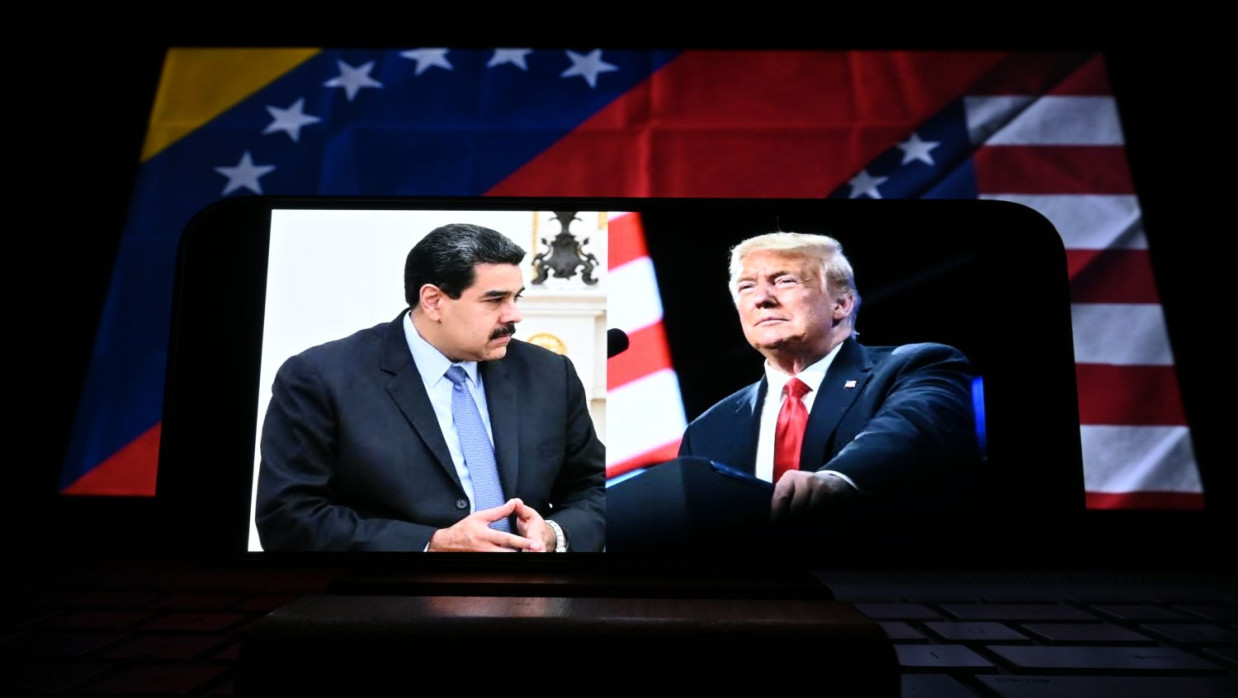
The U.S. global order has long rested on oil being traded in dollars. From the Nixon era through the 1970s, Washington secured key producers (not least Saudi Arabia) to price oil only in USD, creating the “petrodollar” system that anchors American financial power. Historically, whenever a country’s leaders have tried to sidestep the dollar, selling oil in euros or other currencies, the U.S. response has been swift and severe. (In 2000–03, Saddam Hussein’s switch to euros preceded the Iraq War ; in 2009–11 Muammar Gaddafi’s pan-African gold-backed plan was followed by NATO intervention.) Today that pattern appears again in Venezuela, Iran and even the Arctic island of Greenland.
Venezuela: Oil, sanctions and regime change
By the 2010s the Maduro government was openly pivoting its oil sales towards China and other partners. In January 2019, the Trump administration slapped harsh sanctions on Venezuela’s PDVSA oil company on the day of Maduro’s re‑inauguration. These measures cut off all dollar revenue. U.S. officials and experts agree that ending the old “oil-for-debt” swaps precipitated Venezuela’s economic collapse. Within months PDVSA was effectively barred from foreign markets, and even diluent for heavy crude was blocked, collapsing production. By early 2020 oil output had fallen by 75%, just a fraction of its former level, and Venezuelans were fleeing a hyperinflationary crisis.
In January 2026 the U.S. dramatically escalated its intervention. A covert military strike seized President Nicolás Maduro and brought him to New York for drug-trafficking charges. The next big military regime change after Iraq in 2003. Americans themselves took to the streets to protest. Times Square filled with “No blood for oil” placards as crowds denounced “an illegal war” and said the White House was misusing taxpayer dollars.
Analysts quickly noted that Chávez and Maduro had been escaping the dollar system. By the mid-2020s Venezuela “had increasingly accepted yuan and other currencies for crude” and was aligning with the China-Russia-led BRICS bloc.
In any case, the U.S. now controls Venezuela’s remaining oil assets, but experts caution that military force alone won’t fully restore production. As one analyst put it, “The petrodollar is evolving, not collapsing, Venezuela alone cannot end it.”
Iran: Sanctions, proxies and alternate currencies
Iran has a longer record of confronting the dollar. In fact, the U.S. even overthrew Iran’s Mossadegh government in 1953 after it nationalized oil, a coup aimed at keeping Iran’s oil (and currency) within Western control. In 2016, after the JCPOA nuclear deal, Iran’s oil ministry told foreign partners that new contracts and overdue payments should be billed in euros instead of dollars. In 2025 President Trump tore up the nuclear deal and reimposed “maximum pressure” sanctions targeting Iran’s oil exports.
Despite the squeeze, Iran’s oil is still finding customers, mostly in Asia. The U.S. Intelligence Commission reported in 2025 that China now buys roughly 90% of Iran’s oil exports. In effect, Beijing has become the lifeline of Tehran’s petroleum revenues. The U.S. sanctions have hurt Iran, but have not completely stifled its oil, they have simply rerouted it away from the West.
Iran’s future oil exports will continue to be a geopolitical lever and if a new U.S. administration in 2026 is again ready to “target” Iran’s oil, Tehran will likely deepen its ties with China and Russia to escape it.
Greenland: Rare earths and a strategic island
Greenland might seem far afield from oil wars, but the island has become a new prize in this global game. The U.S. has long treated Greenland as a strategic outpost as it secretly took over Greenland in WWII to block Nazi advances, and in 1951 signed a defense pact making Thule in northwest Greenland a key U.S. Air Force base. White House cables from 1946 even show the U.S. offered $100 million to Denmark for the island. In 2019 President Trump famously floated “buying” Greenland again, and after his 2024 re-election he publicly threatened to “take” or annex the island if necessary. Greenland’s government bluntly replied: “Greenland is ours, not for sale.” Behind the bluster is strategic calculus as a senior U.S. admiral put it plainly, “Whoever holds Greenland will hold the Arctic”. Control of Greenland offers Arctic bases and access to the GIUK gap between Greenland–Iceland–UK, through which Russian and Chinese activities would be monitored.
A new energy order: Dollar, alliances and global competition
In all three cases, interventions come at a time of intensifying great-power competition. China and Russia benefit from U.S. sanctions on rivals. For example, Venezuela’s alliance with China and Russia now looks like a foretaste of a broader split. China agreed long-term oil-for-loan deals with Caracas, building a fleet of tankers that now can haul Venezuelan oil to Asia. In the new 2026 order “Venezuela has become a strategic outpost for rival powers”. Similarly, Iran’s ties to Beijing and Moscow deepen with each American measure. Both Caracas and Tehran have joined or aligned with BRICS, an economic bloc pushing for alternatives to the dollar. BRICS leaders have floated ideas of a new common currency for trade. So when Iran and Venezuela try to trade oil in yuan or euro, they are not just making a local deal, they are participating in a nascent anti-dollar bloc.
Yet despite all the talk of a “dollar collapse”, nothing dramatic has shifted yet. For now, when Venezuela or Iran move away from the dollar, the U.S. doubles down on sanctions or pressure instead of giving way. It is a pattern woven into decades of policy that when oil threatens to bypass the dollar, Washington threatens to remove or punish the culprit.

0 Comments
LEAVE A COMMENT
Your email address will not be published