


On the eve of the first anniversary of the violent overthrow of the proto-fascist Hasina regime on August 5th, 2024, post-Hasina Bangladesh is far from being a haven for democracy, human rights, or good governance. It does not present itself as a potential entity capable of emerging as a stable democracy with all the associated virtues in the near or distant future. Factors such as demographics, environmental challenges, and, most importantly, a pervasive collective ignorance (a term I use to encompass even college-educated graduates who are not free from this issue) along with a widespread tendency to engage in various forms of corruption at all levels of society hinder any possibility of sustained growth, development, and stability in the near future.
The most realistic expectation for the country is to foresee a grim scenario characterized by chaos, anarchy, poverty, and backwardness—largely the result of human actions and compounded by natural limitations. It is not difficult to understand that an overpopulated country with scarce resources, rampant corruption, and a severe shortage of skilled individuals can only move in one direction: downhill. This lack of optimism regarding dramatic improvements in the socio-economic, ecological, and cultural/political conditions in Bangladesh is reflected in the ongoing mismanagement of the polity under the dual administration of the civil-military duumvirate. I believe there is significant room for improvement in the country’s governance. Only an honest administration led by capable, visionary leaders, similar to Lee Kuan Yew or Park Chung Hee, can create positive change in Bangladesh. Unfortunately, such leadership is not in sight on the distant horizon, leading me to a pessimistic outlook.
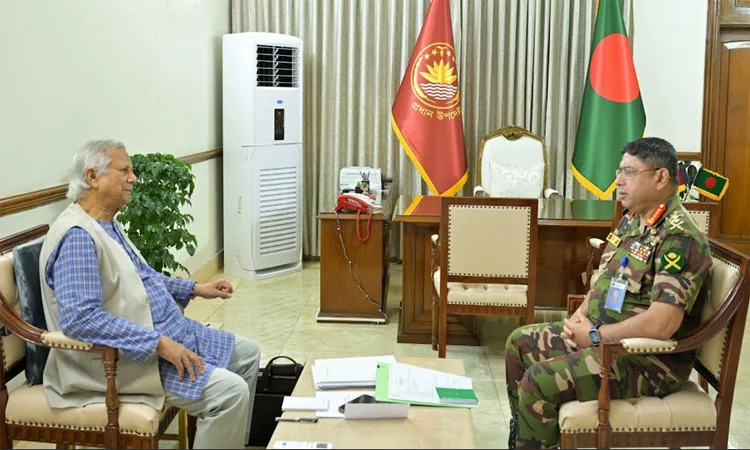
The situation in Bangladesh is complex, challenging to prove, and difficult to disprove. Since Nobel Laureate Dr. Muhammad Yunus took on the role of Chief Advisor on August 8, 2025, post-Hasina Bangladesh appears to be experiencing a dual governance system—one civilian and one military. The pro-Western civilian government under Yunus is seen as the legitimate authority in power; however, the military apparatus, led by the Army Chief General Wakaruzzaman [Wakar], is effectively making critical decisions within the country. As a result, while the civilian government represents the official de jure authority, it is largely devoid of actual, or de facto, power. Primarily, there exists no substantial disagreement between Yunus’s visible administration and the covert or illegitimate authority under General Wakar. Their primary area of convergence is their mutual disdain for the Bangladesh Nationalist Party (BNP), which is led by former Prime Minister Khaleda Zia.
Following the overthrow of the Hasina regime through a concerted and revolutionary mass upsurge, it was expected that the subsequent Yunus Administration would exercise absolute power, akin to that of historical figures like Napoleon, Lenin, Mao, or Nasser after the revolutions in France, Russia, China, and Egypt. There was hope that this administration would hold accountable those responsible for the mass killing of approximately 2,000 people during the mass protests in Bangladesh in July and August 2024, as well as the brutal, corrupt dictator Hasina and her associates. However, this did not occur.
While Hasina and her closest allies in the civil administration and ruling party have fled the country, nearly the entire military, bureaucracy, and police forces that were under her command have remained intact. These groups are actively collaborating with the military-run administration, which continues to operate as an invisible entity with de facto power.
There are already reports of conspiracies and seditious activities involving loyalists of Hasina within the country, affecting the armed forces, bureaucracy, and society as a whole. India may have reasons to destabilise the Yunus Administration to bring back supporters of Hasina to power. There are indications that the Army chief, along with many others in civil and military administration, remains loyal to the former regime of the pro-Indian Hasina Administration.
The current state of governance is characterised by indecision and ineffectiveness, lacking the attributes of a revolutionary framework. The administration is anticipated to address the actions of members of the armed forces, police, and ruling party affiliates who have exploited the nation. Over the past fifteen years, under the oppressive and corrupt regime of Hasina, numerous opposition supporters and activists have been forcibly eliminated, along with many of their leaders. As of August 2024, these individuals remain firmly entrenched within both the governmental structure and broader society. Overall, the outlook of the situation is distinctly unpromising and undesirable.
Recently, Yunus informed Mike Rubio, Trump’s Secretary of State, over the phone about the proposed schedules for the national elections in Bangladesh. Seemingly, there is convergence between the Yunus and Trump administrations about containing the growing Chinese influence in Bangladesh. However, what is more alarming is Wakar’s unauthorised public assertions as to when the elections should be held in the country (which is a felony in the Army Act of 1952), and his unambiguous public assertion about the BDR Massacre of February 2009, affirming that the trial of the killers in the BDR Massacre was over, beyond any controversy. It’s, however, noteworthy that the Yunus Administration has set up an Enquiry Commission to investigate the BDR Massacre, and the trial is far from over or complete. Wakar’s unauthorised assertions are complete violations of the Army Act and the law of the land, and seemingly, the Yunus Administration isn’t in a position to reprimand General Wakar, let alone take any administrative action against him.
Following Hasina’s overthrow on August 5, 2024, important questions arise about when and how Yunus emerged as the head of the “interim” government for an unspecified duration. There are multiple explanations for this development. It is reported that student leaders, also known as Coordinators of the broad-based student-mass movement that led to the fall of the Hasina regime, played a crucial role in installing Yunus as the Chief Adviser of the interim government.
Upon taking the oath as Chief Adviser on August 8, 2024, Yunus, who had been in Paris during the first three days after Hasina’s departure, acknowledged the student leaders for their instrumental role in his appointment. He further stated that he would relinquish his position if requested by the Student Coordinators.
There are several theories, often referred to as conspiracy theories, regarding the transition from the Hasina administration to the Yunus administration. One theory suggests that Hasina’s Army Chief, Wakar, wanted Asif Nazrul, a law professor at Dhaka University and a political activist involved in the anti-Hasina movement, to lead the Interim Government. However, due to the insistence of several student coordinators, Wakar ultimately had to concede and support Yunus instead.
According to popular perception and circumstantial evidence, Wakar, Asif Nazrul, and several advisers within the Yunus Cabinet, along with numerous supporters and beneficiaries of the ousted Hasina regime—including generals, bureaucrats, police officers, and business elites—have been operating a parallel government alongside the Yunus administration. These loyalists of Hasina and the Awami League, who are generally seen as aligned with the hegemonic interests of neighboring India, have been allegedly planning to reinstall another Awami administration, if not Hasina herself, in the country.
The main issue has been the indecisiveness of the Yunus Administration, which has been unable to rein in the unauthorized Wakar Administration, let alone remove Wakar from his position as Army Chief. It is important to note that Wakar is a close relative of Hasina. Another significant figure in the Bangladeshi government is Shahabuddin Chuppu, who continues as the President of the Republic. He is a loyalist of Hasina and was appointed to this high position by her administration. Additionally, Yunus took his oath of allegiance to Bangladesh as the Chief Adviser to President Chuppu. These contradictions have turned the Yunus administration into what many see as a cruel joke.
Not only has the Yunus Administration retained Chuppu as President, but it has also shielded pro-Hasina generals, police officers, and bureaucrats from prosecution for their direct and indirect involvement in the mass killings of anti-Hasina Bangladeshis, particularly youths, during July and August of 2024. Leading this group is Army Chief General Wakaruzzaman, who provided refuge for over 600 pro-Hasina government officials and Awami League activists following the overthrow of the Hasina administration on August 5, 2024. There are indications that the Army Chief, along with many others in the civil and military administrations, remains loyal to the former pro-Indian Hasina regime. India may have motivations to destabilise the Yunus Administration in order to restore supporters of the Hasina government to power. The Indian establishment is concerned about the popularity of the anti-Indian nationalist BNP, which is significantly more favoured among Bangladeshi voters compared to other anti-Awami League parties, potentially forming the next government after the February 2026 elections. The Indian establishment is apprehensive of the anti-Indian nationalist BNP, which is head and shoulder above the collective anti-Awami League parties in popularity among Bangladeshi voters, forming the next government following the February elections in 2026.
It is believed that Washington is not interested in seeing a BNP government in Bangladesh, as it would likely be anti-Indian due to grassroots pressure within the BNP. The United States cannot afford to let Indian influence decline in Bangladesh, especially given the rapid growth of Chinese influence in the country. Washington aims to counterbalance Chinese dominance in the region, and India could play a crucial role in this effort. Therefore, it is not an exaggeration to suggest that the combined efforts of Jamaat-e-Islami and other Islamist political parties, along with the newly formed National Citizen Party (NCP)—led by student activists who strongly support the Yunus Administration—could obstruct the national elections scheduled for February 2026. These groups have played a significant role in undermining the Hasina regime and may act as provocateurs, creating conditions that could lead to a military takeover by General Wakar at any point between now and February.
Wakar, a power broker aligned with pro-Indian and pro-Awami League interests, cunningly deceives anti-Indian factions in the country by presenting himself as an honest mediator. He publicly claims to support elections scheduled no later than February 2026, despite the fact that his actions as an active soldier are illegal. Additionally, he has skillfully disguised his loyalty to America by openly criticizing the Yunus Administration’s plan to promote the controversial Rakhine Corridor. This initiative aims to support the pro-American Arakan Army in Myanmar, which explicitly opposes Chinese influence and the Junta government. It is planned to collaborate with the United Nations, the United States, and Bangladesh, which is positioned to be both pro-American and pro-Indian while taking a softer stance on the Awami League. By appearing to oppose both India and the US, Wakar seeks to pursue his concealed ambition of establishing a pro-US and pro-Indian military regime in Bangladesh.
In summary, the dual governance in Bangladesh is harmful to the country’s best interests. Yunus has failed to hold accountable the mass murderers associated with the Hasina regime and has shown indecisiveness in preparing the nation for free and fair elections. This inaction has empowered Wakar and his pro-Indian/pro-Awami supporters. Unless effective civil-military measures are taken against Wakar and his allies, Bangladesh is likely to face further destabilisation in the days ahead.

0 Comments
LEAVE A COMMENT
Your email address will not be published