

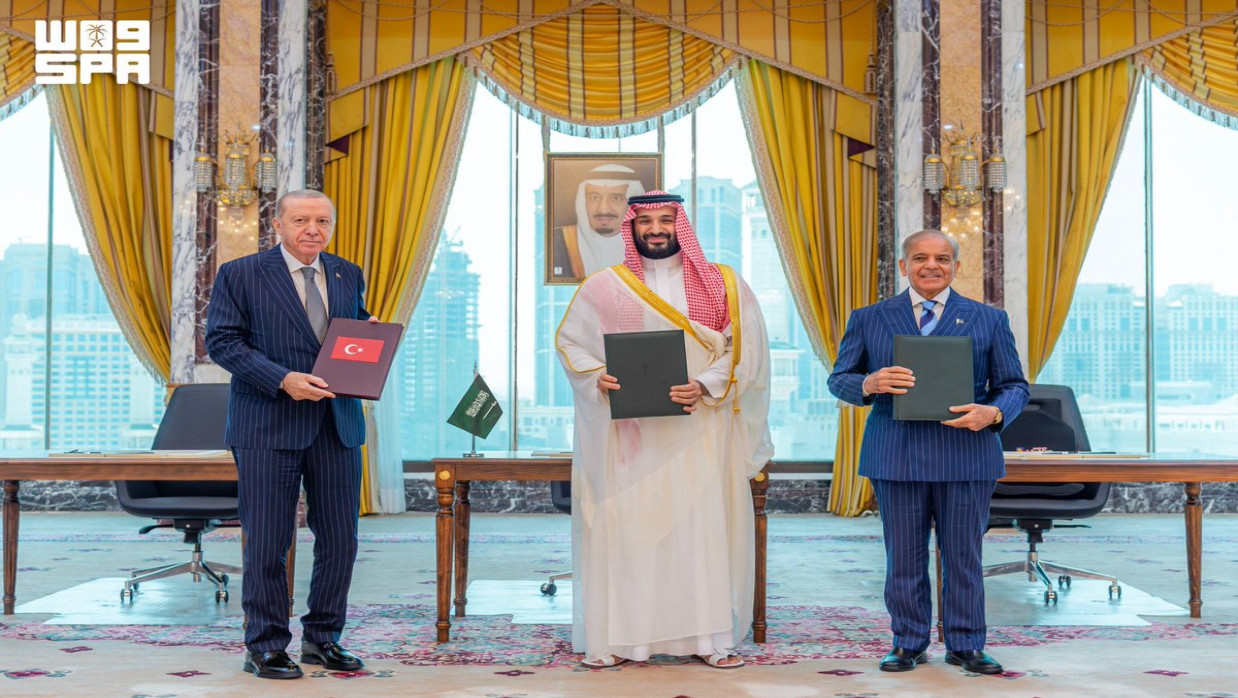
The first meeting of the Strategic Political and Defence Committee of the Makkah Agreement held on August 31, 2026. Saudi Arabia, Turkey and Pakistan agreed to establish a secretariat in Saudi Arabia under their Mecca joint defence agreement, which will initially be headed by a Pakistani secretary-general for three years.
The signing of the Makkah Joint Defence Agreement by Pakistan, Saudi Arabia and Turkiye on August 7, 2026 represents an important development in the evolving security architecture of the wider West Asia and South Asia. The agreement should be understood neither as the creation of an ideological bloc nor as an instrument directed against a particular state. It is, above all, an assertion of collective security, strategic autonomy and sovereign responsibility for national defence.
The agreement brings together three states with established defence relationships, significant military capabilities and growing strategic interests. The countries will work to strengthen their collective defence capabilities and cohesion of their armed forces. Its central commitment, that an armed attack against one would be regarded as an attack against all, establishes a principle of collective deterrence. Pakistan’s Foreign Office has emphasized that the agreement is intended to institutionalize defence cooperation and strengthen collective deterrence against aggression. This development is significant because the regional security environment is undergoing profound transformation.
Pakistan, Saudi Arabia and Turkiye have maintained extensive bilateral defence relationships for decades. Pakistan and Saudi Arabia have particularly deep military ties, including joint training and defence cooperation, while Pakistan and Turkiye have steadily expanded their strategic and defence partnership. The Makkah Agreement builds upon these existing relationships rather than creating them from scratch. Its significance therefore lies in institutionalization.
The cooperation becomes strategically meaningful when it moves beyond political statements and develops mechanisms for coordination, consultation, interoperability, intelligence sharing, military exercises and defence-industrial cooperation. The agreement provides a framework through which the three states can gradually transform existing bilateral relationships into a more coordinated trilateral security partnership. For Pakistan, this is strategically valuable.
Collective deterrence is often misunderstood as inherently offensive. In reality, the central logic of collective deterrence is preventive: the cost of aggression is raised by making clear that an aggressor would not confront an isolated state. The Makkah Agreement therefore strengthens the principle that security can be enhanced through credible collective deterrence without seeking confrontation. Pakistan has consistently maintained that it seeks peaceful relations with neighboring and regional states while retaining the capability to defend its sovereignty and territorial integrity. The same principle applies here.
A stronger defensive partnership can reduce the incentives for coercion by creating greater uncertainty for any potential aggressor about the consequences of military action. The agreement's language regarding an armed attack on one member being regarded as an attack on all is consequently its most strategically consequential element.
For Pakistan, the agreement provides several strategic benefits. First, it strengthens Pakistan's position as an important security actor linking South Asia, the Gulf and the wider Muslim world. Pakistan has historically maintained defence relationships across these regions. The Makkah framework gives those relationships a more structured strategic dimension. Second, it deepens Pakistan's relationship with Saudi Arabia, a partnership that extends beyond defence into economic, political and strategic domains. Third, the inclusion of Turkiye creates a trilateral framework involving one of NATO's most capable military powers, a major Gulf state and a nuclear-armed South Asian state. This combination creates opportunities for cooperation across conventional military domains, including air defence, maritime security, counterterrorism, intelligence, cyber capabilities, unmanned systems and defence production.
Recent statements from Turkiye indicate that the pact is expected to facilitate political and military coordination as well as joint exercises and cooperation in areas including unmanned systems, electronic warfare and artificial intelligence. For Pakistan, this technological dimension may prove as important as the traditional military component.
Perhaps the broader significance of the Makkah Agreement lies in the changing nature of international security. For decades, Gulf security was heavily dependent upon external security providers. Yet recent regional crises have encouraged states to reconsider the reliability, sustainability and political conditions attached to external security guarantees. The emergence of indigenous and regional security arrangements is therefore not unique to the Makkah framework.
The participation in such an arrangement is consistent with a broader principle of strategic autonomy for Pakistan . Strategic autonomy does not mean abandoning relations with major powers. Nor does it require choosing one bloc over another. It means maintaining sufficient diplomatic and defence options to protect national interests in an increasingly uncertain international environment The Makkah Agreement can consequently be viewed as an additional layer of Pakistan's strategic partnerships rather than a replacement for existing relationships.
Saudi Arabia's participation is particularly significant. The Kingdom occupies a central position in the Gulf's economic and strategic architecture. Its security is connected not only to the defence of its territory but also to energy infrastructure, maritime routes, airspace and regional stability. Pakistan has a long-standing interest in the security and stability of Saudi Arabia.
The two countries' defence relationship has historically included military training and cooperation. The bilateral Strategic Mutual Defence Agreement signed in September 2025 already established a framework under which aggression against one would be treated as aggression against both. The 2026 Makkah Agreement expands the strategic context by bringing Turkiye into a trilateral framework. The progression from bilateral to trilateral cooperation demonstrates that the relationship is evolving from traditional defence cooperation toward a broader regional security partnership.
Turkiye adds a different strategic dimension. Its military-industrial base, experience in unmanned systems, electronic warfare, naval capabilities and indigenous defence production provides an important technological component to the partnership. For Pakistan, Turkiye is already an important defence partner. Cooperation in naval platforms, aviation, unmanned systems and defence technology has expanded considerably over recent years. The Makkah framework could therefore provide an institutional setting for deeper technological and industrial cooperation.
This is particularly relevant at a time when modern warfare is increasingly shaped by drones, artificial intelligence, cyber operations, electronic warfare, precision weapons and network-centric capabilities. The future of collective defence will not be determined solely by troop numbers or conventional platforms. It will increasingly depend on technology, interoperability and information superiority.
Pakistan has an important diplomatic interest in preventing the Makkah Agreement from being interpreted as an exclusive military bloc. The agreement should not be framed as a "Muslim NATO" or as a mechanism directed against a particular regional power. Such interpretations risk narrowing Pakistan's diplomatic space.
Pakistan's official position has emphasized defence cooperation, collective deterrence and regional stability rather than confrontation. The agreement should therefore be communicated according to its stated purpose i-e strengthening institutionalized defence cooperation among three sovereign states. This distinction is particularly important because the Middle East remains highly polarized.
Pakistan has strategic relationships with Saudi Arabia, Turkiye, Iran, China, the United States and other regional and global actors. Its national interest lies in preserving the flexibility to maintain constructive relations across competing geopolitical spaces. The Makkah Agreement should strengthen Pakistan's strategic position without unnecessarily limiting its diplomatic options.
From Islamabad's perspective, the agreement also has implications for the broader strategic environment in which Pakistan operates. Pakistan's security environment is not confined to its immediate borders. Its strategic interests extend into the Arabian Sea and the Gulf, while developments in the Middle East increasingly intersect with South Asian security. Nevertheless, Pakistan should resist the temptation to present the Makkah Agreement primarily as an instrument against India. A state-centric approach requires a broader understanding. The agreement is about collective defence and strategic cooperation, not the creation of an anti-India alliance. Indeed, positioning it in this manner would undermine Pakistan's diplomatic narrative and unnecessarily transform a defensive partnership into a perceived geopolitical confrontation.
The signing of an agreement is the beginning, not the end, of strategic cooperation. The real test will be implementation. The three states will need to develop effective mechanisms for political consultation, military coordination, intelligence sharing, joint exercises and interoperability. They also possess different military structures and equipment ecosystems. Pakistan has significant Chinese-origin defence systems, Saudi Arabia operates extensively with Western equipment, while Turkiye has developed a substantial indigenous defence industry. Creating genuine interoperability across these systems will require sustained institutional investment. The agreement will therefore need practical mechanisms rather than merely political symbolism.
Regular exercises, common communication procedures, intelligence-sharing arrangements, maritime coordination and joint training could gradually transform the agreement from a political commitment into a credible collective-defence framework.
One of the most promising areas is defence-industrial cooperation. Pakistan and Turkiye already possess growing indigenous defence industries, while Saudi Arabia has ambitious plans to localize defence production under its Vision 2030 framework.
The three countries could potentially cooperate in areas such as unmanned systems, electronic warfare, cyber capabilities, air defence, naval technologies and precision systems. Such cooperation would serve two objectives. It would strengthen collective military capabilities while simultaneously reducing excessive dependence on external suppliers. For Pakistan, this could contribute to the growth of its defence-industrial base, technological capacity and export potential.
The Makkah Agreement arrives at a time when regional security arrangements are becoming more diversified. States increasingly seek overlapping partnerships rather than dependence upon a single security provider. This creates the possibility of a more multipolar regional security architecture, in which regional states assume greater responsibility for their own security. Pakistan has a natural interest in such a transformation. Its geographical position gives it strategic relevance to both South Asia and the Gulf. A stronger Pakistan-Saudi-Turkiye security relationship can enhance Pakistan's role as a bridge between these two strategic regions. However, Pakistan must ensure that this role remains constructive. Its objective should be to contribute to regional stability rather than become trapped in regional rivalries.
The credibility of the Makkah Agreement will ultimately depend not simply on its military strength but on how responsibly it is employed. Collective defence should be accompanied by collective restraint. The three states should make clear that the agreement is designed to deter aggression, protect sovereignty and preserve peace. At the same time, mechanisms for crisis communication and diplomatic consultation should be developed alongside military cooperation. A strong defence posture and active diplomacy are not contradictory. They are complementary. For Pakistan, the ideal strategic posture is therefore one in which credible deterrence provides the foundation for diplomacy rather than replacing it.
The Makkah Joint Defence Agreement represents an important evolution in Pakistan's strategic partnerships. It brings Pakistan, Saudi Arabia and Turkiye into a more structured framework of collective defence at a time of significant geopolitical uncertainty. Its importance lies not simply in the military capabilities of the three states, but in the institutionalization of their strategic cooperation.
For Pakistan, the agreement can strengthen deterrence, deepen defence partnerships, enhance technological cooperation and expand its strategic relevance across South Asia and the Gulf. But its success will depend on implementation. Pakistan pursue the agreement with strategic clarity: not as an ideological alliance, not as an instrument against a particular state, but as a sovereign state's effort to strengthen collective security in an uncertain international environment.
The strategic message is equally clear: Pakistan seeks peace, but peace is most sustainable when supported by credible deterrence, capable partnerships and respect for sovereignty. The Makkah Agreement provides an opportunity to build precisely that kind of regional security framework. Its ultimate value will be measured not by the conflicts it enters, but by the conflicts it helps prevent.


0 Comments
LEAVE A COMMENT
Your email address will not be published