

by Kulani Wijayabahu
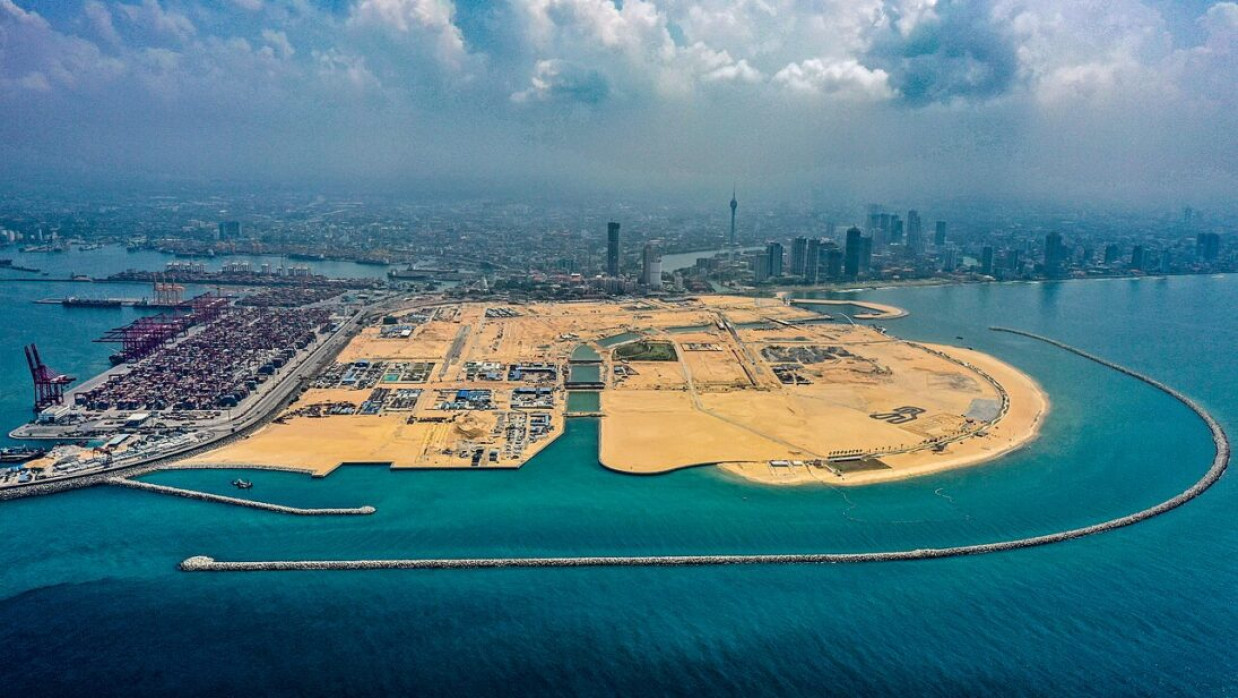
Colombo Port City began as a promise of transformation, but it has become a measure of Sri Lanka’s constrained autonomy. Built on 269 hectares of reclaimed land beside Colombo’s central business district, the Chinese-backed project is designed as a Special Economic Zone for finance, real estate, tourism, and offshore services. Yet what makes Port City politically significant is its endurance: It has survived successive changes in presidential leadership, ruling parties, governing coalitions, and economic policy narratives.
This continuity constitutes the most significant characteristic of this post-war development project. The initiative progressed under Mahinda Rajapaksa (2005-2015), was suspended and renegotiated by the Sirisena-Wickremesinghe administration (2015-2019), legally consolidated during Gotabaya Rajapaksa’s tenure (2019-2022), retained throughout Ranil Wickremesinghe’s crisis presidency (2022-2024), and has now been inherited by Anura Kumara Dissanayake’s National People’s Power government (2024-present). Although each administration articulated a distinct political discourse, none completely suspended the Port City project.
This persistent continuity provides critical insight into the nature of small-state agency in South Asia. Colombo Port City is frequently analyzed using frameworks such as China’s Belt and Road Initiative (BRI), debt dependence, and India-China rivalry. While these perspectives are significant, they remain incomplete. The Port City project also illustrates how successive Sri Lankan governments create, contest, restrict, and occasionally forfeit policy autonomy over time.
About Port City
The project originated within Sri Lanka’s post-war development vision. Following nearly three decades of civil conflict, highways, ports, airports, and land reclamation were promoted as indicators of progress from conflict toward modernity. For the Rajapaksa administration, large-scale infrastructure projects symbolized national renewal and helped project an image of decisive post-war governance. Port City was accordingly positioned as a transformative initiative to establish Colombo as a financial and maritime hub. The availability of Chinese capital and construction expertise, reinforced by Sri Lanka’s growing participation in China’s BRI, made this ambition seemingly attainable.
However, the project was contentious from its inception. Environmental organizations, fishing communities, opposition parties, and policy analysts expressed concerns regarding ecological degradation, coastal erosion, transparency, sovereignty, and public accountability. These objections did not halt the project, partly because the Rajapaksa government’s post-war standing rested on its claim to deliver visible national transformation through large-scale infrastructure and major-power partnerships. Yet the controversy exposed a deeper tension: Port City reflected strong executive decisiveness externally, but it was not grounded in broad domestic consultation or consensus.
“[Port City] has survived successive changes in presidential leadership, ruling parties, governing coalitions, and economic policy narratives.”
From 2015 to 2021
The 2015 change of government briefly disrupted this pattern. After coming to power, the Sirisena-Wickremesinghe administration suspended Port City, citing environmental, legal, procedural, and transparency concerns surrounding the project’s approval and terms. The pause also carried a political message: It allowed the new government to distance itself from Mahinda Rajapaksa’s China-backed mega-project model and present itself as more reformist, accountable, and attentive to sovereignty concerns. The suspension mattered because it showed that electoral change could produce policy review and that Sri Lanka was not simply a passive recipient of Chinese infrastructure. It also challenged the assumption that small states have no room to maneuver once they enter into major agreements with larger powers.
But the project’s eventual resumption in 2016 revealed the limits of corrective agency. Contractual obligations, Chinese pressure, concerns over investor confidence, and the absence of a coherent alternative development strategy narrowed the space for a reversal. Sri Lanka could pause and renegotiate specific terms—including the removal of freehold land rights, the conversion of land granted to the Chinese project company into 99-year leases, additional environmental review, and adjustments related to compensation for the suspension—but it could not easily walk away. That was a crucial turning point in which Port City moved from being a policy choice to becoming a policy inheritance.
The Gotabaya Rajapaksa government later sought to institutionalize Port City through the Colombo Port City Economic Commission Act of 2021. This would create a special legal and regulatory framework that could attract foreign investment, administer the reclaimed territory, and convert Port City from a construction project into a functioning Special Economic Zone (SEZ). Before this phase, Sri Lanka’s major infrastructure and investment projects were generally managed through existing state institutions such as the Urban Development Authority, the Board of Investment, line ministries, and project-specific agreements; while projects such as Hambantota Port, Mattala Airport, and other Rajapaksa-era infrastructure initiatives were politically central to the post-war development model, they did not create a separate regulatory space with the same degree of institutional autonomy. Port City therefore marked a shift from project implementation to enclave-style governance.
The Act generated debate in Parliament, before the Supreme Court, and among opposition parties, legal commentators, and civil society groups. Critics raised concerns about sovereignty, tax concessions, regulatory autonomy, parliamentary oversight, and the possibility that the proposed Commission would exercise powers normally held by existing state institutions, whereas supporters presented the Act as necessary to make Port City commercially viable and to position Colombo as a regional financial and services hub. The government ultimately proceeded with the establishment of the SEZ after making amendments required by the Supreme Court determination.
This process did not reveal an absence of Sri Lankan agency. Rather, it showed a narrower form of agency: one exercised mainly through centralized executive and legal-institutional channels, with limited space for broader public deliberation over the long-term social, fiscal, and geopolitical implications of the project.

From 2022 to the Present
The 2022 economic crisis once again altered the significance of Port City. Following sovereign default, resource shortages, widespread protests, and negotiations with the International Monetary Fund, Sri Lanka’s development discourse shifted from ambition to survival. Under Ranil Wickremesinghe’s leadership, Port City was reframed less as a Rajapaksa-era or China-linked mega-project and more as part of a recovery-oriented policy. In this framing, the project was presented as a vehicle for attracting foreign investment, restoring investor confidence, expanding service-sector growth, and signaling that Sri Lanka remained commercially viable after default.
This did not mean Sri Lanka had become a Chinese proxy. Rather, the country was operating in a severely constrained environment, requiring debt restructuring, foreign exchange, investment confidence, and signals of policy continuity. In such a context, abandoning an already embedded project would have carried prohibitive costs. Wickremesinghe’s pragmatic approach retained Port City not because it was politically uncontested, but because the space for reversal had become too narrow to navigate.
Anura Kumara Dissanayake now assumes responsibility during the most challenging phase. The National People’s Power government entered office in 2024 with a mandate emphasizing accountability, anti-corruption, and a departure from the political practices of previous administrations. While this mandate theoretically supports a more critical stance toward projects like Port City, in practice, the new government confronts a project that is already deeply embedded legally, diplomatically, and economically. The January 2025 China-Sri Lanka joint statement made this clear: Beijing and Colombo agreed to advance major signature projects, including Colombo Port City and Hambantota Port integrated development. This means Port City is not a leftover of a previous government that can be easily ignored.
Recent investment developments further complicate this challenge. In May 2026, Prime Melwa Port City, a luxury real estate development, entered into a sales and purchase agreement with CHEC Port City Colombo for a marina-front development, reportedly valued at USD $57.6 million. This is significant because Port City is evolving beyond a Chinese-backed infrastructure controversy, increasingly integrating into Sri Lanka’s post-crisis investment landscape and involving domestic corporate entities, real estate interests, professional sectors, and future revenue expectations.
This development reframes the central question of agency. It is no longer sufficient to debate whether Sri Lanka should accept or reject Port City; the more pressing issue is whether the country can exercise effective governance over the project. Since coming to power, the Dissanayake government has not canceled the project. Instead, it has moved toward revising the Colombo Port City Economic Commission Act, with proposed amendments focused on compliance, monitoring of tax incentives, and institutional reorganization. Recent agreements with domestic investors, such as the Prime Melwa marina-front real estate development, further suggest that Port City is being managed as an active investment zone rather than treated as a project to be reversed.
Meaningful agency for the Dissanayake administration should therefore be judged not by dramatic cancellation, but by whether it can ensure transparency in land transactions, parliamentary oversight of regulatory decisions, rigorous environmental monitoring, public disclosure of anticipated benefits, and the establishment of clear regulations to prevent the zone from becoming isolated from the broader economy. The central test is whether Port City becomes a governed national asset, or a legal and economic enclave that disproportionately benefits a select group while shifting risks onto the wider public.
“Rebuilding Sri Lanka’s agency depends on whether the state can govern Port City transparently, regulate it effectively, and ensure that its benefits extend beyond a narrow circle of political and commercial stakeholders.”
Conclusion
Colombo Port City offers a wider lesson for South Asia: Small-state agency can appear as initiation, suspension, renegotiation, legal embedding, crisis management, or reformist recalibration. But agency also changes over time. A government may begin with room to make choices while later governments may inherit reduced policy space because contracts, diplomatic commitments, financial weakness, elite led decision making, limited consultation and economic crises intersect.
Sri Lanka should thus not be viewed solely as a battleground between China and India, nor as a passive victim of the Belt and Road Initiative. The Port City case instead demonstrates how small-state agency can narrow when external financing becomes embedded in domestic development strategies and when major projects move forward without sustained public accountability. Its lesson is not that Sri Lanka lacked agency, but that its agency became progressively more constrained as the project moved from post-war ambition to legal-institutional entrenchment and then to post-crisis recovery policy.
The principal challenge for Sri Lanka’s new government, then, is to expand the mechanisms of accountability surrounding the project. If Port City is to remain integral to Sri Lanka’s economic future, it must be governed in a manner that prioritizes the public interest, rather than diplomatic continuity or investor confidence. Rebuilding Sri Lanka’s agency depends on whether the state can govern Port City transparently, regulate it effectively, and ensure that its benefits extend beyond a narrow circle of political and commercial stakeholders.
The article appeared in the southasianvoices
0 Comments
LEAVE A COMMENT
Your email address will not be published