

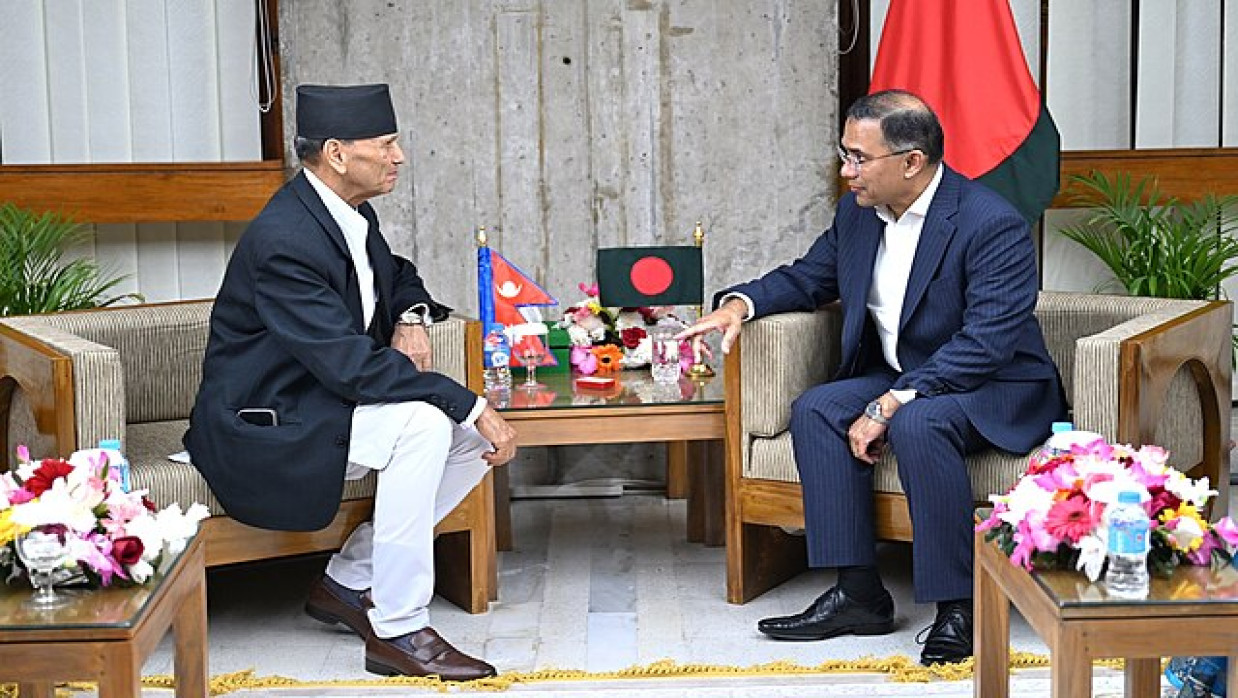
On February 12, 2026, Bangladesh held its first election after the fall of Sheikh Hasina in August 2024. The Bangladesh Nationalist Party (BNP), led by Tarique Rahman, secured a decisive two-thirds majority, with 212 of 299 parliamentary seats, ending eighteen months of interim governance under Nobel laureate Muhammad Yunus and formally closing the post-Hasina transition.
The new government starts with a strong mandate, a foreign policy slate that has been partially rewritten during the interim period, and a neighborhood that is watching closely. India, China, the United States, and Pakistan have each signaled a willingness to engage. That convergence of goodwill is rare; the question is whether Dhaka has the strategic clarity, given its domestic challenges, to capitalize on this opening without upsetting external balance.
South Asia: A Reset in Calculus
For years, the relationship between Dhaka and New Delhi rested on the Awami League (AL)-India axis. With the collapse of the AL, Delhi lost its footing, and the interim government’s reorientation away from India drove bilateral ties to their lowest point in decades. Elections alone will not erase accumulated damage, but both capitals are attempting a precarious reset, and the early gestures of goodwill have been notable.
That Indian External Affairs Minister Jaishankar attended the funeral of Khaleda Zia, the former Prime Minister and Tarique Rahman’s mother, was the most consequential diplomatic signal of the pre-election period. Indian Prime Minister Modi’s congratulatory phone call to Rahman inviting him to visit India reinforced the message. In turn, Dhaka’s early language has been warmer than anything the Yunus administration produced. Bangladesh has moved to reopen consular services suspended during the interim period, and Rahman’s foreign policy advisers have been explicit about wanting a reciprocal reset.
Yet the reservoir of mistrust runs deep in the relationship. The accusation that previous BNP governments harbored Indian insurgents remains lodged in India’s memory. Delhi’s calculus will be shaped more by what actually happens along the border than by statements. India’s red lines are long-established: zero-tolerance for cross-border militancy; security of the Siliguri corridor, the narrow strip of land connecting India’s mainland to its northeastern states and one of Delhi’s most sensitive geographic vulnerabilities; and protection of Bangladesh’s Hindu minority. While Rahman is unlikely to cross these lines, these tensions are structural and will outlast any reset.
The immediate potential flashpoint is the deportation of Sheikh Hasina and exiled AL leaders. India, which views Hasina as a longtime partner, is unlikely to extradite her. While Rahman has been characteristically measured, pressure may mount from his political opponents—Jamaat-e-Islami and the National Citizen Party, born out of the student-led uprising of 2024—as well as from the BNP’s own grassroots base to move the case forward. Pressing New Delhi too hard, however, risks hardening Indian resolve and converting a fragile rapprochement into a rigid standoff.
Pakistan occupies a complicated position in this realignment. Under the interim government, Dhaka-Islamabad ties moved faster than any other bilateral: direct flights resumed, visa procedures eased, and military visits exchanged. Rahman will likely normalize trade and diplomatic ties, but deeper defense engagement with Islamabad will need to be weighed carefully against Dhaka’s calculus with India.
“Pakistan occupies a complicated position in this realignment. […] Rahman will likely normalize trade and diplomatic ties, but deeper defense engagement with Islamabad will need to be weighed carefully against Dhaka’s calculus with India.”
China: Partnership Without Dependence
The Bangladesh-China relationship has been building for two decades, and a change of government is less likely to alter that trajectory. The BNP has historically run warmer towards Beijing than the AL, which, despite extensive economic engagement with China, maintained a consistent political preference for India.
Rahman’s post-election comments on China were careful and conditional. Asked about the Belt and Road Initiative, he offered: “If it benefits Bangladesh and supports the economy, we will make a decision.” That framing reads, at least in part, as reassurance to Washington, which has watched Dhaka’s China tilt with growing unease, and as a signal to India that a recalibration is underway.
The Teesta River Project, which sits very close to the sensitive Siliguri Corridor, is the most geopolitically loaded element of the China relationship. This USD $1 billion river management project would give Bangladesh greater control over a river whose waters India has long diverted upstream. China has coveted involvement in the project for years, and the Yunus government advanced Chinese participation in ways that alarmed India. Whether Rahman accelerates, pauses, or restructures the project will be read in both capitals as a definitive early signal.
The United States: Opportunity and Obligation
The congratulatory letter President Trump wrote to Prime Minister Rahman was notable for its directness. It explicitly urged Rahman to complete routine defense agreements that would give Bangladesh access to U.S. military equipment. The two foundational defense agreements—the Acquisition and Cross-Servicing Agreement (ACSA), which enables logistical interoperability, and the General Security of Military Information Agreement (GSOMIA), which establishes the information-sharing architecture required before the U.S. can transfer sensitive military technologies—have been on Washington’s agenda for years. Hasina shelved both agreements throughout her tenure. Should Dhaka now proceed, it will face the structural constraint that over 70 percent of Bangladesh’s military inventory is Chinese-sourced. Managing deeper U.S. defense ties without provoking a Chinese reaction—or, alternatively, managing Chinese expectations while deepening U.S. defense ties—is not impossible, but it requires a strategic clarity that the new administration has yet to articulate publicly.
The letter also referenced the reciprocal trade arrangement, signed by the interim government, that reduced U.S. tariffs on Bangladeshi goods to 19 percent. Economists and business leaders have since called for a review, arguing the terms bind Dhaka more unfavorably than Washington. The Rahman government wants to renegotiate, but the U.S. Supreme Court’s ruling striking down the underlying tariff framework has muddied the legal ground. Bangladesh cannot simply walk away from its single largest trading market, yet reopening a freshly signed agreement, with the legal basis still in flux, carries its own diplomatic risks.

Among the hardest tests Tarique Rahman faces in office is the Rohingya crisis, which intersects the U.S.-Bangladesh relationship in underappreciated ways. Bangladesh hosts over 1.1 million Rohingya refugees and has pressed for immediate repatriation. Myanmar is in the midst of a civil war, and the Rohingyas’ homeland Rakhine province is controlled by the Arakan Army, an ethnic Rakhine insurgent force, with no particular stake in Rohingya return. Where China’s primary interest is to safeguard infrastructure and energy corridors in Rakhine, in which it has invested billions, and to secure access to the Indian Ocean, the United States has a different calculus: sanctions on the junta, support for democracy, and strategic competition with Beijing. The United States is also still the largest provider of humanitarian assistance for the Rohingya, having contributed nearly USD $2.4 billion since 2017, with Congress authorizing another USD $121 million under the Burma Act this year. With Dhaka between two external powers that have evinced no clear interest in resolving the refugee crisis on Bangladesh’s timeline, moving the needle on Rohingya repatriation will significantly test Rahman’s diplomatic acumen.
The Domestic Anchor
Foreign policy is, in part, a projection of domestic capacity. The strength of what Rahman builds abroad will be bound by his government’s ability to deliver on economic recovery, institutional reform, and political reconciliation at home.
The economy is the most pressing claim on his attention. During the 2024 to 2025 transition period, Bangladesh registered its weakest GDP growth in 36 years, and millions were pushed back into poverty. The garment sector, the backbone of the export economy, was disrupted by political instability and investor caution. Recovery depends on restoring investor confidence, which in turn depends on political stability and predictable governance.
“The strength of what Rahman builds abroad will be bound by his government’s ability to deliver on economic recovery, institutional reform, and political reconciliation at home.”
The July 2024 uprising produced the National Charter, a constitutional reform agenda passed by referendum alongside the parliamentary election. But scholars have noted that the charter is legally flawed and strains against the constitution’s own basic structure. The BNP filed significant dissent notes on key clauses during the drafting, objecting to proportional representation in the upper house, restrictions on holding the offices of prime minister and party leader simultaneously, and the appointment mechanism for independent commissions. Now, with a two-thirds majority, BNP controls how the charter is implemented. Managing the gap between what the charter promises and what the party is prepared to deliver without fracturing the reform coalition or handing the opposition a standing grievance will demand a quality of political discipline seldom exercised in Bangladesh’s majoritarian political culture.
The AL question is the toughest domestic issue Rahman inherits, with real foreign policy overtones. Banned by the Yunus administration and barred from the February elections, the party’s fate now hinges on whether the new parliament ratifies and lets lapse the ordinance underpinning the ban—a choice Rahman has kept deliberately ambiguous. In a recent interview with Reuters, Rahman indicated that Hasina’s children are free to participate in politics if the people accept them, while stopping short of committing to lifting the ban. Internationally, the U.S. House Foreign Affairs Committee raised concerns that suspending an entire party was inconsistent with democratic principles, a point quietly reiterated in their post-election message; India and international rights watchdogs have also strongly criticized the ban on the AL. While the temptation to permanently cripple the BNP’s historical rival is strong, especially with the surging Islamist parties demanding a harder line, weak or absent opposition rarely produces stable pluralism; it more often enables authoritarian consolidation, and can open space for more radical forces.
Rahman inherits a foreign policy that needs both restoration and reimagination—two tasks that pull in different directions and rarely move at the same speed. A government too consumed by domestic polarization and too uncertain in its own political footing cannot project the consistency that effective foreign policy requires. Restoring credibility abroad and restoring political cohesion at home are not separate agendas: for Rahman, they are the same task.
The article appeared in the southasianvoices


0 Comments
LEAVE A COMMENT
Your email address will not be published