

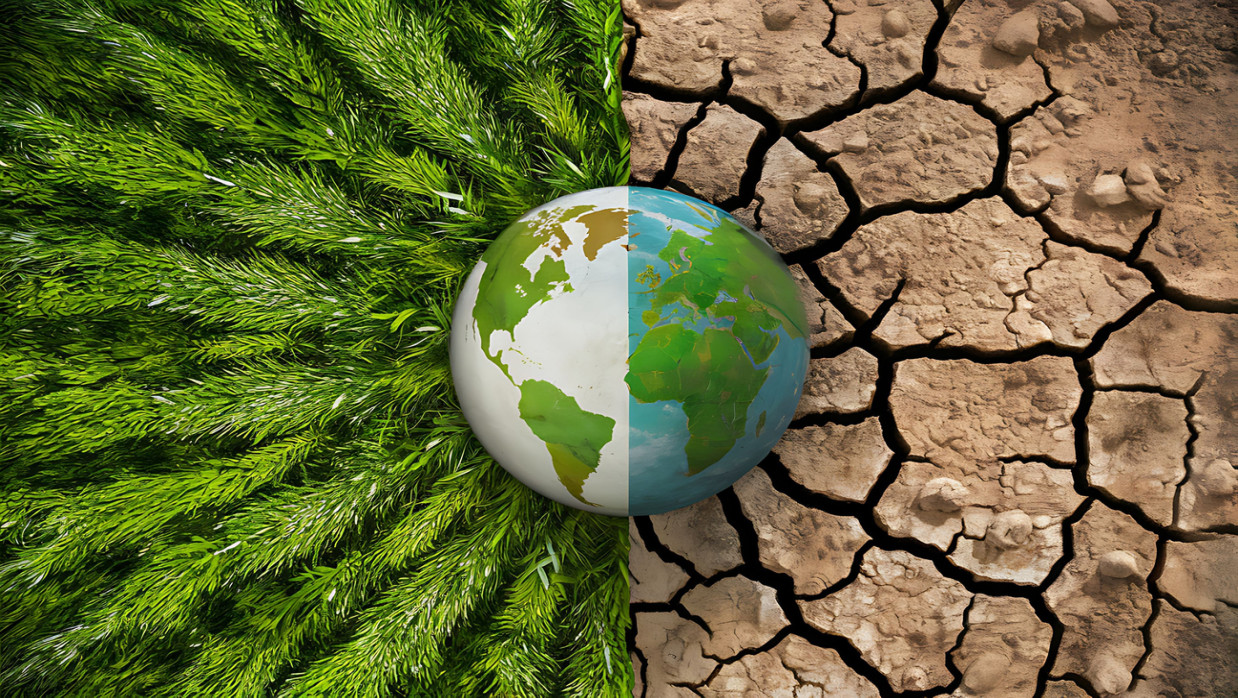
Adoption of climate-resilience practices and investment in green technology across the globe strike an optimistic note that a greater understanding is emerging globally pointing to the realisation that individual interest of a state lies in collective well-being. Based on this understanding, economic growth, exploitation of resources, employment generation, provision of health and education facilities and electricity generation within a state need to conform to the principles of sustainable development and collective well-being. However, spikes in global temperature and resultant surges in natural disasters, more pollution, changing American and European approach to foreign aid, competition over green technology and geopolitical competitions in the forms of wars and spheres of influence cast strong doubts about the planet Earth’s future.
Deliberations on Climate Change have come a long way from the sovereign right of states to exploit resources to partially assigning responsibility to developed countries onto treating it as a collective responsibility but the way to deal with is national determined actions and incentives.
Traversing down the lane confirms how the 1972 Stockholm Conference while affirmed a universal right to a healthy environment but it asserted the sovereign right of states to exploit their resources. The Kyoto Protocol signed in 1997 imposed legal obligations to reduce emissions on developed countries thereby provided greater leeway to developing and underdeveloped countries to contribute to green house emissions. Paris Agreement on Climate Change, 2015 provided latitude to each country that they can decide their 'nationally determined contribution' without enforcement mechanisms.
Every country must protect its citizens from extreme climatic conditions the sources of which lie outside the national boundaries. In extraordinary circumstances, international agreements have become more successful as the national interest of a country converged squarely with the collective well-being. For instance, the Montreal Protocol signed in 1987 led to virtual elimination of ozone-depleting substances primarily because particular interest of nations converged with the collective well-being. However, the objective of limiting the global temperature below 2 degree Celsius, preferably 1.5 degree Celsius above pre-industrial levels appears to be impossible considering the sheer lack of a collaborative approach which has already taken the global temperature beyond the 1.5 degree Celsius threshold.
Even though the states experience the impacts of climate change and understand the urgency to address the global challenge, wars, geopolitical competitions and fragmentation of economy have made collaborative approach difficult. Even there is a competition over green technology rather than empowering the low income countries to adopt these.
US Strikes Hardest to Collaborative Approach
American retrenchment from a collaborative approach to address the issue of climate change has been myopic and self-destructive. The US had been funding and providing aid to various developing and underdeveloped countries to develop climate-resilience infrastructure and practices through United States Agency for International Development (USAID). The investment reduced the possibility of financial instability thereby ensured political stability and helped contain civil wars and migration pressures. The Trump administration has not only drastically cut down foreign aid in general by slashing grant to USAID, it has reduced funding towards Climate resilience infrastructure and practices abroad to zero. Beijing, on the other side, is promoting solar farms, dams and other projects across the Africa, Southeast Asia and the Pacific under the rubric of 'South-South Cooperation'. For instance, in Mongolia, following the Trump administration's closing down of USAID, China has stepped in and launched a climate-resilience project and gained greater access to the copper deposits of the country. However, the countries run the risk of financial instabilities and indebtedness in the long-term as Beijing promotes these projects through cheap and opaque loans.
Many farmers who lose their crops due to extreme weather conditions often switch to cultivating illicit crops. Climate resilience practices can prevent them from trading that path. The US can prevent itself from illegal migration from Latin American countries if it can fund to protect the livelihoods of people from draught, storms and extreme heat. In 2023, USAID and the Bill & Melinda Gates Foundation collaborated with more than 80 African seed companies to distribute draught-resistant seeds to around 7 million farming families which spiked crop yields, cut food costs and added about $1.5 billion to the African continent's GDP just in a single year.
Investment in climate resilience automatically reduces humanitarian aid by averting losses to human lives and socio-economic institutions. The Trump administration even while has entirely cut the climate funding, it provided humanitarian assistance to countries affected by natural disasters such as the Melissa hurricane. Declaration of a package of $2 billion to fund the UN humanitarian assistance programmes in December, 2025 point to this irony.
Expecting aid and funds on Climate resilience practices from Trump administration is quixotic as it had called 'Climate Change' a hoax and withdrew from the Paris Agreement on Climate Change. The US alibi to save money by halting funds for climate resilience abroad would not only cede ground to China with its advancements in producing, utilising and trading green technology, it would make the external conditions unsafe for the US as well by breeding more geopolitical tensions and instability as noted by the 2021 National Intelligence Estimate on Climate Change. Estimates by the Global Commission on Adaptation point to the fact that 24 hours of advance warning of hazardous weather conditions can reduce the damages almost by 30 percent.
Low-Income Countries Need Critical Assistance
Climate change through its multifarious manifestations such as cyclone, flood and extreme weather conditions has been unevenly affecting the developing and underdeveloped parts of the globe by impinging on the infrastructural facilities and leading to disruption of services. It incurs financial losses to households, firms and public services alike.
Countries need to invest in climate-resilience practices such as development of early warning systems, infrastructure resilience, water storage facilities and drought-tolerant crops to alleviate their concerns to certain extent. Green industries to meet emission targets can be successful when capital and technology move across the border. But subsidy competition and resource nationalism chip away at the objective of shared prosperity and cause geopolitical friction. Clean air and lateral diffusion of plastic need collective action plainly because the sources and destination of the pollutants remain fused. Bangladeshi farmers have benefited immensely from early warning systems and satellite data where heavy rain and flash floods are more frequent. The USAID’s early climate warning system had been helpful for farmers of Bangladesh to protect their harvest and safeguard them against huge financial losses in a low-income country.


0 Comments
LEAVE A COMMENT
Your email address will not be published