

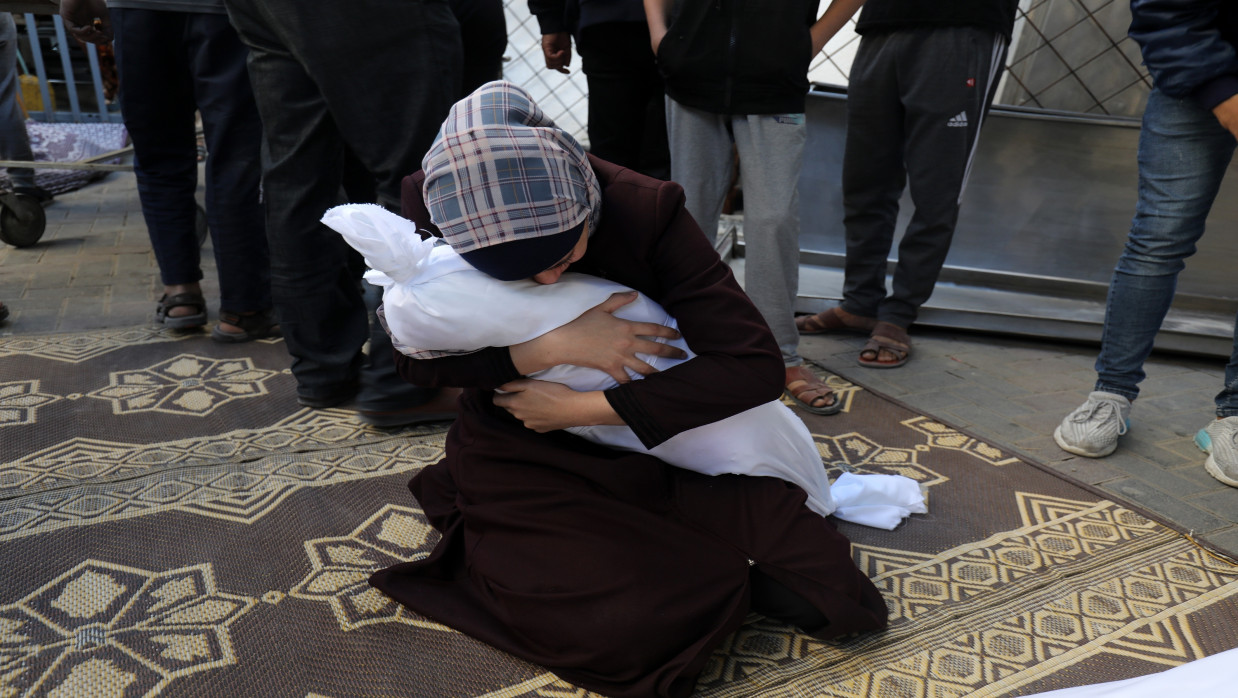
Israel’s indiscriminate assault on Gaza in response to Hamas’s brutal October 7, 2023, attack against the Jewish-majority state that killed more than 70,000 people and reduced the Strip to a pile of rubble should have turned the tortured territory into an ethical, moral, and geopolitical flashpoint for the defence of international law and the rule of law.
To be sure, there was plenty of public censure of Israel, but when the chips were down, most democracies at best paid lip service to legal and humanitarian principles.
With no other game in town, the world ultimately rallied around US President Donald J. Trump’s flawed Gaza ceasefire proposal.
 |
In a twist of irony, implementation of that proposal has elevated Gaza to the frontline, pitting the rule of law against the principle of might is right, with Mr. Trump positioning he administration of post-war Gaza as a monkey wrench that challenges multilateral institutions, like the United Nations, and celebrates his megalomania and narcissism.
With Mr. Trump threatening to gain control of Greenland by hook or by crook and pursuing a foreign policy driven by impunity, naked power, bullying, coercion, intimidation, and disregard for rules, human life, and people’s aspirations, Gaza has joined the Danish territory in drawing a line in the sand.
Not because of the unimaginable suffering and collective punishment that Israel imposes on innocent Gazans, its West Bank landgrabs, its making innocent West Bank Palestinians’ lives intolerable, but because of Mr. Trump’s challenging of international norms that threaten core European interests.
 |
The burden of drawing a line in the sand rests at this point on the shoulders of the European Union and its member states.
To be sure, the question is to what degree Europe will heed political scientist Francis Fukuyama’s advice to stop appeasing Mr. Trump and feeding his narcissism remains to be seen.
Mr. Fukuyama cautioned Europe that “Trump is a bully…Trying to placate him with concessions is a fool’s errand. He despises weakness…As an American, I say to my European friends: do not back down. Appeasing Trump with flattery has failed and must stop.”
Europeans aren’t quite there yet, even though they have rallied around Denmark in rejecting Mr. Trump’s insistence on taking control of its autonomous region of Greenland in the name of US national security, a misnomer for Mr. Trump’s unbridled, often illegal, aspirations for personal and national grandeur.
Even so, European leaders are considering countermeasures, including €93 billion in tariffs in response to Mr. Trump’s threat to impose an additional 25 per cent tariff on eight European countries if they resist a US takeover of Greenland.
 |
In addition, France, the first European nation to categorically state that President Emmanuel Macron would not join Mr. Trump’s Board of Peace, overseeing the administration of post-war Gaza, is pushing for the implementation of the European Union’s first-ever “Anti-Coercion Instrument.”
Mr Trump threatened to impose 200 per cent tariffs on French wine and champagne if Mr. Macron continued to refuse to join the Board.
Describing the instrument as Europe’s “nuclear option,” European diplomats said it would allow them to bar US companies from entering the European market, including from competing in public tenders.
They said European leaders, scheduled to meet in Brussels on Thursday, would discuss implementing the instrument.
“That turns Davos, whose theme this year is ‘A Spirit of Dialogue,’ into the epicentre of the worst transatlantic economic conflict in memory,” said Atlantic Council President and CEO Fred Kempe in an email analysis, referring to this week’s World Economic Forum in the Swiss town.
 |
Ironically, Mr. Trump has put the nationalist European far-right, his closest allies on the continent, in a bind.
Morten Messerschmidt, the head of the Danish People’s Party, who last year posted selfies with Mr. Trump on X, now criticises the government for its effort to resolve the Greenland dispute through dialogue.
In a series of recent postings, Mr. Messerschmidt asserted that “walking into the lion’s den” and “inviting oneself to meetings with a nation that threatens Denmark” were dangerous.
 |
France is likely to be joined by the European Commission and most EU members, except for Hungary, and possibly Germany, in declining Mr. Trump’s invitation to join the Board of Peace.
The Board, composed of heads of state, senior officials, and billionaires, would sit at the top of a three-tiered administration for Gaza. Seemingly, no Palestinian was invited to join, even though, tellingly, Mr. Trump reportedly invited Israeli Prime Minister Binyamin Netanyahu.
An executive Board headed by former UN Special Coordinator for the Middle East Peace Process, Nickolay Mladenov, and including Secretary of State Marco, Rubio, US Special Envoy Steve Witkoff, and Jared Kushner, Mr. Trump’s son-in-law, as well as former British prime minister Tony Blair, and World Bank President Ajay Banga, would serve as the link between the Board of Peace and a committee of non-partisan Palestinians technocrats responsible for running Gaza’s daily affairs.
 |
Europe’s refusal to join the Board is due not only to Mr. Trump’s invitation to Russian President Vladimir Putin, who, like Mr. Netanyahu, is wanted by the International Criminal Court, but also to the Board’s charter, which gives it a mandate that goes far beyond Gaza and involves an autocratic structure worthy of a non-democratic leader.
In fact, the charter makes no mention of Gaza. It includes no provisions for an international stabilisation force in Gaza, as envisioned by Mr. Trump, or for the policing of the Strip.
Instead, the charter asserts that “only sustained, results-oriented partnership, grounded in shared burdens and commitments, can secure peace in places where it has for too long proven elusive.”
In doing so, the charter positions the Board as rivalling the United Nations globally endorsed role as a peacekeeper.
Furthermore, the charter suggests that Mr. Trump could serve as the Board’s chairman beyond his term as president of the United States.
It gives Mr. Trump virtually absolute control of the Board and of who can become a member.
In line with his global ambitions, Mr. Trump has reconceived the Board as a permanent body rather than a transitional entity that would oversee the funding and reconstruction of Gaza and eventually hand over authority to the Palestinians.
Members of the Board will be required to contribute US$1 billion for a permanent seat on the Board.
It’s not clear whether those funds would be allocated to Gaza’s reconstruction.
For now, Palestinians are relegated to performing the Board’s daily chores by managing the distribution of goods and services.
Even that is proving to be problematic.
Palestinian sources asserted that Israel was barring members of the Palestinian committee from entering Gaza to take over the civil administration of the Strip in what they view as an effort to delay, if not derail, the implementation of the Gaza ceasefire plan’s second phase.


0 Comments
LEAVE A COMMENT
Your email address will not be published