

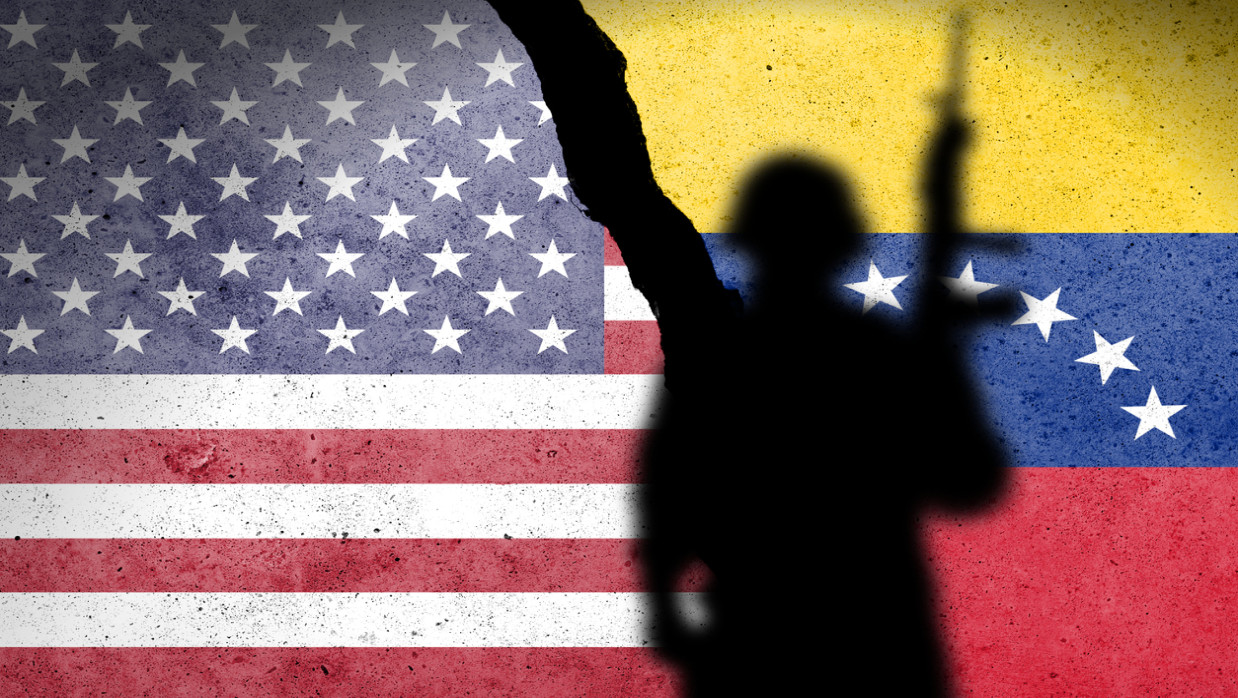
The Trump administration has set a new precedent by conducting twenty lethal pre-emptive strikes against allegedly unarmed drug cartels from Venezuela in which around 80 individuals have lost their lives. The vessels in the Caribbean and eastern Pacific, according to the administration, were carrying drugs from Venezuela and the victims of the strikes carried out by the administration were dubbed narco-terrorists and the drug cartels were equated with terrorist organisations.
In the recent past, in a bid to build military pressure on the Venezuelan President Nicolas Maduro, the US military has made largest naval deployment in the southern Caribbean, attacked vessels allegedly carrying drugs and sent an aircraft carrier to the region alongside US President Donald Trump authorising the CIA to conduct covert operations in Venezuela. The Trump administration believes that Maduro is running an unpopular regime without public legitimacy and support from the opposition. It has relied on brute force and suppression of democratic voices and institutions to cling to power and it refused to accept results of the 2024 Presidential election that had mandated his political debacle. It has been fostering anti-US activities being the sources of drug trafficking and illegal migration. Opposition leader Maria Corina Machado (Winner of Nobel Peace Prize, 2025) has been supportive of the American military pressure. Further, to American discomfort, Venezuela under Maduro's leadership has developed close relationships with US's adversaries including China, Russia, Iran and Cuba.
In this light, the maritime strikes spanning over a period of three months need to be interpreted as pressure tactics to put enough military pressure on the Maduro regime generating anticipations of direct military intervention and pave way for regime change in Venezuela and avert the problems emanating from the regime such as drug-trafficking, illegal migration and rising energy cost.
Trump administration crushes democratic principles
By authorising and executing such lethal maritime strikes, the executive in the US has transcended all limits to its power jeopardizing American democracy. French philosopher Montesquieu had once articulated the concept of separation of powers with checks and balances which the American Constitution also internalised as a cardinal principle to safeguard democracy. The American president has brazenly ignored these basic constitutional limitations of seeking authorisation from Congress prior to permitting such licentious acts.
The Trump administration by executing these strikes has flouted both national and international legal guardrails underpinning unlawful and extra-judicial killings paving the way for authoritarian regimes to follow the suit. Unlike 9/11 attacks, the US did not face an armed attack on its mainland from the drug cartels and hence there was hardly any legal provisions in support of the US to invoke the right to self-defence. Post 9/11, the UN Security Council, in fact, had authorised the US to act in self-defence. The Trump administration argues that drug trafficking constitutes an armed attack but fails to provide the rationale for such eerie definition.
Similarly, post 9/11, the American Congress had authorised the executive to take all necessary and appropriate actions against the perpetrators of attacks. President Trump has neither sought the authorisation of Congress nor that of the UN Security Council prior to or following conducting maritime attacks. Although the article II of US Constitution refers to the President as the Commander in Chief of military, it does not automatically allow the president to take unilateral military actions against threats emanating from outside the US. The drug cartels are not organised armed groups like Al-Qaeda, the Taliban and the ISIS against which armed conflict can be carried out and the doctrine of self-defence can be invoked. The cartels clearly lacked chain of command of military type, organisational set-up and arms and ammunition and other capabilities needed to be designated as armed groups.
The Trump administration's reference to Designated Terrorist Organisations currently used to describe the drug cartels may be flexibly used to target and use force against different groups perceived as a threat to the administration such as immigrants and domestic political opponents.
In many instances, the administration, distancing from directly labelling the drug cartels as terrorist organisations, it has described them being operated by or having affiliations with designated terrorist organisations.
A former chief prosecutor of International Criminal Court (ICC) described the strikes as a crime against humanity that involves widespread and systematic attacks against civilians. The European partners of the US have chosen to distance themselves from the American such brazen actions with Britain restricting intelligence sharing and the French foreign minister calling these actions as antithetical to international laws. Trump administration's unmitigated preference to use unlawful violence has further ripped apart the transatlantic alliance that was long founded on mitigating such kinds of insolent violations of international laws. While in previous occasions of transatlantic differences in perspectives on international laws, efforts were made to evolve common understanding at the bilateral and multilateral levels, the Trump administration hardly cares about the implications of such fallouts.
A new precedent has been established by the Trump administration by its attempts at politically redefining and strategically widening the concept of armed attack to serve political interests. Unless legal barriers around this gross violation of international laws are sufficiently restored through collective efforts, the administration will be inclined to define many perceived or minor threats as threats to the country’s sovereignty and territorial integrity and justify its disproportionate military actions in self-defence.


0 Comments
LEAVE A COMMENT
Your email address will not be published