



A 22-YEAR-OLD from Satkhira district in southwest Bangladesh, bordering the Indian state of West Bengal, shared the story of how she and her family had ended up in India some two years ago. Back in Bangladesh, she recalled, they lived on just BDT 200 a day – just over USD 2 at the time – the meager income her father made working in a biscuit factory. One day, he stopped receiving his salary. Their debts began to mount. Then, in 2020 and 2021, Cyclone Amphan and Cyclone Yaas struck their village in close succession. Soon they lost all their belongings, including their home.
The 22-year-old’s father then worked gruelling hours as a farm labourer, but he was always underpaid. “Even food was a luxury. Sometimes, there were days when we didn’t eat at all,” she said. Her father was unable to repay the debt he had taken on to rebuild their house after the cyclones.
“Goons threatened to kidnap me and force me to marry one of them to recover their losses. I was 16 at the time,” she recalled. “That’s when my father contacted a family member living in India, and we decided to leave the country for good.” The family crossed the porous border into India about two years ago, and she became one more of the many undocumented migrants from Bangladesh pushed into India by poverty and the climate crisis.
We spoke to the 22-year-old from Satkhira huddled in a van in a village in West Bengal, a couple of hours walk from the Bangladesh border. Her gaze constantly darted to the people passing by. She feared that if her origins were revealed, she might be sent back.
Undocumented migrants from Bangladesh – especially Muslim migrants – face an uncertain future in India. Their presence is increasingly scrutinised, and Hindu nationalist groups, including India’s ruling Bharatiya Janata Party (BJP), vilify them as “illegal immigrants” who pose a threat to the country’s security. In recent months, Bengali-speaking Muslims, indiscriminately labelled “illegal Bangladeshis” even if they are of Indian origin, have faced crackdowns from authorities in several parts of the country, including Delhi. In an increasingly Islamophobic India, their vilification and targeting is unlikely to abate even as escalating climate risks look likely to drive more people from their homes.
In India, the 22-year-old works as a babysitter, earning about INR 5000 a month – around USD 55 – while her parents work in a brick factory and make around INR 1000 for a full day of back-breaking work. “We don’t want to go back to Bangladesh,” she said. “We could barely survive in Bangladesh. Here, we at least earn 1000 rupees a day, and that helps us get by.”
Her family has received support from relatives in Kolkata, who have promised to help them with paperwork to secure their stay in India. She appeared unaware of their precarious status. The family has received Aadhaar cards – digital identification available for every resident of India – which she mistakenly believed made them Indian citizens. That will not be enough to shield them if they ever face official scrutiny.
THE LAND BORDER between India and Bangladesh is 4096 kilometres long. Five Indian states stand along it: West Bengal, Assam, Meghalaya, Tripura and Mizoram. The border runs through jungles, hills, rivers and farmland, making it easy to cross undetected at many points despite extensive Indian efforts at fencing and policing. About 790 kilometres of the border follows rivers, where shifting courses, floods and erosion complicate demarcation. Many villages and even individual houses straddle the border, particularly in West Bengal, making policing especially difficult.
A visit to the border at Panitar, in West Bengal’s North 24 Parganas district, revealed its vulnerabilities. The fencing on the Bangladesh side appeared tattered, and the Indian side was separated from it only by a narrow canal. Officials present at the time, who refused to be interviewed for this story, mentioned that infiltration was a common occurrence.
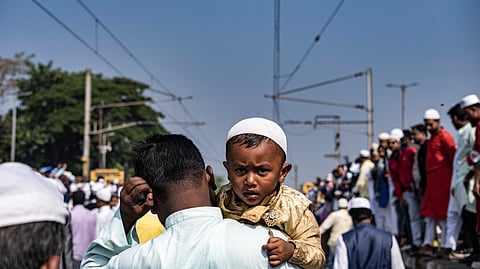
Earlier this year, following an attack in Pahalgam, in Indian-administered Kashmir, Indian authorities moved over 2000 people across the Bangladesh border – at times at gunpoint – after a “verification” exercise in Tripura, Meghalaya and Assam. They had been identified as Bangladeshi migrants, but at least some of them turned out to be Indian citizens. In June, Mamata Banerjee, the chief minister of West Bengal, said that between 300 and 400 Bengali-speaking workers from Itahar, in Uttar Dinajpur district, were being detained in the state of Rajasthan despite producing Indian identity documents. Several similar cases of Bengali migrants facing crackdowns have been reported from numerous parts of India in recent months.
Climate change-induced migration is becoming a growing concern in West Bengal and Bangladesh, with additional push factors such as poverty and conflict compounding the issue. Both places, with extensive low-lying areas and located at the northern tip of the Bay of Bengal, are severely vulnerable to cyclones, and climate change is thought to be leading to an increase in their frequency and intensity. At least five tropical cyclones have hit West Bengal since May 2020, and rising sea levels are causing erosion in the Sundarban, the extensive mangrove ecosystem that straddles the West Bengal and Bangladesh coasts. A study by the International Institute of Environment and Development has found that households in several regions of Bangladesh, like Sylhet in the northeast and Pirojpur in the southwest, have seen their livelihoods disrupted and experienced food insecurity as a result of climate disasters, including cyclones but also slower phenomena like riverine or coastal erosion and salinity intrusion. Households impacted by climate risks were much more likely to migrate both internally and internationally, the study shows.
This movement, especially across borders, often happens quietly and without legal protection, as there is no regional policy or framework to address climate migration, explained Anamitra Anurag Danda, a fellow at the Observer Research Foundation, a Delhi-based think tank. “People will move because of environmental changes,” Danda said. “Take parts of Sindh, in Pakistan, for example. Those areas are going to become so dry that nobody can live there. So, where will those people go?”
Danda added, “The first thing we need to do is recognise that parts of the world are becoming uninhabitable. We’re having trouble accepting this because we’ve lived through a very stable period and haven’t experienced anything like this before. Our institutions, our laws, our policy frameworks, they simply don’t have this within their frame of reference.”

Sohanur Rahman, a Bangladeshi climate-justice activist and the executive coordinator of YouthNet Global, a platform for youth-led organisations, explained that climate-induced internal displacement is a critical issue in Bangladesh, with an estimated 20 million people projected to be internally displaced by 2050.
Bikash Das is the general secretary of the non-profit Basirhat Initiative for Rural Dedication, which works with survivors of trafficking in West Bengal, including Bangladeshi migrants. He said many Bangladeshis are fleeing climate change, conflict and political violence in their country. He pointed to a string of cyclones and the ousting of the Bangladesh prime minister Sheikh Hasina last year, which has triggered a wave of persecution against supporters of her party, the Awami League.
Das described how climate change phenomena, especially floods, have driven soil salinisation in many areas, making agriculture unsustainable. “This environmental shift has devastated the local economy, leaving families with no means of livelihood,” he added. “That’s when traffickers step in, offering jobs that seem like a way out but often lead to trafficking, forced labour or sexual exploitation.” Das explained that many of those rescued by his organisation “didn’t leave because they wanted to, they left because they had no choice.”
Many migrants are stuck in legal limbo, with no official citizenship or rights to settle anywhere. To compound the issue, India and Bangladesh do not officially recognise refugees under international law, as neither country has signed the 1951 United Nations Refugee Convention. In both, climate-displaced women are among the most vulnerable people, especially susceptible to violence, trafficking and exploitation.
WITH UNDOCUMENTED MIGRATION from Bangladesh to India being politically weaponised by Hindu nationalist and nativist groups in India to whip up hate against Muslims and outsiders, numerous inaccurate and exaggerated estimates of migrant numbers are in circulation in the country. A lack of reliable data exacerbates the problem, leaving a vacuum to be filled with dubious figures. In 2016, Kiren Rijiju, a senior BJP leader who was then a minister of state, told the Indian parliament that there were 20 million undocumented migrants from Bangladesh in the country, but without citing a source. Two years later, Amit Shah, then the president of the BJP and now India’s home minister, put the number at 40 million and likened undocumented migrants to “termites”.
The Indian government has since admitted that it does not have accurate data on the total number of undocumented migrants in the country. The 2024 Global Migration Report, from the International Organisation for Migration. estimates that just under 2.5 million migrants from Bangladesh were living in India as of 2020.
We met a 23-year-old migrant from Bangladesh’s Maltipur village in her rented home in West Bengal, about an hour’s drive from the international border, where she lives with her husband and son. The family pays a monthly rent of INR 4000 – roughly USD 45. Her husband, a mechanic, earns between INR 3000 and 4000 each month, though his attendance at work – and, as a result, their income – is inconsistent. The money is slightly higher than what he made in Bangladesh. To help make ends meet, the 23-year-old said, she earns INR 5000 a month babysitting, and supplements this with some bead-making and embroidery. The family continues to struggle financially.
“He doesn’t like to work much,” the 23-year-old said as her husband returned to their two-room, exposed-brick house. The structure lacked a door, and a torn dupatta was all that offered some privacy from curious neighbours. “I want to educate my son and support him to achieve what I couldn’t,” she said.
Apart from financial troubles, the 23-year-old was also struggling with homesickness. She had lost touch with her family since she moved to India. “I think about them all the time, but I have no way to contact them,” she said. Her parents live in a village in Satkhira, only an hour away from the village in India where she now lives. But barriers to communication and crossborder travel have made it nearly impossible for the family to remain in contact.
On top of these personal struggles, the family also faces the challenges brought on by India’s increasingly divisive political climate. The country’s Citizenship Amendment Act (CAA), which came into effect in 2024, has marginalised Muslims and fuelled hysteria around crossborder migration from Bangladesh. Put forward by India’s BJP-led government, the CAA provides a pathway to citizenship for Hindu, Sikh, Parsi, Buddhist, Jain and Christian refugees from neighbouring Muslim-majority countries who entered India by December 2014 – but does not offer the same to Muslims and other refugees which do not fall within these categories. Discussions around the controversial CAA have been charged with political rhetoric about “illegal” Bangladeshi migrants, often driven or amplified by BJP politicians and Hindu nationalists.
“India’s political landscape is divided – the Bharatiya Janata Party views Hindu migrants as a vote bank, the Trinamool Congress does the same for Muslim migrants, and Assam opposes all migration,” Ashok Swain, a professor at Uppsala University in Sweden, said. The Trinamool Congress is the ruling party in the state government of West Bengal, with the BJP trailing behind it here. Mamata Banerjee, the state’s chief minister, often highlights India’s forced deportations, and has recently assailed the BJP-led national government for targeting Bengali-speaking citizens.
In Assam, myths around an onslaught of Bangladeshi migrants have proliferated since Independence, with rhetoric on the issue weaponised by politicians since the 1970s and 1980s. In 2019, the National Register of Citizens (NRC), an attempt to document all legal citizens in India, was rolled out in Assam in response to concerns about undocumented Bangladeshi migrants. The flawed and controversial process of checking citizenship credentials rendered an estimated 1.9 million people stateless, including many Muslims. (In 2024, Assam’s chief minister, Himanta Biswa Sarma, estimated that around 700,000 Muslims had been left out of the NRC. Many in Assam were ultimately disappointed that the NRC exercise did not uncover as many Bangladeshi migrants as they thought existed in the state – and that many of those rendered stateless by the process were not Muslims but Hindus.) Thanks to the xenophobic rhetoric built up around the CAA and NRC – introduced in tandem by the BJP and sparking demonstrations across India in opposition to their Islamophobic intent – the topic of migration is now viewed in India mainly through the lens of national security and religious nationalism. This makes any acknowledgement of or cooperation on climate-induced migration between India and Bangladesh especially challenging.

“With India tightening border controls and deportations, climate migrants face greater vulnerability, statelessness and exploitation,” Swain said. Indian border security has been stepped up after the Pahalgam attack, with reports of the presence of banned militant groups like the Jamaat-ul-Muhajideen Bangladesh near the border also leading to increased security presence.
In the 13 months starting from January 2024, Indian authorities apprehended 2601 Bangladeshi nationals along the India–Bangladesh border, the Indian home ministry said in parliament this March. A report by the Border Security Force, India’s primary border guard, has said that nearly 14,000 Bangladeshi nationals have been stopped and pushed back while trying to cross into India since 2019.
Bangladesh, meanwhile, has tried to downplay the issues of migration and deportations. In November 2022, the information minister, Hasan Mahmud, called the CAA an “internal matter” for India, even as Indian rhetoric continued to vilify Bangladeshis. This was under the government of Sheikh Hasina, a close friend and ally of India’s ruling BJP government. After Hasina’s government was toppled by student-led protests in 2024, however, political and diplomatic tensions between India and Bangladesh have been rising, with potential fallouts for the bilateral relationship and for Bangladeshi migrants.
Uday Chandra, an assistant professor at Georgetown University in Qatar, explained that in this fraught atmosphere, diplomats were unlikely to prioritise climate change and its consequences. “What purpose is served by creating a policy that is not to either side’s benefit?” Bangladesh is also navigating political turbulence in Hasina’s wake, with the interim government currently in charge in Dhaka facing increasing pressure to hold fresh elections. “I don’t think it even ranks in the top 20 issues they would want to address once a new government is elected in Bangladesh,” Chandra said. “I imagine that whenever there are political openings between India and Bangladesh and cooperation improves, a different set of priorities will emerge.” He added that if migration did come up, the focus would likely be on keeping numbers relatively low and border enforcement.
While Bangladesh and India already cooperate on biodiversity conservation in the Sundarban area, there is no dialogue on climate-induced migration. Climate migrants lack legal recognition and protection under international law, and India has no national policies to support or compensate people migrating from vulnerable areas like the Sundarban. Existing disaster policies focus only on short-term relief after extreme weather events, not on slow-moving issues such as erosion or on long-term displacement. Since environmental change often overlaps with other reasons in driving people to migrate, it is also hard to neatly identify climate migrants and address such migration as an urgent issue.
Still, there have been some attempts to recognise climate migrants. Pradyut Bordoloi, an Indian parliamentarian from Assam, introduced the Climate Migrants (Protection and Rehabilitation) Bill in 2022, marking the first serious legislative effort to address climate displacement in India. The bill proposed legal recognition, funding, monitoring and rehabilitation for climate refugees. As a private bill, it was not enacted into law, nor discussed and debated, but was recorded in the annals of parliamentary records.
“It may someday – probably – be taken out, or fished out, and maybe discussed,” Bordoloi said.
He believes the bill could help stimulate national discourse on climate refugees. Climate-related displacement in India includes internal migration in areas like the central states of Chhattisgarh and Madhya Pradesh, where soaring temperatures are causing agricultural workers to move away. Across the Bangladesh border, Bordoloi noted, people from coastal or other vulnerable regions are also likely to move inland in search of safer places to live.
“I have seen how changing climatic conditions have led to internal migration from one place to another. These people are climate refugees,” said Bordoloi. “But official systems have not yet recognised such people. Even in cases of international migration, there is no legal framework or established system to acknowledge them as climate refugees.”
OF COURSE Muslims are not the only ones being pushed from Bangladesh into India. Hindu refugees are equally facing the brunt of extreme weather and other push factors. Purnendre Vishnu, father to a 12-year-old son works as a labourer in the Sunderban in West Bengal, earning around INR 10,000 a month. “When we left Bangladesh, we thought we would do better, but here also cyclones in the Sundarban ravage everything,” he said. “Every time a cyclone hits, our house gets destroyed. I have to rebuild it all over again.”

His wife manages the household and tends to their cattle. The family used to cultivate rice, but rising soil salinity has made farming difficult. “When there is no work here, I go to Kerala for work,” Vishnu said. “I have to support my family.”
To help people like Vishnu, researchers including Danda are advocating planned and strategic retreat with supporting legislation, as well as other adaptation policies. While some people in the Sundarban are moving away from risky areas informally and on an individual basis, experts think there could be benefits from planning a more systematic retreat from areas experiencing fast erosion and other threats.
At the regional level, climate displacement could be addressed through bilateral agreements. Danda pointed to the arrangement between India and Nepal that grants their citizens the freedom to move, live and work freely in either country without special permits. “People generally prefer to stay where they are unless absolutely forced to leave,” he said. And the flows would not all be one way: Bangladesh’s strong economic growth, for instance, can also mean new opportunities for Indian workers going forward. “The human approach is to not make it illegal,” Danda said. “Nobody asks a Nepali why they are living in India or if they are here because of climate change or economic issues. There is an arrangement in place, and there is nothing illegal or unacceptable about it.”
Swain agreed that an agreement on bilateral labour mobility could be a solution, alongside other cooperation agreements on trade, transit routes and energy. Investment in climate resilience, including through improved coastal protection and methods of flood management, could also mitigate displacement pressures. But this requires a shift in thinking, away from short-term electoral calculations and towards long-term regional stability and cooperation. “The choice is clear: cooperate to protect vulnerable people or allow the crisis to deepen, with damaging consequences for both countries.”
The article appeared in himalmag

0 Comments
LEAVE A COMMENT
Your email address will not be published