

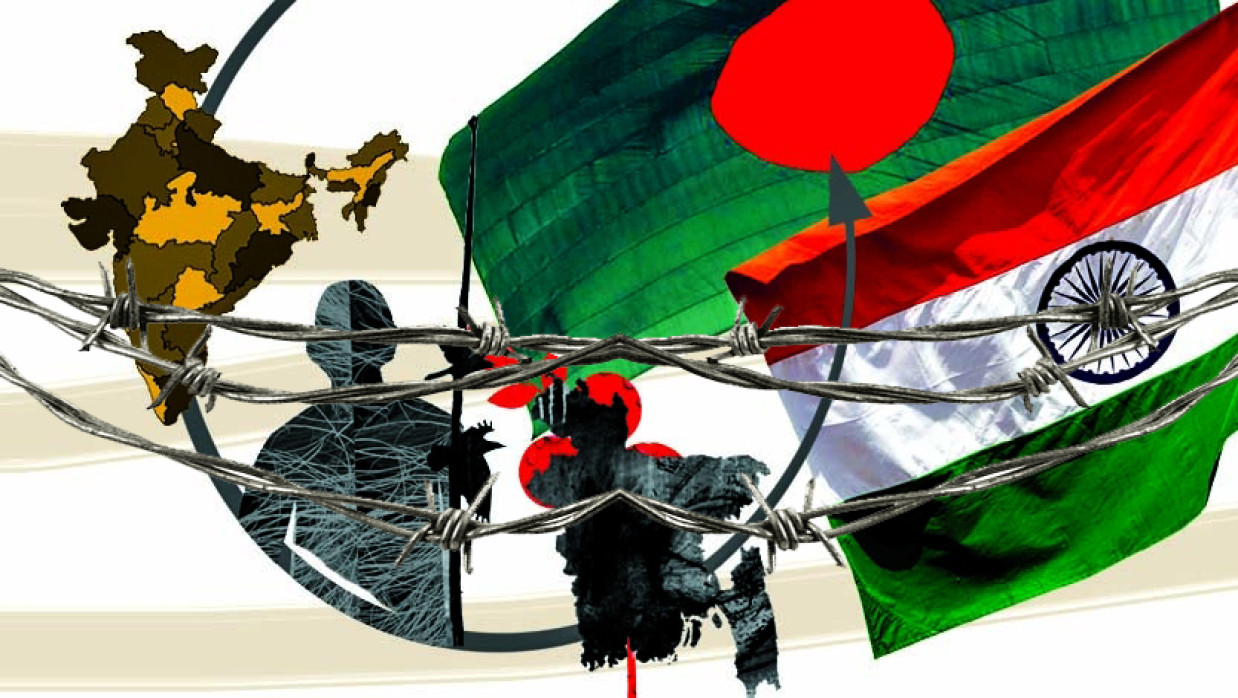
India has long presented itself as a benign regional power whose role in Bangladesh is defined primarily by shared history, language, culture, and the natural affinity built during the liberation war. The image it has sought to project in both its own citizenry and the international community is one of soft power cultural influence without force, attraction without coercion. This has been particularly true in South Asia. At home, Indian political culture has pushed for strategic autonomy as its preferred mode of being. But from a Bangladeshi standpoint, Indian soft power has never been truly ideological or normatively neutral. In recent years, it has also quietly drifted closer and closer to strategic pressure, a kind of soft coercion that is deployed not through tanks or troops, but through cultural products, education, media, historical narrative, and framing.
The result is a two-pronged strategy that uses soft instruments to produce hard outcomes. Today, the goal is not classic imperialism. It is calibrated influence, a mix of coercion and collaboration, of economic inducement and political arm-twisting that applies pressure while allowing cultural osmosis to do much of the heavy lifting. The real challenge for Bangladesh is not to dismiss the two as one and the same. It is to recognize that the cultural osmosis can be just as powerful as any direct pressure and that, left unchecked, cultural influence can gradually rewrite political alignment, historical memory, and national identity.
Soft Power as Strategic Instrument
Soft power is the ability to change others' preferences through attraction rather than coercion or payment. This concept was first popularized by Joseph Nye, and India has long been one of its most effective practitioners in South Asia.
In Bangladesh, Bollywood films, popular music, TV serials, literary fads, shared festivals, foods, and the simple intimacy of the Bangla language have made India an ever-present influence in our everyday life. This feels, by design, organic and familiar. Soft power is rarely as innocent as it appears.
In Bangladesh’s case, it has also, in recent years, been a complement to India’s hard power and diplomatic influence. Dhaka makes a foreign policy move that New Delhi deems unfriendly, turning to China for infrastructure loans or port development, buying military hardware from abroad, and the response from India is likely to be indirect pressure: water-sharing issues, trade bottlenecks, border incidents, or behind-the-scenes criticism through non-government actors, civil society, and diaspora networks.
In short, India’s soft power is no longer simply cultural outreach. It has become a lubricant for pressure, a strategic enabler of more confrontational tactics.
1971: An Example of Effective Soft Power Alignment
Perhaps the best example of effective Indian soft power is the Concert for Bangladesh, organized by George Harrison and featuring Ravi Shankar in 1971. The event is said to have played a significant role in turning the tide of Western public opinion about the humanitarian crisis in East Pakistan, giving it the sympathy, awareness, and space it needed to intervene politically.
From a Bangladeshi perspective, this was clearly welcome. It helped to internationalize the trauma and hasten its liberation. But it was also extremely helpful to India, the most important strategic objective being the elimination of Pakistan as a single state. Soft power was a means to an end.
This duality of humanitarian advocacy serving the strategic needs of a more powerful country has since become a regular feature.
Bollywood, Mythmaking and the Manufacture of Consent
Indian cinema, particularly Bollywood films, has long been a key vehicle of India’s quasi–soft power in Bangladesh. Its influence is extensive, its penetration nearly complete. Songs, dialogues, heroes, villains, and stories have all been woven into the social fabric of everyday life in Bangladesh. They seep into popular political consciousness in subtle but often decisive ways.
Recent Bollywood films like Dhurandhar play an even more pointed geopolitical role. Presented as pure entertainment, it tells the story of a RAW agent inside Pakistan who helps stop terrorist plots. The historical events dramatized include the IC-814 hijacking and the Mumbai attacks, among others. Pakistan is the obvious villain, but the film's subtext is the moral acceptability of Indian covert actions as stabilizing forces in the region.
The real target is not just Pakistan. The film also creates a general sense of Indian moral righteousness and regional entitlement. Neighbors are all seen as unstable, intolerant, sectarian, or externally manipulated. India alone is the beacon of reason, restraint, and secularism. Absorbed uncritically across borders, this discourse has real, if often hidden, consequences.
A Selective Sense of Human Rights and Moral Superiority
India’s media and political class are quick to point to the victimization of minorities, particularly Hindus, in the neighboring countries. Every communal incident is inflated into a representative sample of systemic persecution, weaponized for diplomatic posturing and debate. Inside India itself, there are many protest marches that include inflammatory language and portrayals of neighbors as intolerant or repressive.
This tone deafness is even more remarkable given the actual situation of Muslims in India. There is a great deal of institutional discrimination, economic marginalization, and social exclusion that operate at all levels of society. Lynching, house demolitions, disenfranchisement, and preventive detention are becoming all too normalized.
Consider the case of Omar Khalid, a Kashmiri human rights activist imprisoned for years on terrorism charges, with no formal conviction. International support for his cause, including appeals by American politicians, has been met with widespread condemnation and punitive responses by Indian authorities. Criticism is only acceptable if it flows in one direction.
This is part of a broader hegemonic process that filters back into culture.
Cultural Hegemony Through “Bengali Culture”
The most insidious manifestation of India’s soft power over Bangladesh is cultural. Indian norms and practices, in the name of Bengali culture, have been accepted as standard and natural. Bengali culture, largely synonymous with upper-caste Kolkata-centric Hindu culture, has been the default within which all other cultures have had to find their place.
In practice, this has meant that Indian cultural influence has expanded with relative ease in Bangladesh. Indigenous Muslim, Buddhist, and rural folk practices and sensibilities are still routinely sidelined as low-class, backward, or unrefined. Secularism, as articulated during the colonial and post-colonial period, is often a coded vehicle for expressing anti-Muslim sentiment.
This imbalance is by no means accidental. It is a product of deeper historical trends.
A History Written Out of Bengal
Bangladesh’s education system, inherited from the British, starts and ends with colonialism and the so-called Bengali Renaissance. In between is a blur of historical erasure and selective amnesia.
The fact that few of us today study or are even aware of the Sultani period and other pre-colonial cultural achievements is no accident. The Bengali Renaissance movement was not pan-Bengali. It was a Hindu Bengali renaissance. It was facilitated, encouraged, and deliberately crafted by the British to increase colonial control over the subcontinent.
A major fault line that runs through this history is the systematic exclusion of Muslim contributions. But this is only the most recent iteration of a historical pattern. The great irony is that Bengal’s cultural capital was Dhaka and Murshidabad long before Kolkata was a village.
The Sultani Period: Bengal’s Forgotten Golden Age
The independent Muslim sultans who ruled Bengal from the 13th to the 16th centuries were significant patrons of the Bengali language and literature. Jalaluddin Muhammad Shah, Alauddin Hussain Shah, and Ghiyasuddin Azam Shah were the first three of these sultans.
It was during the reign of Ghiyasuddin Azam Shah that Krittibash Ramayan was written by Krittibas Ojha with royal patronage. Far from persecuting local culture, these Muslim rulers allowed the first major vernacularization of Hindu scripture in Bangla. For several centuries, this text would become the Bengali Ramayana, shaping generations of literature, theatre, and devotional practice.
The fact that this text was central to Bengali culture for centuries is proof enough that Muslim rule did not destroy Bengali culture.
Language and the Sen Dynasty
Muslim rule did not always mean patronage of the Bangla language and literature. The Sen dynasty of Hindu kings that preceded the Muslim sultans treated Bangla as an uncouth language and Sanskrit as the only language fit for religious and courtly purposes. Translations of Hindu scriptures into Bangla were not just forbidden. If found, the translators were punished by having their noses, ears, and hands cut off and being paraded around on a donkey.
If Bangla literature, especially literature based on Hindu texts, managed to flourish, it was under Muslim rule, and with royal patronage. Monks belonging to the Buddhist monastic order in Bengal used a proto-form of Bangla in their scriptures and were persecuted by the Sens, with many fleeing to Nepal and carrying their manuscripts with them. These texts were only rediscovered in the 19th century.
If Bengal’s history begins with the colonial period, Muslims destroyed Bengali culture, and Bangla owes its expanse and popularity to Hindu Bengali cultural revivalism; it is not an accident. This colonial historiography has been internalized, naturalized, and expanded.
The Nalanda Myth: Historical Distortion
The story that Ikhtiyaruddin Bakhtiyar Khilji overran Nalanda University and systematically burned down its library and buildings is another piece of historical distortion. There is no evidence to back this up. Yet this story is told in almost every single mainstream historical account and work of fiction to further cement the narrative of Muslim barbarism.
But historical facts that disturb the status quo or reflect poorly on our political present do not see the light of day. This is selective historiography by another name.
Literature, Secularism, and Exclusion
The treatment of Muslims in colonial-era Bengali literature was either caricaturish or non-existent. At the more extreme end of the spectrum, Muslims were attacked openly in both writing and public performances. At the other end, a certain kind of secularism was practiced that simply had no room for the Muslim experience. “Bengali” was increasingly treated as a value system that was inherently incompatible with being Muslim.
When secular humanism was practiced, it was rare. Atheism was not uncommon. But free-thinking that embraced multiple worldviews and that treated non-Hindu belief systems as valid was an exception.
This left little room for the experiences, culture, and worldview of Muslims in Bengal, and ultimately had to account for the isolation of Muslims within our own collective.
Why Bangladesh Was Necessary
This is why Muslims in Bengal eventually had to separate and create their own state. Bangladesh was not just a linguistic rebellion. It was an attempt to regain agency, dignity, and historical voice.
But the question is whether we have succeeded.
Mongol Shobhajatra and Unfinished Liberation
This Bengali Muslim identity may have embraced various cultural forms after 1971, Mongol Shobhajatra, chief among them, without interrogating the entire project of modern nationhood and the narrative framework within which these elements were contained. At the same time, we have yet to fully develop, theorize, or represent Muslim Bengali culture in literature or popular art.
We must start with language.
Our Sense of History, Language, and Power
Language is power. By not recognizing Muslim linguistic and literary contributions in Bengal, and by dismissing any historical reality that does not fit the Indian nationalist and colonial historiography, India has managed to create a significant blind spot for Bangladeshis inside their minds.
There can be no healthy national culture without pluralism, homogeneity, or a monolithic national identity imposed and monitored by the state. It must be a space that celebrates all of its peoples’ cultures equally, and does not erase Islam from the identity, any more than it should erase Hindu, Buddhist, tribal, or any other sensibility. The state cannot inculcate culture. Its only job is to make space for all of it.
But until we write our history based on empirical evidence, the dominance of colonial and post-colonial distortions in our curricula will continue to reproduce Indian cultural influence in all its forms, filtered through the most powerful castes in Kolkata.
Conclusion: Battle for Bengali Consciousness
India’s soft power is real. It is effective and growing. It does not yet constitute hegemony, but it is getting there, bit by bit, and being used more and more like a strategic asset. Cultural influence, whether through media, education, or historical framing, can be just as politically effective as economic coercion or military pressure.
Bangladesh’s challenge is not to reject this cultural osmosis out of hand. It is to recognize its ability to alter political discourse, public memory, and national identity. A wounded and embattled nation is only a step away from being infiltrated, penetrated, and redrafted by narratives that might be charming at first but are no less dangerous for that.
To be effective, our resistance must not be cultural xenophobia. It must be intellectual revivalism. We must rediscover our history, our pride, our self-sufficiency. There is an entire era of our past that we have yet to properly study, theorize, and share with our own people. Until we do, Bangladesh will remain incomplete, independent only in name and politics, not in intellectual life.
Soft Power, Silent Pressure, and the Battle for Bengali Consciousness: India’s Cultural Hegemony and Bangladesh’s Unfinished Liberation

Ghulam M. Suhrawardi
Ghulam M. Suhrawardi is the Publisher of South Asia Journal.

0 Comments
LEAVE A COMMENT
Your email address will not be published