


Myanmar’s junta and Russia are pushing to establish a new trade corridor through India – an ambitious trilateral proposal that could offer a lifeline for the cash-starved and sanction-hit regime.
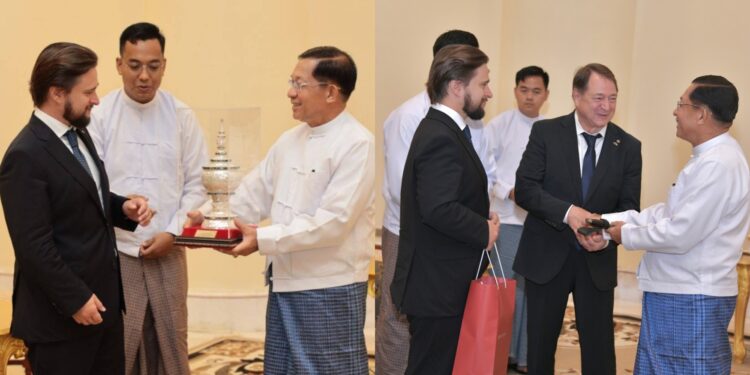
Junta Minister for Transport and Communications General Mya Tun Oo discussed the project with a Russian delegation led by Alexander Sergeevich Shatirov, director of Roscongress Investment Fund, in Naypyitaw on Monday.
The meeting focused on a plan to establish a logistics route connecting Russia with Yangon Port through Mumbai Port in India.
The talks followed Mya Tun Oo’s appearance at the 28th St. Petersburg International Economic Forum last month, where he promoted Yangon as a strategic transshipment hub for Russian exports to Asia.
He said goods from Russia could be shipped through Yangon’s ports to other Southeast Asian destinations via road and rail.
While details of the project have not been released, junta media reported that Mya Tun Oo and the Russian delegation discussed importing high-quality fertilizers from Russia and expansion of bilateral e-commerce ventures.
At the Fifth Meeting of the Russia-Myanmar Inter-Governmental Commission on Trade and Economic Cooperation held in Naypyitaw in February, the junta expressed interest in joining the Russian-led Eurasian Economic Union (EAEU) as a way of gaining access to European markets.
The regime also invited Russian industrial cooperation and investment in Myanmar’s transport infrastructure, while discussing opportunities for Moscow to penetrate Asian markets.
Meanwhile, junta chief Min Aung Hlaing highlighted Myanmar’s strategic location at the heart of regional markets totaling nearly 3 billion people as he courted investment during his visit to Russia in March.
The planned corridor reflects a broader effort by both nations to forge alternative trade partnerships amid tightening sanctions imposed by the United States and its allies. Myanmar’s military regime has been actively seeking closer ties with regional powers and multilateral organizations as part of its diplomatic pivot.
Its efforts included bids for full membership of regional blocs such as BRICS and the Shanghai Cooperation Organization (SCO), where it currently holds dialogue partner status. During his visit to Belarus last month, Min Aung Hlaing called for Myanmar’s admission to the Russia-led Eurasian Economic Union (EAEU) as an observer at the earliest opportunity.
New Delhi has yet to comment on the proposed Russia-India-Myanmar corridor, which could overlap or intersect with India’s ongoing Kaladan Multi-Modal Transit Transport Project, a key component of its “Act East” policy.
Launched in 2008, the Kaladan project aims to connect India’s eastern seaboard with its remote northeastern states and foster economic integration with Southeast Asia. The corridor links Kolkata Port with Rakhine State’s Sittwe Port via the Bay of Bengal, before progressing through the Kaladan River to Paletwa and onward by road to Zorinpui on the India-Myanmar border. While its key sea and river segments have been completed, the 109-km road section has faced repeated delays due to fierce fighting in Rakhine as well as contractor disputes and land acquisition issues.
Despite setbacks, India has pledged to complete the project by 2027, viewing it as a cornerstone of its regional strategy and a geopolitical counterbalance to China’s Belt and Road Initiative.
If realized, the proposed trilateral corridor would also offer Moscow an important economic outlet at a time when its global trade options are increasingly constrained.
The article appeared in irrawaddy

0 Comments
LEAVE A COMMENT
Your email address will not be published